
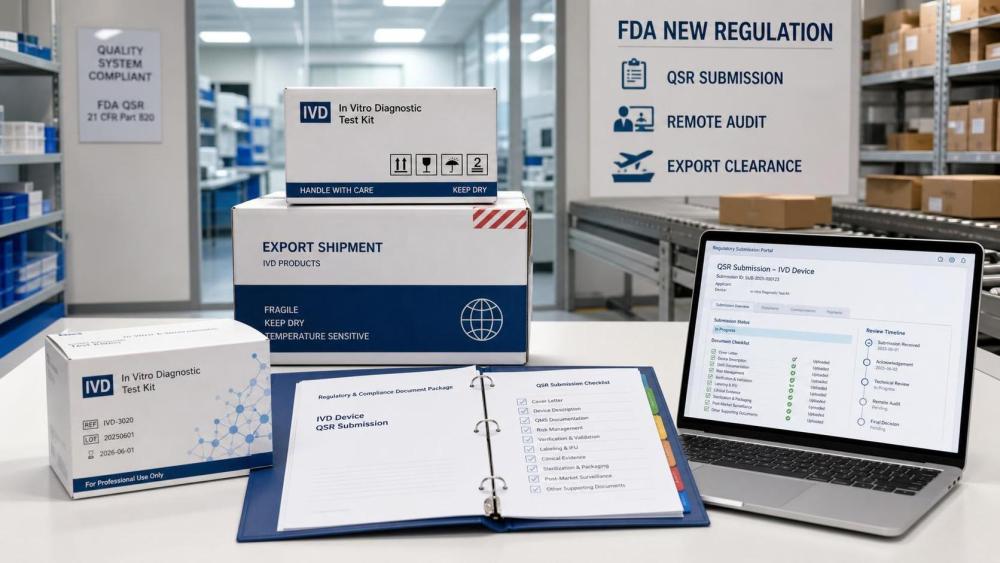
On August 2, 2026, the U.S. FDA issued a final guidance that changes how foreign manufacturers export in vitro diagnostic devices to the U.S. market. Starting on September 1, 2026, overseas IVD manufacturers must submit a QSR 21 CFR Part 820 compliance declaration online through their designated U.S. Agent and may be selected for FDA remote audit review. For Chinese IVD exporters, this is worth close attention because it reaches beyond a procedural update and directly touches market access, customs timing, and distributor qualification review.
What the New Guidance Formally Requires
The confirmed facts are limited but clear. The FDA released the document titled Final Guidance: Responsibilities of Importers of In Vitro Diagnostic Devices on August 2, 2026. The guidance states that, from September 1, 2026, all foreign manufacturers exporting IVD products to the United States must use their designated U.S. Agent to submit an online declaration of compliance with QSR 21 CFR Part 820. The same guidance also states that these manufacturers will be subject to FDA remote audit spot checks. The requirement directly affects the access path for Chinese IVD exporters, the timing of customs clearance, and the qualification review process for distributors.
Where the Pressure Will Be Felt First
Export access is becoming more document-driven
For manufacturers selling IVD products into the U.S., the immediate impact is on the entry process itself. The requirement to file the QSR compliance declaration through a designated U.S. Agent means that access to the market is more closely tied to agent designation, filing readiness, and the availability of compliance materials in a form that can support submission and possible remote review.
Distributor review may become more closely linked to compliance readiness
For channel partners and distributors, the reported effect on qualification review is significant. From an industry perspective, this suggests that distributor onboarding and continuation reviews may pay closer attention to whether the foreign manufacturer has completed the required U.S. Agent arrangement and whether the compliance declaration process is in place. The business impact is less about sales language and more about documentary readiness and responsibility alignment.
Customs timing may be affected by front-end preparation
For supply chain and trade execution teams, the mention of customs clearance timing deserves attention. Analysis shows that when a new filing or declaration step is placed ahead of shipment acceptance, even a narrow compliance gap can affect release timing. Companies involved in shipping, import coordination, and delivery scheduling should therefore watch for changes in how submission status, supporting records, and agent coordination affect shipment planning.
What Companies Should Review Now
Check whether the U.S. Agent arrangement is operational, not only contractual
What deserves closer attention is whether the designated U.S. Agent can actually handle the online submission workflow required by the guidance. A nominal appointment may not be enough if filing responsibility, communication channels, and document preparation are not clearly organized before the September 1, 2026 effective date.
Prepare QSR-related records for possible remote review
Because the guidance refers to remote audit spot checks, companies should pay attention to how QSR 21 CFR Part 820 compliance is documented and how quickly supporting materials can be retrieved. This is an observation about preparation priorities rather than a statement that a specific audit format or record list has already been confirmed in the input.
Reassess delivery schedules and order commitments
For exporters, procurement teams, and delivery planners, it is reasonable to review whether existing shipment schedules assume uninterrupted customs processing. Observably, any new front-end compliance step can affect lead-time assumptions, so internal planning should be checked against the new filing requirement without presuming a uniform outcome across all shipments.
Review distributor qualification files and role allocation
The summary provided indicates a direct effect on distributor qualification review. Companies should therefore examine whether current distributor documentation, role definitions, and compliance responsibilities are aligned with the new guidance. This is especially relevant where commercial arrangements and regulatory responsibilities are handled by different parties.
How This Change Should Be Read at This Stage
Analysis shows that this update is better understood as an execution signal rather than a broad policy discussion. The guidance sets a defined effective date and identifies concrete obligations tied to U.S. Agent submission and remote audit spot checks. At the same time, it is also appropriate to keep watching how the requirement is applied in practice, particularly in relation to operational interpretation, review expectations, and market feedback once companies begin implementing it.
A Practical Reading for the IVD Trade Chain
For the industry, the main significance of this development is that importer responsibility is being translated into a more explicit compliance gate for foreign IVD manufacturers entering the U.S. market. A neutral reading is that this is neither a purely administrative notice nor a fully observable end-state yet. It is more appropriate to understand it as a rule change that has formally landed, while its practical effect on customs timing, distributor review, and day-to-day export execution still needs continued observation.
Basis of This Article and What Still Needs Verification
This article is based on the user-provided news title, event date, and event summary. For events of this type, source categories usually include official regulatory announcements, notices issued by competent authorities, customs or trade administration information, industry association updates, standards-related documents, and reporting by authoritative media. The specific official source link was not provided in the input, so continued verification is still necessary. Follow-up attention should remain on detailed implementation language, compliance interpretation, distributor review practice, possible changes in procurement and tender documents, industry feedback, and how enterprises carry out the requirement in actual export operations.