
What FDA Cleared Means When Comparing Magnetic Resonance Imaging Systems
What FDA Cleared Really Tells You About an MRI System
When comparing magnetic resonance imaging systems, understanding what FDA cleared actually means is essential for technical evaluators. The term signals regulatory review, but it does not automatically define image quality, workflow efficiency, serviceability, or long-term clinical value. This article explains how magnetic resonance imaging systems FDA cleared status should be interpreted within a broader equipment assessment framework.
The most common mistake is to treat FDA clearance as a shorthand for “good system” or “high-end system.” It is neither. In the United States, FDA clearance generally means the manufacturer has gone through a regulatory pathway that allows the device to be legally marketed for specific intended uses. For many imaging devices, this is often associated with the 510(k) process, where a manufacturer demonstrates that the new device is substantially equivalent to a legally marketed predicate device. That is a regulatory conclusion, not a clinical ranking.
For MRI buyers, engineers, and technical reviewers, that distinction matters. An FDA-cleared scanner may meet the regulatory threshold for market entry and still differ widely from competing systems in gradient performance, software maturity, coil ecosystem, patient throughput, installation demands, uptime expectations, or service network strength. Clearance tells you the product passed review for its stated scope. It does not tell you whether it is the best fit for a neurology center, an orthopedic imaging chain, a community hospital, or a site with difficult shielding and power conditions.
What Is Being Cleared, Exactly?
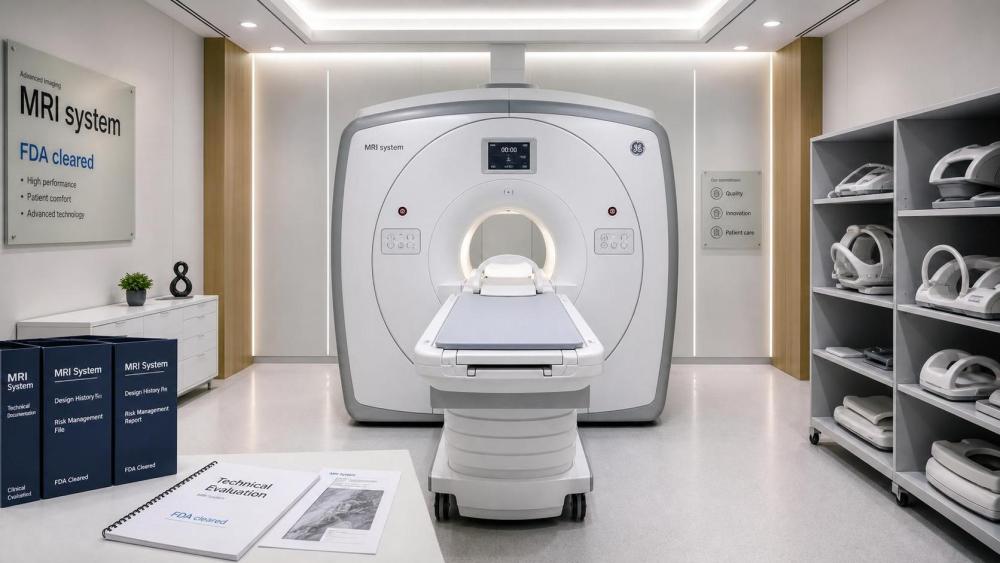
With MRI systems, the cleared product is not just a magnet in isolation. The regulatory review can involve the integrated system as presented by the manufacturer: magnet, gradients, RF chain, software, coils, user interface, safety controls, and sometimes specific clinical applications or post-processing functions. If a vendor promotes advanced cardiac packages, AI-assisted workflow, motion correction, or specialized coils, those claims should be understood in relation to the exact cleared configuration and intended use.
This is where technical evaluation often becomes more nuanced than sales language. A system may be FDA cleared as a whole platform, while some accessories, software modules, or optional applications have separate regulatory histories, version dependencies, or market limitations. The practical question is not “Is this MRI FDA cleared?” but “Which configuration is cleared, for what use, and under what documentation?” That is the level at which procurement and engineering teams avoid downstream surprises.
A careful review usually includes the device labeling, intended use statement, operator documentation, and any publicly available FDA database records. Those materials help confirm whether the promoted capabilities align with the cleared scope. If a supplier demonstrates a feature that is still under development, available only in another market, or dependent on a later software release, the distinction should be made explicit before a purchasing decision moves forward.
Why Clearance Matters, But Only Up to a Point
FDA clearance matters because it is one of the baseline indicators that the device has been reviewed within a recognized regulatory framework. For a hospital, distributor, or project planner, that supports documentation confidence, import and commercialization planning, and a more disciplined starting point for technical review. It also matters for risk management. MRI is not a simple capital good. It involves electromagnetic safety, software behavior, mechanical installation constraints, cryogenic considerations in many systems, patient screening protocols, and workflow interactions that can affect clinical operations every day.
Still, regulatory clearance is only one layer of decision-making. It does not answer whether image quality is consistent across body regions, whether exam times are realistic for your patient mix, whether technologists can learn the workflow quickly, or whether service engineers are available in your region. Two systems may both be legally marketable and still perform very differently in a high-volume outpatient center or in a hospital where pediatric, bariatric, and emergency patients create more demanding operating conditions.
This is especially important in MRI because technical tradeoffs are often hidden behind broad claims. Open versus closed design, 1.5T versus 3.0T, gradient strength, bore size, acoustic management, table capacity, coil flexibility, and software packages all influence practical value. FDA clearance does not normalize these differences. It sits above them.
What It Does Not Prove
A cleared status does not prove that one MRI system produces better images than another. It does not certify shortest scan time, best lesion detectability, strongest service infrastructure, lowest lifecycle cost, or easiest installation. It also does not mean that every marketed feature has the same operational maturity. In practice, software stability, protocol optimization, upgrade history, and local application support can have as much impact on user satisfaction as the hardware platform itself.
Another misunderstanding is that FDA clearance should be read as a universal global approval. It is not. FDA is a U.S. regulator. Other markets may require different registrations, conformity assessments, quality documentation, labeling rules, or local representative arrangements. For multinational procurement or distribution, “FDA cleared” may strengthen confidence, but it does not replace region-specific compliance work.
There is also a tendency to assume that a cleared system is automatically future-proof. That is too generous. MRI platforms evolve through software revisions, coil additions, interoperability updates, cybersecurity maintenance, and service bulletins. A technically sound system can become operationally weak if upgrades are slow, spare parts are difficult to source, or the manufacturer’s support model is thin in the target market.
How Technical Evaluators Should Use the Label
In real procurement work, magnetic resonance imaging systems FDA cleared status should be treated as a verification point, not an endpoint. It helps answer one important question: is the device cleared to be marketed for the intended application in the relevant regulatory context? After that, the harder questions begin.
A practical review usually moves across four layers:
That framework is closer to how experienced clinical engineering and procurement teams actually work. They do not stop at regulatory vocabulary. They ask whether the vendor’s submission-backed claims translate into reliable daily use.
Questions Worth Asking Suppliers
When a vendor highlights FDA clearance, the right response is not skepticism for its own sake. It is to narrow the discussion. Which exact model is cleared? Which coils and software packages are included in that status? Are all demonstrated applications commercially available now in the target market? Has the system architecture changed materially since the cited clearance? What are the site requirements? How are upgrades handled? What service response times are contractually supported?
Those questions are not regulatory formalities. They are operational filters. Many procurement disputes do not begin with the magnet or the image itself. They begin with ambiguity: optional functions assumed to be standard, local installation conditions underestimated, training scope left vague, or software modules described in general terms without version-level clarity.
For distributors, the same discipline applies. A platform that is cleared and technically impressive may still be hard to support if application training is thin, parts logistics are slow, or documentation packages are incomplete for regional tenders. Clearance can support market confidence, but distribution success depends on commercial execution and after-sales depth.
The Difference Between Compliance and Suitability
This is the distinction that deserves the most attention. Compliance answers whether a product has met a regulatory requirement for market entry in a defined context. Suitability answers whether that product belongs in your facility, for your patient volume, under your staffing model, and within your service environment.
A smaller hospital may prioritize reliability, broad general imaging capability, manageable siting requirements, and predictable service cost over premium research-oriented features. A specialized center may care more about advanced neuro, cardiac, or musculoskeletal protocols, higher throughput, and an expanded coil portfolio. Both may compare FDA-cleared MRI systems, but they should not evaluate them through the same weighting model.
That is why experienced buyers look beyond the badge. They connect regulatory status with intended clinical use, installation feasibility, support ecosystem, and total operating burden. In that wider view, FDA clearance is necessary information, but it is not decisive information by itself.
A Better Way to Read “FDA Cleared” in MRI Comparisons
The most useful reading is also the most disciplined one: FDA cleared means the MRI system has passed a defined regulatory review for specific claims and intended use, allowing legal marketing in the U.S. It does not settle comparative performance, ownership cost, workflow quality, or project risk. Those still have to be evaluated directly.
For technical evaluators, that approach keeps the term in its proper place. It prevents overconfidence, reduces confusion during supplier discussions, and leads to better documentation review. In MRI procurement, the right decision rarely comes from a single label. It comes from reading the label correctly, then testing everything around it with equal care.
Have questions about the global trade trends discussed here, or planning your expansion and supply chain strategy? Leave a message below and let the trade experts at MTHH guide you.
We respect your privacy. Your information is strictly confidential.
Related News
- Hong Kong Outlines Medical Device Legislation and Plans for Statutory RegulatorNov 14, 2026Hong Kong medical device legislation could reshape regulatory oversight. Explore the proposed regulator and what businesses should monitor.
- AAMI Issues TIR115 Guidance on Public Cloud Use in Medical DevicesNov 13, 2026AAMI TIR115:2026 guides public cloud use in medical devices. Explore its focus on risk management, supplier assessment and device boundaries.
- How are critical care devices regulated in the United States?Nov 12, 2026Critical care devices face FDA requirements based on intended use and risk. Explore classifications, marketing pathways, and practical compliance checks.
- Hong Kong Drafts Medical Device Bill to Establish Statutory OversightNov 12, 2026Hong Kong's Medical Devices Bill could introduce risk-based statutory oversight. Discover what the proposed framework may mean for suppliers.