
On July 15, 2026, the FDA released a new advisory for imported IVD reagents that shifts cold-chain control from a transport preference to an immediate customs requirement. The update centers on continuous 2–8C temperature control from factory release onward and on submission of a tamper-proof electronic temperature log as part of clearance documentation. For IVD manufacturers, exporters, distributors, and logistics providers, this is worth close attention because it directly touches packaging design, shipment documentation, delivery timing, and the risk of goods being returned or diverted into additional inspection.
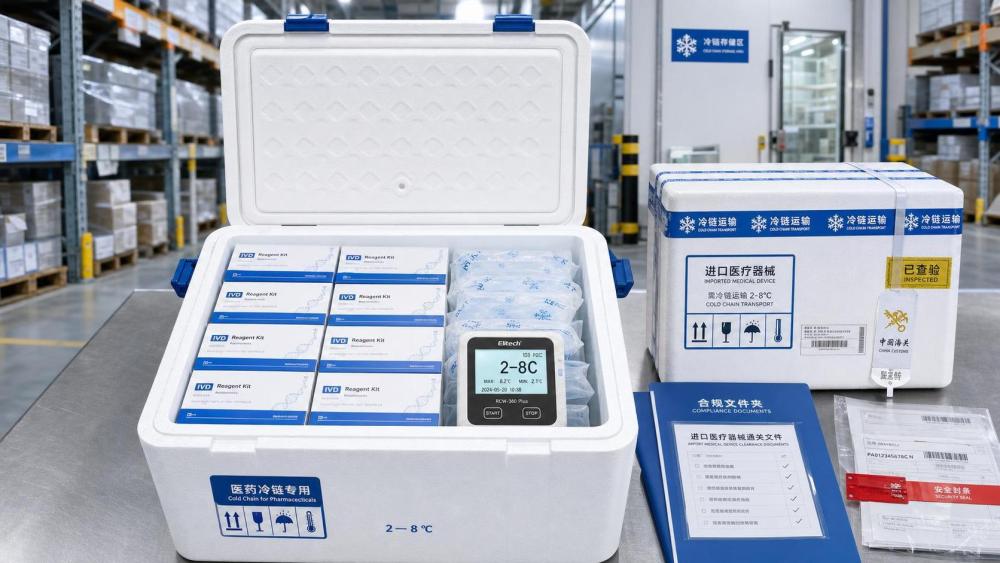
What the FDA advisory now requires
According to the provided event summary, the FDA issued the IVD Reagents Cold Chain Management Advisory on July 15, 2026. The advisory applies to all imported IVD reagents, including biochemical, immunological, and molecular categories.
The confirmed requirements in the summary are twofold. First, imported IVD reagents must remain within a 2–8C environment throughout the entire journey starting from departure from the factory. Second, a tamper-proof electronic temperature log, described as an e-Temp Log, must be provided as a mandatory customs clearance document.
The summary also states that the rule took effect immediately on the day of release. Shipments that do not meet the requirement will either be automatically returned or moved into an additional inspection process.
Where the pressure will show up first across the supply chain
Export shipments face a stricter release threshold
From an industry perspective, exporters are likely to be affected first because the new requirement is tied directly to import clearance. The practical impact is not limited to transport conditions alone; it also extends to whether shipping files are complete and whether temperature records can stand up to scrutiny at the border. What deserves closer attention is that delivery risk now appears linked to both physical cold-chain control and document readiness at the same time.
Manufacturing teams may need to revisit packaging and dispatch design
Analysis shows that manufacturing operations involved in export fulfillment may need to pay closer attention to how outbound shipments are prepared before handover. The event summary specifically points to packaging compliance design as an affected area. That suggests the burden is likely to fall on the stages where products are packed, released, and transferred into transport, because the temperature requirement begins at factory departure rather than later in the logistics chain.
Logistics and distribution partners take on a documentation-sensitive role
Observably, supply-chain service providers and distribution partners may face more pressure around traceability and handoff discipline. Since a tamper-proof electronic temperature log is described as a required customs document, the transport leg is no longer only about maintaining conditions in practice; it is also about preserving a record that can be used during clearance. For this part of the chain, attention is likely to center on data integrity, record continuity, and whether shipment files can move with the goods without gaps.
Procurement and downstream buyers may need to reassess delivery assumptions
For procurement teams and downstream buyers, the immediate issue is less about policy interpretation and more about delivery reliability. If noncompliant goods can be returned or routed into extra inspection, procurement schedules, replenishment timing, and supplier communication may need closer review. It is more appropriate to understand this as a change that could affect expected lead times and document checks rather than as a purely technical cold-chain matter.
Practical points companies should watch now
Check whether shipment files match the new clearance expectation
Analysis shows that companies involved in U.S.-bound IVD shipments should pay close attention to whether the e-Temp Log is prepared in a form consistent with the new requirement. Because the input does not provide further execution detail, it would be premature to assume a settled filing format or acceptance process. What deserves closer attention is whether customs-facing documentation, internal release files, and logistics records remain aligned shipment by shipment.
Review cold-chain control from factory handoff onward
The summary makes the start point explicit: compliance begins when the goods leave the factory. Observably, that shifts attention to the handoff between production, warehousing, and transport. Companies may therefore need to examine whether their current dispatch, packing, and transfer procedures actually support uninterrupted 2–8C control across the full route, rather than only during the main transport segment.
Pay attention to packaging compliance and delivery planning
From an industry perspective, packaging design now deserves closer operational review because the event summary directly identifies it as an affected area. At the same time, delivery planning may need a more conservative approach where shipments depend on tight timing or limited buffers. This should be understood as a practical compliance question tied to export execution, not simply as a quality management discussion.
Continue watching for implementation language and market response
Because the provided information confirms immediate effectiveness but does not include more detailed enforcement language, companies should continue monitoring how the requirement is reflected in downstream compliance checks, shipment acceptance practices, and related commercial documents. Analysis shows that later signals could appear in operational instructions, customer document requests, or revised supplier requirements, even if those details are not yet confirmed here.
How this rule change is best understood at this stage
Observably, this development is better read as an active enforcement signal than as a distant policy direction. The requirement is described as effective immediately, and the consequence for noncompliant goods is framed in operational terms: return or additional inspection. At the same time, it is still necessary to distinguish confirmed facts from broader market interpretation. The input confirms the compliance threshold and the immediate trade consequence, but further detail on execution practice, documentary format, and industry adaptation still needs continued observation.
What this means for the market right now
At this stage, the update is most appropriately understood as a rule change with direct effects on export execution for imported IVD reagents, especially where cold-chain continuity, documentation integrity, and shipment timing are closely linked. It does not by itself confirm longer-term market outcomes, but it clearly raises the near-term compliance threshold for affected shipments. A rational reading is that companies should treat it as an implemented trade and compliance requirement while continuing to watch how enforcement language and market practice develop.
Basis of this article and what still needs verification
This article is based on the user-provided news title, event date, and event summary. For developments of this kind, relevant source categories usually include official regulatory releases, customs or trade administration notices, industry association updates, standards-related documents, and reporting by authoritative trade or healthcare media. A specific official source link was not provided in the input, so that link still needs to be verified on an ongoing basis. Continued attention should also be given to any later clarification on implementation details, compliance interpretation, tender document changes, market feedback, and how affected companies carry the requirement into daily shipment practice.