
On July 12, 2026, the FDA updated its IVD Labeling Compliance Guidance and set a new labeling requirement for in vitro diagnostic kits entering the U.S. market from October 1, 2026. The update matters for manufacturers, exporters, packaging teams, labeling suppliers, and customs documentation staff because it ties the smallest sales unit label to both UDI-DI identification and batch-level QR traceability, making label execution and document readiness a practical compliance issue rather than a formatting detail.
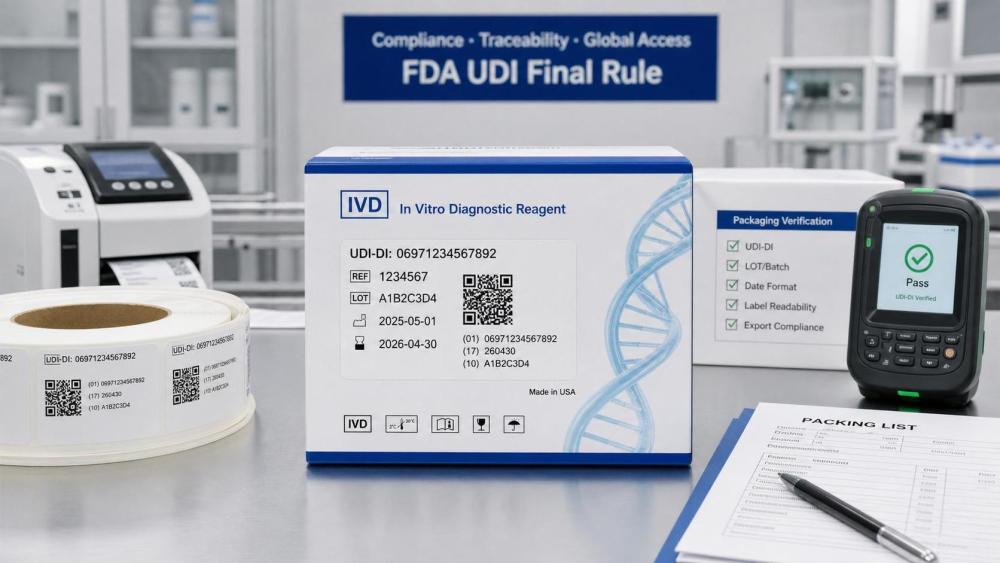
What the FDA update explicitly requires
According to the information provided, the FDA revised its IVD Labeling Compliance Guidance on July 12, 2026. From October 1, 2026, all in vitro diagnostic kits entering the U.S. market, including POCT, biochemistry, immunology, and molecular products, must display both a UDI-DI code and a dynamic batch-level QR code on the label of the smallest sales unit.
The QR code must support real-time access to production batch number, expiration date, sterilization parameters, and CE/FDA registration status. The information provided also states that this requirement directly affects packaging design, label printing compliance, and customs clearance document preparation for Chinese IVD exporters.
Where the operational impact is likely to appear first
Export-facing IVD manufacturers will feel it at the packaging stage
From an industry perspective, manufacturers shipping IVD kits to the U.S. are likely to be affected first because the rule applies at the smallest sales unit label level. The main pressure points are likely to be packaging layout, data field arrangement, and the ability to align printed labels with traceable product information.
Labeling and printing partners will be drawn into compliance execution
Analysis shows that suppliers involved in label design and printing may also be affected because the requirement is not limited to static identification. A dynamic batch-level QR code implies closer coordination between print output and variable batch information, which raises practical attention around file control, print validation, and version consistency.
Customs and documentation teams may face tighter preparation demands
What deserves closer attention is the document side of cross-border shipment preparation. The provided information specifically notes an impact on customs clearance document efficiency for Chinese IVD exporters, which suggests that labeling content and supporting registration-related materials may need to match more closely in actual shipment workflows.
Distributors and downstream channel operators may need cleaner traceability handoffs
Observably, channel participants handling imported IVD kits may need to pay closer attention to how product traceability information is presented and retrieved. If label-based scanning becomes a routine checkpoint, downstream teams may need clearer internal processes for confirming batch number, expiry, and registration-related information during receipt and circulation.
What companies should focus on now
Distinguish the confirmed rule from internal assumptions
Companies should keep their implementation work anchored to the confirmed points only: the effective date, the product scope described in the input, the smallest-unit labeling requirement, and the listed traceability fields accessible through the QR code. Internal teams should be careful not to treat unconfirmed process details as final rules.
Review which SKUs and packaging formats are exposed first
Analysis shows that firms should identify which IVD kit categories for the U.S. market fall under current export plans and whether their smallest sales units can physically accommodate both UDI-DI and the required QR code without creating readability or layout conflicts.
Check data readiness behind the QR code
What deserves closer attention is not only whether a QR code can be printed, but whether the linked information can be maintained consistently at batch level. The requirement described in the input refers to real-time access to batch number, expiration date, sterilization parameters, and CE/FDA registration status, so companies should examine whether these data points are controlled in a way that supports reliable label use.
Align shipping documents and customer communication early
Observably, exporters and supply chain teams should also watch the connection between labeling changes and customs documentation efficiency. Customer-facing teams may need to explain revised label formats, while logistics and compliance staff may need to confirm that shipment paperwork and product label information remain aligned throughout delivery preparation.
Why this looks like more than a short-term label adjustment
Analysis shows that this update is best understood as a concrete compliance signal rather than a minor editorial change to labeling language. The requirement connects product identification, batch traceability, and registration-related visibility at the smallest sales unit level. That combination suggests the issue should be watched not only as a packaging update, but also as an operational coordination matter across regulatory, production, printing, and export documentation functions.
At the same time, it is more appropriate to understand this as a confirmed rule with practical implementation questions still worth monitoring, rather than as a fully settled end state for every workflow detail. The input confirms the requirement and timing, but companies will still need to track how those requirements are interpreted in day-to-day execution.
How the market may best read this update today
For the industry, the immediate significance lies in the fact that FDA labeling compliance for IVD kits is being expressed in a more traceability-oriented format at unit-label level. For affected exporters, especially those serving the U.S. market from China, the development is not simply about adding another code to the pack. It is more appropriate to understand this as a near-term compliance change with broader implications for packaging control, data consistency, and shipment readiness.
Basis of this article and points still to verify
This article is based on the user-provided news title, event date, and event summary. For this type of industry update, commonly relevant source categories may include official notices, company disclosures, industry association releases, authoritative media reports, and standard-setting documents. A specific official source link was not provided in the input, so the exact source document path still requires ongoing verification. Continued attention should be paid to any later official clarification on implementation wording, operational interpretation, and related documentation expectations.