
On August 1, 2026, a revised FDA compliance guide for exported IVD devices took effect after being issued on July 31, 2026, setting a clear requirement for structured electronic UDI submissions through the FDA Unified Registration and Listing System (FURLS). For companies shipping in vitro diagnostic instruments and related reagent kits to the U.S., the update deserves close attention because it connects export compliance more directly with label data, packaging hierarchy records, registration workflows, customs timing, and distributor inventory handling.
What the revised FDA guidance confirms
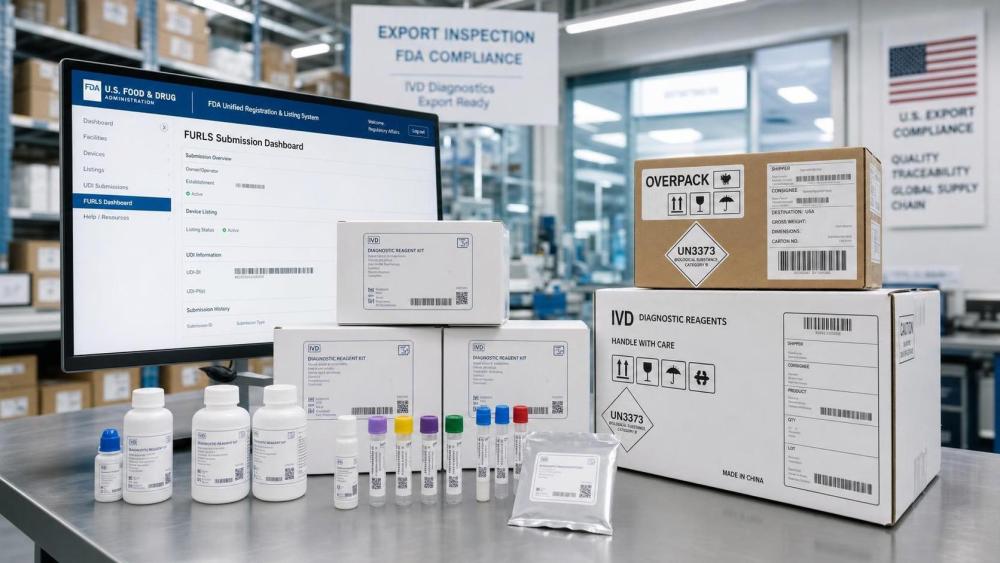
The confirmed change is specific and procedural. The FDA released a revised operational guide for IVD export compliance on July 31, 2026. Under that revision, from August 1, 2026, all in vitro diagnostic instruments and supporting reagent kits exported to the United States must submit structured electronic UDI data through FURLS.
The guidance also makes clear that the submission must be linked to label information and packaging hierarchy information. Based on the input provided, the change directly affects export registration to the U.S., customs clearance timeliness, and distributor inventory management processes for Chinese IVD manufacturers.
Where the operational impact is likely to appear first
Manufacturers handling U.S. export registration
From an industry perspective, manufacturers are likely to feel the most immediate impact because the new requirement sits at the point where product identification data, labels, and packaging information must match in a structured electronic format. The business areas most exposed are registration preparation, submission accuracy, and internal coordination between regulatory, labeling, and packaging functions. What deserves closer attention is whether existing product records are already organized in a way that supports FURLS submission without delay.
Teams responsible for shipment release and customs timing
Analysis shows that export execution teams may be affected where compliance readiness and shipping schedules intersect. If structured UDI data and linked label or packaging information are not aligned before shipment, the main pressure point may appear in customs timing rather than only in regulatory filing itself. For companies with active U.S. orders, the practical issue is not just whether data can be submitted, but whether it can be submitted in a form that does not slow handover and release processes.
Distributors managing inventory by packaging level
Observably, distributor-side operations may also be affected because the revised requirement explicitly connects UDI submission with packaging hierarchy information. That means inventory records, product identification at different packaging levels, and stock handling procedures may require closer consistency with what is filed in FURLS. The relevant change to watch is whether upstream manufacturers and downstream distributors are working from the same packaging and labeling reference set.
What companies should monitor in practice
Whether official wording is followed by further operational clarification
What deserves closer attention is the difference between a published compliance requirement and its day-to-day execution. Companies should continue monitoring whether the FDA provides additional clarification on submission handling, data formatting, or process expectations tied to this revised guide. The current confirmed fact is the requirement itself; the operational details may still need continued verification.
Whether label and packaging records are aligned before filing
For affected exporters, a practical priority is to review whether label information and packaging hierarchy records can be connected consistently to structured electronic UDI data. This is less a general management issue than a document and data readiness issue tied directly to the new filing requirement.
Whether internal and external handoffs are ready for the new sequence
The update also points to a coordination issue across regulatory teams, export operations, and channel partners. Companies should pay attention to how submission timing, shipment preparation, and distributor communication are sequenced, especially where inventory records depend on packaging-level identifiers.
Whether customer and partner communication needs to change
Analysis shows that Chinese IVD manufacturers supplying the U.S. market may need to communicate more clearly with distributors and other downstream partners about label-linked UDI records and packaging hierarchy consistency. The core issue is not broader branding or sales messaging, but whether compliance-related product data is understood in the same way across the chain.
Why this looks bigger than a simple filing update
As an editorial observation, this development is more appropriately understood as an operational compliance signal rather than a one-off administrative notice. The confirmed rule change is already in effect, which gives it short-term relevance. At the same time, the broader industry meaning still depends on how consistently companies can translate structured UDI requirements into registration, customs, and inventory workflows.
It is also more appropriate to understand this as a change that links data quality with trade execution. The input provided does not confirm wider market outcomes, so any claim about long-term market reshaping would go beyond the available facts. What can be said is that the update shifts attention toward execution discipline in U.S.-bound IVD exports.
How this update is best understood now
At this stage, the FDA revision should be read as an immediately applicable compliance change with direct operational consequences for IVD exporters to the United States. The confirmed impact areas are export registration, customs clearance timeliness, and distributor inventory management. A neutral reading is that this is already a real near-term requirement, while its full downstream effects still need continued observation through actual implementation.
Basis of this article and what still needs verification
This article is based on the user-provided news title, event date, and event summary regarding the FDA revision to IVD export compliance guidance and the mandatory electronic UDI submission requirement from August 1, 2026. For developments of this type, common source categories usually include official notices, company disclosures, industry association updates, authoritative media coverage, and standard-setting documents.
No specific official source link was provided in the input, so the exact official publication path still requires ongoing verification. Continued monitoring should focus on any further FDA clarification related to FURLS submission practice, label linkage, packaging hierarchy handling, and how these requirements affect cross-border execution for U.S.-bound IVD products.