
What Drives Healthcare Infrastructure Pricing Across Market Access Stages?
Why price comparisons break down so early in healthcare infrastructure deals
If you are evaluating healthcare infrastructure pricing, the first quote is rarely the real number you need. A low entry price can still turn into a high-cost project once market access requirements, installation constraints, service obligations, software support, training, and document readiness start showing up. That is why business evaluation teams often struggle when they compare suppliers too early, before checking what stage the product or system has actually reached in the target market.
In practice, pricing moves as a product moves through access stages: early market exploration, regulatory preparation, registration or approval, local commercialization, procurement submission, installation, and long-term support. The commercial number changes because the supplier’s workload changes. So does your risk.
What does “market access stage” really change in the price?
It changes more than paperwork. At each stage, the supplier may need different technical files, labeling, local representation, translation, quality records, product registration materials, training content, installation planning, and after-sales arrangements. Those costs are not abstract compliance overhead. They usually show up directly in the deal structure.
For example, a system that is still being evaluated for market entry may be priced aggressively to attract a distributor or pilot project. But if the same system later needs market-specific documentation, local service coverage, spare parts stocking, software localization, or site validation, the pricing logic changes. You are no longer buying only equipment. You are paying for market readiness.
That is the first filter for procurement and investment review: is this quote based on a product that is commercially ready in this market, or on a product that still needs work before it can be deployed at scale?
Which cost drivers matter most before a product is fully commercialized?
Before full commercialization, pricing is often shaped by uncertainty costs. These are the items that tend to be missed in early discussions:
- Documentation gaps: technical files, user manuals, labeling sets, risk documents, and installation instructions may need adaptation for the target market.
- Regulatory preparation work: even when a supplier already sells elsewhere, the target market may require different submission content or commercial conditions.
- Local service setup: no installed base usually means no local engineers, no parts stock, and slower support response.
- Training burden: if the product is unfamiliar to operators or biomedical teams, onboarding costs rise fast.
- Workflow adaptation: integration into hospital processes, laboratory routines, or imaging operations may require extra configuration and support.
These items are especially important in imaging, laboratory systems, sterilization, digital hospital infrastructure, and ICU-related equipment, where installation and operational continuity matter as much as the unit price.
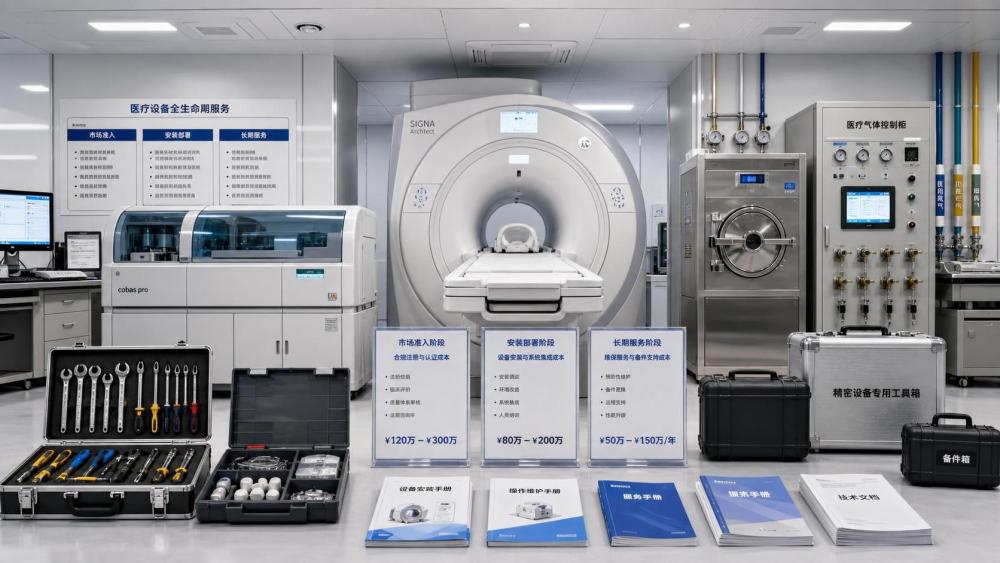
Why can two similar systems have very different healthcare infrastructure pricing?
Because similar function does not mean similar delivery burden. Two patient monitoring systems may both display vital signs, yet one quote includes networking support, alarm configuration, user training, spare accessories, installation assistance, and a defined service response model, while the other covers only the base devices.
The same happens with imaging rooms, lab analyzers, sterilization equipment, and medical gas systems. One supplier may price the equipment only. Another may price the real deployment package. If you compare those numbers without normalizing scope, you will almost certainly reward the thinner quote and inherit the missing cost later.
A practical rule: if the quote looks unexpectedly low, check what has been excluded before treating it as a commercial advantage.
What should a business evaluator ask for before comparing suppliers?
Ask for a scope-matched package, not just a price sheet. You need to see which commercial and operational elements are already included and which are being pushed into later negotiation.
This is where many procurement reviews become much cleaner. Once scope is aligned, price gaps often make sense.
How much of the price is driven by installation conditions?
Sometimes a lot more than buyers expect. Hospital infrastructure is not plug-and-play in the ordinary industrial sense. Imaging systems may require room preparation, shielding, power stability, HVAC adjustments, data connectivity, structural review, or workflow redesign. Laboratory systems may need water quality control, environmental conditions, LIS connectivity, sample routing, or reagent storage planning. Sterilization and cleanroom-related systems can trigger utility and facility modifications that outweigh a portion of the equipment price.
This is why business evaluation teams should always separate three numbers:
- Equipment supply cost
- Installation and commissioning cost
- Site adaptation or facility preparation cost
When suppliers combine all three into one number, comparison becomes harder. When they separate them, your risk analysis improves immediately.
Does regulatory readiness affect price even after approval or registration?
Yes. Approval is not the end of pricing pressure. After market access is achieved, suppliers still need to maintain technical documents, labeling control, traceability, complaint handling, field support, and in many cases distributor coordination. Those obligations sit behind the commercial offer even if the quote does not spell them out.
For the buyer or channel partner, the useful question is not “Does the product have approval?” but “What commercial costs remain because of the way approval is maintained in this market?” If the supplier relies on limited local support, outsourced service, or fragile documentation workflows, the price may be lower today but more exposed to disruption later.
Where do lifecycle costs usually hide?
They hide in the parts that do not look like procurement line items. In healthcare infrastructure pricing, the obvious purchase figure is only the visible layer. The deeper cost usually sits in operation.
Typical examples include preventive maintenance, calibration, software support, user retraining, accessories with limited lifespan, reagent commitments, response time expectations, equipment downtime, and replacement part dependency. A laboratory analyzer with attractive capital pricing may become expensive if the reagent model is restrictive. A monitor network may look straightforward until software licensing and upgrade support appear. A sterilization setup may seem complete until spare chamber parts, validation activity, and service intervals are mapped over several years.
If your review only covers acquisition cost, you are not really evaluating cost.
What are the most common mistakes in early procurement costing?
One mistake is assuming that a technically acceptable quote is commercially complete. Another is letting distributors, manufacturers, and hospital teams describe scope in different ways and then comparing the numbers as if they mean the same thing.
Other frequent problems include:
- Ignoring operator training and biomedical support requirements
- Missing software, interface, or connectivity dependencies
- Treating warranty length as equal to actual service capability
- Overlooking consumables, accessories, or recurring validation activities
- Accepting incomplete site readiness assumptions from either side
None of these are unusual. They are exactly the kind of issues that make one supplier seem cheaper on paper and more expensive in live operation.
How should pricing be evaluated when the buyer is a distributor, not a hospital?
The logic shifts slightly. A distributor is not only buying for use; it is buying for resale, support, market development, and reputation. That means pricing must be tested against channel obligations.
A distributor should check whether the margin still works after local registration support, demo activity, customer education, spare parts stocking, field service coordination, and slower adoption cycles in capital equipment categories. A quote that looks commercially attractive at import stage can become weak once the distributor carries service exposure and documentation burden.
This is especially relevant for medical devices and infrastructure systems that need application training, post-install support, or regular consumable supply. Channel economics and end-user economics are related, but they are not the same model.
What is a practical way to compare quotes across market access stages?
Use a staged comparison instead of a single ranking. Put each offer into the access stage it actually represents, then compare only like with like.
- Define the target use case: pilot, registration support, distributor launch, hospital procurement, or scale deployment.
- Map missing items in documentation, service, site preparation, and training.
- Convert each missing item into a commercial responsibility: supplier, distributor, buyer, or third party.
- Rebuild a normalized landed project cost.
- Only then compare margin, risk, and long-term operating burden.
That method takes more effort up front, but it prevents the usual mistake of choosing the lowest visible number and discovering the real project cost later.
What is the clearest decision rule for healthcare infrastructure pricing?
Do not ask which quote is cheapest. Ask which quote reflects the full burden of getting the system into the target market, into the facility, and into stable operation. In healthcare, pricing changes at every market access stage because readiness changes. The more complete the readiness, the more complete the price usually becomes.
For business evaluation professionals, the useful sequence is simple: verify stage, normalize scope, separate installation from site cost, test lifecycle burden, and identify who carries the gaps. That is where better procurement decisions come from.
Have questions about the global trade trends discussed here, or planning your expansion and supply chain strategy? Leave a message below and let the trade experts at MTHH guide you.
We respect your privacy. Your information is strictly confidential.
Related News
- Hong Kong Outlines Medical Device Legislation and Plans for Statutory RegulatorNov 14, 2026Hong Kong medical device legislation could reshape regulatory oversight. Explore the proposed regulator and what businesses should monitor.
- AAMI Issues TIR115 Guidance on Public Cloud Use in Medical DevicesNov 13, 2026AAMI TIR115:2026 guides public cloud use in medical devices. Explore its focus on risk management, supplier assessment and device boundaries.
- How are critical care devices regulated in the United States?Nov 12, 2026Critical care devices face FDA requirements based on intended use and risk. Explore classifications, marketing pathways, and practical compliance checks.
- Hong Kong Drafts Medical Device Bill to Establish Statutory OversightNov 12, 2026Hong Kong's Medical Devices Bill could introduce risk-based statutory oversight. Discover what the proposed framework may mean for suppliers.