
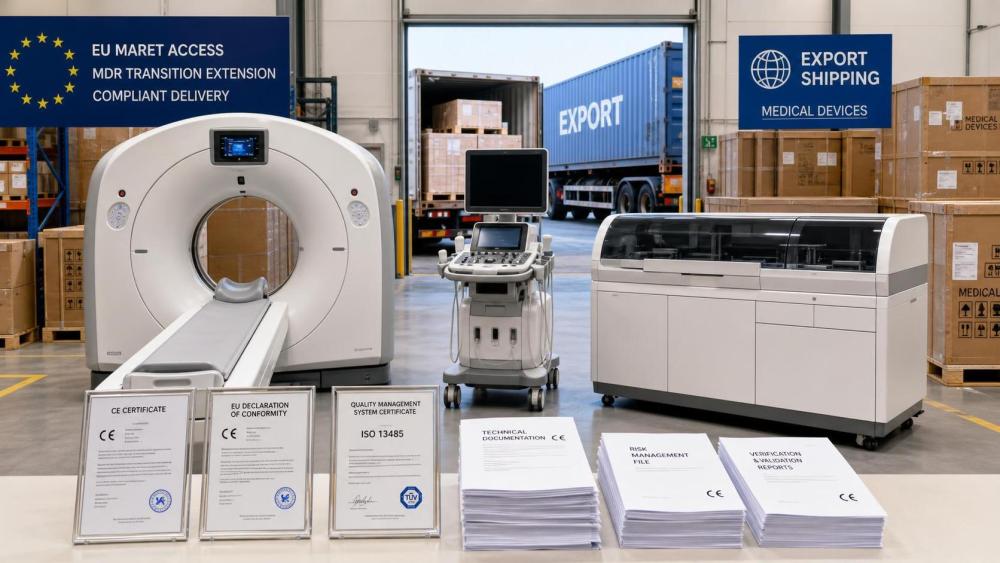
On July 30, 2026, the European Commission issued Regulation (EU) 2026/1892, extending the MDR transition period for IVD products and certain Class IIa and IIb medical imaging devices to December 31, 2027. At the same time, it set a nearer compliance checkpoint: certified products must complete updated clinical evaluations and submit them to the notified body by October 1, 2026. For exporters shipping CT systems, ultrasound equipment, and fully automated biochemical analyzers into the EU, this matters not only for registration status, but also for customs and delivery compliance.
What the new rule changes now
The confirmed change is twofold. First, the European Commission formally extended the MDR transition period for IVD products and some Class IIa and IIb medical imaging devices through December 31, 2027. Second, the extension is tied to a specific requirement: products that have already been certified must complete an updated clinical evaluation and submit it to the relevant notified body no later than October 1, 2026.
The information provided also makes clear that this development directly affects Chinese exporters supplying the EU market with products such as CT equipment, ultrasound systems, and fully automated biochemical analyzers, particularly in relation to registration continuity and customs compliance.
Where the pressure is likely to appear across the chain
Export-facing manufacturers face a shorter operational deadline
From an industry perspective, manufacturers that already hold certificates may see the main pressure shift from the headline extension date to the earlier October 1, 2026 submission requirement. The practical impact is likely to concentrate on clinical evaluation updates, document readiness, and coordination with the notified body rather than on the transition extension alone.
EU-bound shipment planning may become more documentation-sensitive
For companies delivering equipment into the EU, the immediate concern is not only whether a product remains within the extended transition period, but whether its updated evaluation has been submitted on time. Analysis shows that registration status and customs compliance may become more tightly linked to document timing for shipments involving CT, ultrasound, and automated biochemical testing equipment.
Distributors and channel partners may need closer certificate checks
For channel participants and downstream commercial partners, the likely impact sits in transaction verification and delivery scheduling. What deserves closer attention is whether product files, certificate-related materials, and supporting compliance documents remain aligned with the new requirement before goods move through EU-facing sales and logistics arrangements.
What companies should watch in the coming months
Do not treat the 2027 extension as the only key date
The extension to December 31, 2027 may appear to ease pressure, but the nearer requirement is the more immediate operational trigger. Companies should distinguish between the longer transition window and the October 1, 2026 deadline for updated clinical evaluation submission.
Check affected product lines and certification status early
Businesses involved with IVD products and certain Class IIa and IIb imaging devices should review which certified products fall within the scope described in the regulation summary. In practice, attention should stay on whether the products shipped to the EU depend on continued registration validity under the updated submission requirement.
Prepare customer and customs-facing documentation workflows
Analysis shows that this is not only a regulatory interpretation issue. It also touches shipment execution. Exporters, supply chain teams, and commercial staff should pay close attention to the completeness and timing of compliance materials that may be needed for customer communication, order release, and customs handling.
Keep watching for official wording and implementation detail
Because the input provides the core rule change but not a full procedural explanation, companies should continue monitoring how notified body submission expectations and related compliance interpretations are expressed in subsequent official communications.
Why this looks like a conditional extension rather than a simple delay
Observably, this development should not be read simply as more time for the sector. The combination of a longer transition period and an earlier mandatory update requirement suggests a conditional form of regulatory relief. Analysis shows that the message to industry is not that compliance pressure has eased across the board, but that continued market access remains tied to active documentation maintenance.
It is more appropriate to understand this as both a short-term operational change and a longer-term regulatory signal. In the short term, the October 2026 submission point may shape immediate workload and shipment planning. As a longer-term signal, the rule indicates that transition extensions do not remove the need for refreshed clinical support within the MDR framework.
How the industry should read this update
At this stage, the most balanced reading is that the EU has extended time on paper while preserving a firm compliance condition for products already on the market path. For IVD and imaging device manufacturers, especially exporters serving the EU from China, the issue is less about headline relief and more about whether updated clinical evaluations are submitted in time to avoid disruption in registration status and customs compliance. It is more appropriate to understand this as an actionable regulatory development that still requires close follow-up, rather than as a fully settled outcome.
Basis of this article and what still needs verification
This article is based on the user-provided news title, event date, and event summary. In this category of industry update, relevant source types typically include official regulatory notices, company disclosures, industry association updates, authoritative media reporting, and standards-related documents. A specific official source link was not provided in the input, so the exact text and any subsequent implementation detail still require continued verification against official publications and related compliance communications.