
On July 14, 2026, Brazil’s health regulator ANVISA introduced an immediate amendment to the registration path for certain dental imaging devices with AI-assisted diagnostic functions. The change applies to dental CBCT systems, intraoral scanners, and panoramic X-ray equipment, and it matters because the AI component must now be documented separately through a Clinical Equivalence Report. For manufacturers, exporters, registration teams, distributors, and procurement-facing functions, the short 30-day transition window makes this more than a technical filing update; it is a near-term compliance and delivery issue.
What the amendment changes in the registration file
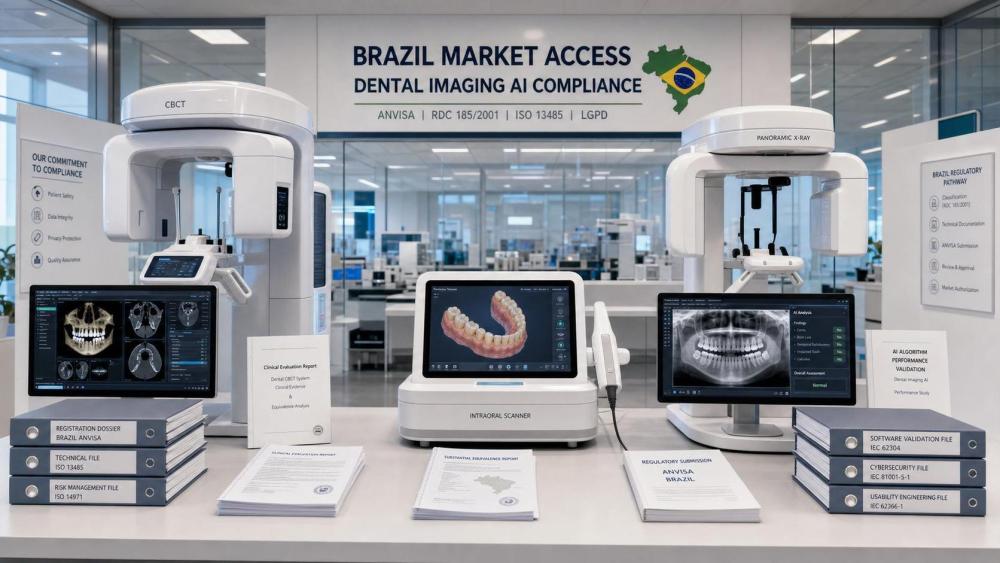
According to the provided event summary, ANVISA issued Amendment RDC No. 32/2026 on July 14, 2026. The amendment covers dental CBCT, intraoral scanners, and panoramic X-ray devices that include AI-assisted diagnostic functions.
The confirmed requirement is that the AI module must be submitted as an independent subsystem with a Clinical Equivalence Report. That report must demonstrate that the AI output is statistically consistent with an already approved comparable AI system, with the stated threshold of p>0.95.
The rule took effect immediately on the date of release, and the transition period is 30 days.
Where the pressure is likely to appear first
Registration and compliance teams face a narrower filing path
Analysis shows that the most direct impact will fall on teams preparing market registration dossiers for affected dental imaging products. The reason is straightforward: the AI function is no longer just part of the overall device description in practice, but a separately documented subsystem under the new requirement. What deserves closer attention is the need to align technical files, equivalence arguments, and supporting evidence around the AI output itself rather than only around the main hardware platform.
Manufacturers and exporters may need to reassess launch and shipment timing
From an industry perspective, companies supplying Brazil-bound dental imaging equipment may need to review whether products with AI-assisted diagnostic features are ready for the revised filing sequence. The likely pressure points are product release planning, shipment timing, and customer delivery commitments where registration status is tied to import or commercial readiness. The short transition period means firms should pay close attention to whether existing submission packages, pending registrations, or near-term export plans require additional documentation for the AI subsystem.
Distributors and channel partners may see changes in document requests
Observably, local distribution and channel functions may be affected because documentation expectations can change quickly when a regulator separates one functional module from the broader device registration path. In practical terms, commercial teams may need updated compliance materials, clearer product scope descriptions, and revised communication with clinics, procurement contacts, or tender-facing partners when a device includes AI-assisted diagnostic output.
Procurement and service-side stakeholders should watch product definitions closely
Buyers, import-facing procurement teams, and after-sales organizations may also be affected if product specifications, registration materials, or delivery schedules are adjusted to reflect the standalone AI filing requirement. The issue is not only whether a device is available, but whether its marketed AI functionality is fully aligned with the revised registration expectation. That can influence purchase planning, acceptance documentation, and service preparation for configured product versions entering the Brazilian market.
What companies should review now
Recheck whether the AI function is documented as a separate subsystem
Analysis shows that companies should first review whether affected product files clearly separate the AI-assisted diagnostic module from the rest of the device in regulatory documentation. This is especially relevant for products that were prepared under a more integrated device description.
Examine the basis for the Clinical Equivalence Report
What deserves closer attention is whether the available technical and clinical support materials are sufficient for a Clinical Equivalence Report framed around statistical consistency with an already approved comparable AI system. The provided event summary gives the requirement and the p>0.95 threshold, but it does not provide further execution detail, so companies should treat filing assumptions cautiously.
Review near-term submissions, tenders, and delivery commitments
Observably, the immediate effective date and 30-day transition window make this relevant for submissions already in preparation, products close to market entry, and commercial commitments that depend on registration progress. Companies should therefore review tender documents, customer schedules, internal approval gates, and shipment plans tied to AI-enabled models.
Track follow-on regulatory wording and market execution signals
From an industry perspective, the event summary confirms the rule change but does not provide a full operational interpretation for every filing scenario. For that reason, companies should continue monitoring official wording, registration practice, and any changes in how supporting documents are requested or evaluated in the market.
Why this looks like an execution signal, not just a policy note
Analysis shows that this development is more appropriate to understand as an active compliance signal rather than a distant policy direction. The immediate effectiveness and short transition period indicate that the market should pay attention to present-tense execution risk. At the same time, it should not yet be overstated as a fully settled operating pattern across every business scenario, because the provided information does not include detailed implementation examples, expanded procedural guidance, or observed enforcement outcomes.
Observably, the industry will need to watch how this requirement appears in registration practice, commercial documentation, and buyer-facing specifications. That is likely to determine whether the main consequence is limited to dossier restructuring or extends into broader timing and market-access adjustments.
How this update is best understood at this stage
At this stage, the ANVISA amendment should be read as a concrete rule change with immediate compliance relevance for dental imaging devices that include AI-assisted diagnostic functions. Its practical significance lies less in headline language and more in the filing consequence: AI must stand on its own in the registration package through a Clinical Equivalence Report. A neutral reading is that the change is already in force, while the full market impact will depend on how quickly companies adapt documentation and how consistently the requirement is applied in execution.
Basis of this article and what still needs verification
This article is based on the user-provided news title, event date, and event summary. For events of this type, commonly relevant source categories include official regulatory notices, publications by supervisory authorities, trade or customs authority updates, industry association communications, standards body documents, and reporting by established professional media.
No specific official source link was provided in the input, so the exact official publication path still requires further verification. Observably, the next points worth monitoring are any additional implementation details, certification or registration interpretation, changes in tender or procurement documents, market feedback, and how companies execute the new requirement in practice.