
On July 15, 2026, a new import control step took effect for selected rehabilitation devices entering the EFTA market. The change centers on a mandatory Pre-Clearance Data Submission (PCDS) requirement for products such as physical therapy beds, electric wheelchairs, and gait training systems, with filing required 72 hours before departure. For importers, exporters, manufacturers, and compliance teams, this is worth close attention because it shifts part of customs readiness upstream into the pre-shipment stage and creates a direct delivery risk for shipments that are not filed on time.
A new pre-shipment filing rule now applies
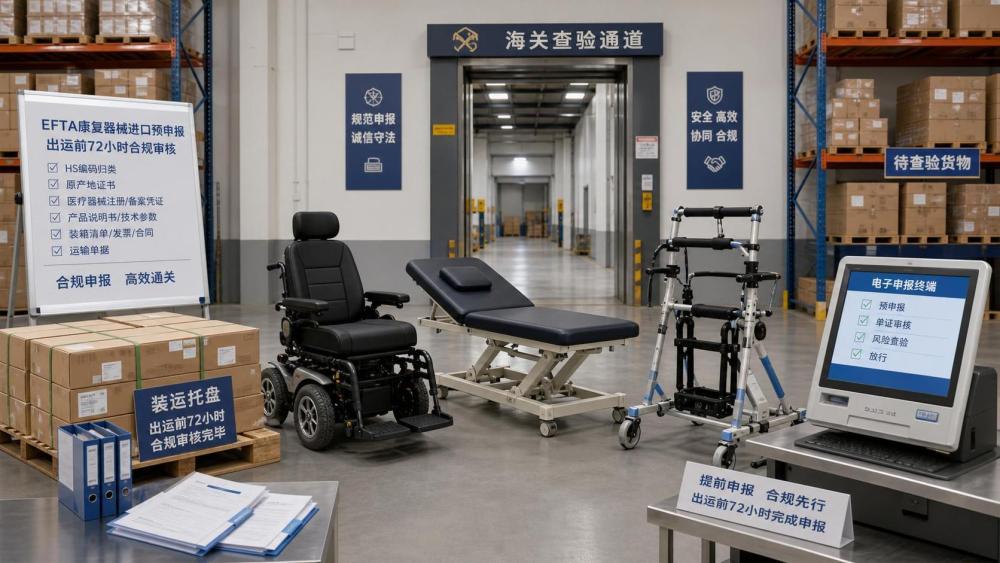
According to the information provided, EFTA announced on July 12, 2026 that, starting July 15, selected rehabilitation devices would be subject to a mandatory PCDS regime. The products specifically referenced include physical therapy beds, electric wheelchairs, and gait training systems.
Under this mechanism, the importer must submit data through the EFTA customs portal no later than 72 hours before the goods leave the port of departure. The required filing elements include a summary of technical documentation, the CE certificate number, the manufacturer authorization declaration, and local representative contact information.
The provided information also states that goods not filed in advance will be held at the Swiss or Norwegian border and will incur daily storage charges.
The immediate pressure points are in documentation, shipping, and border timing
Import operations now carry a stricter pre-departure responsibility
From an industry perspective, importers are the first group directly affected because the filing obligation is tied to the customs portal submission before shipment departs. The practical impact is likely to fall on shipment planning, document collection, and customs coordination. What deserves closer attention is whether import teams can gather the required technical and authorization information early enough to avoid a last-minute loading delay or a border hold.
Exporters and manufacturers may face earlier document handover demands
Analysis shows that exporters and device manufacturers may feel the effect even if the formal filing duty sits with the importer. The reason is straightforward: the importer cannot complete a compliant pre-clearance submission without core product and authorization materials. This may shift pressure upstream to technical file preparation, CE certificate reference accuracy, and confirmation of the manufacturer authorization declaration before cargo release.
Channel and logistics partners may need tighter dispatch control
Observably, distributors, freight coordinators, and other supply chain service participants may be affected through revised booking and dispatch timelines. Because the rule is linked to a 72-hour pre-departure window, the risk is not only customs non-compliance but also disruption to delivery sequencing if a shipment is ready physically but not ready from a data filing standpoint.
Procurement and delivery teams may need to reassess lead-time assumptions
For buyers and downstream delivery planners, the main issue is not a confirmed market-wide delay but a new checkpoint that can influence promised delivery schedules. It is more appropriate to understand this as a trade execution change that could affect order timing, especially where project deliveries depend on complete regulatory and representative information being available before export.
What companies should review first
Check whether current files support a pre-departure submission
Analysis shows that companies involved in the covered products should first verify whether the required materials can be assembled in a usable format before shipment. The key issue is not only whether technical documentation exists, but whether a summary, CE certificate number, manufacturer authorization declaration, and local representative contact details can be provided in time for the importer to file through the customs portal.
Reconfirm handoff points between exporter, importer, and local representative
What deserves closer attention is the operational interface between the parties handling compliance and the party handling customs submission. Where those responsibilities are split across different entities, the risk may arise from incomplete handoff rather than from product non-conformity itself. Companies should pay close attention to who owns each document element and when that information is transferred.
Watch for changes in shipment scheduling and contract execution
Observably, the new rule may require businesses to review internal shipping cutoffs, booking lead times, and delivery commitments for the affected device categories. The provided information does not define broader enforcement details, so it would be premature to treat all execution outcomes as settled. Still, companies should closely monitor whether customers, distributors, or logistics partners begin adjusting dispatch expectations around the 72-hour filing requirement.
Continue tracking how the rule is applied in practice
The available information confirms the filing requirement and the consequence of non-submission at the border, but it does not provide wider interpretive detail. From an industry perspective, businesses should continue watching for further official wording, operational clarifications, or document handling expectations that may shape how the rule is executed in day-to-day trade.
This looks like an execution signal more than a distant policy discussion
Analysis shows that this development is best read as a live compliance and trade execution change rather than a general policy direction without immediate effect. The reason is that the rule comes with a specific start date, a defined pre-departure filing window, named document elements, and a stated consequence for non-filed cargo.
At the same time, it is also appropriate to keep the interpretation measured. The information provided does not establish how consistently the mechanism will be applied across all transaction scenarios, nor does it describe any later-stage implementation guidance. For that reason, the market still needs to observe how customs practice, importer workflows, and document review expectations develop after the start date.
Why this matters now
For the rehabilitation device trade, the significance of this update is not simply that another customs form exists. More importantly, it moves compliance readiness closer to the shipping decision and links missing pre-clearance data to a direct border and storage cost consequence. It is more appropriate to understand this as a rule already entering execution, while also recognizing that the finer points of implementation and market response still require continued observation.
Basis of this article and what still needs verification
This article is based on the user-provided title, event date, and event summary concerning EFTA's new PCDS requirement for selected rehabilitation device imports. For events of this kind, relevant source categories typically include official announcements, customs or trade authority releases, regulator notices, industry association communications, standards-related documents, and reporting by authoritative trade media.
A specific official source link was not provided in the input, so the underlying official publication and any subsequent explanatory materials still need to be verified on an ongoing basis. Observably, the areas that warrant further tracking include implementation details, certification-related execution standards, possible changes in tender or procurement documentation, market feedback, and how companies actually adapt their shipping and compliance workflows after the rule takes effect.