
For healthcare leaders, deciding whether to repair or replace a critical device is a strategic choice affecting patient safety, continuity, capital planning, and long-term operating cost.
Biomedical equipment maintenance repair is usually preferable when the asset remains clinically suitable, repair restores reliable performance, and support can be secured at a defensible lifecycle cost.
Replacement becomes the stronger decision when failure risk, unsupported technology, compliance exposure, workflow limitations, or recurring downtime outweigh the apparent savings from another repair.
The correct question is not simply whether a repair quote costs less than a new device. Leaders should compare serviceable life, operational risk, clinical value, and total ownership economics.
This guide gives hospital executives, procurement teams, clinical engineering leaders, and distributors a practical framework for making a documented, business-ready repair-or-replace decision.
Start With Clinical Reliability, Not the Repair Invoice
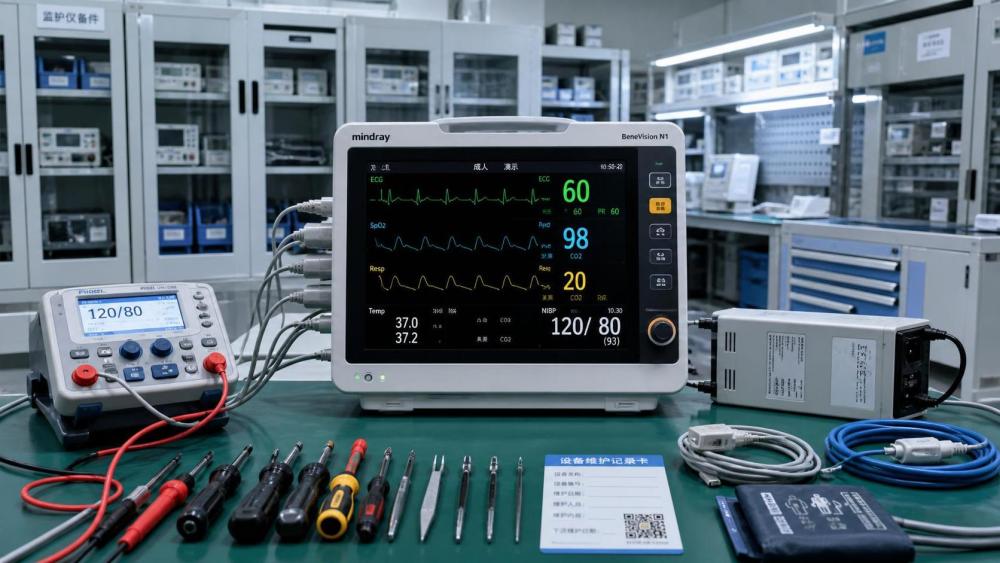
A low repair price can be misleading if the equipment is unreliable after service, creates repeated workflow interruptions, or exposes patients and staff to avoidable operational risk.
Biomedical equipment maintenance repair is most valuable when it returns the device to verified performance specifications and preserves safe, predictable clinical use for a meaningful period.
Clinical engineering should first confirm whether the failure is isolated, recurring, or linked to broader deterioration in hardware, software, power systems, sensors, or mechanical assemblies.
For example, replacing a damaged monitor display differs fundamentally from repairing a patient monitor with repeated alarm, battery, module, and communications failures across several units.
Decision-makers should ask whether the device can still perform its required clinical function without workarounds that increase staff burden, delay care, or reduce confidence in results.
Equipment supporting high-acuity care, anesthesia, ventilation, defibrillation, sterilization, imaging diagnosis, or laboratory reporting requires a more conservative risk threshold than secondary assets.
A repair decision should therefore include documented functional testing, electrical safety checks, calibration verification where applicable, and confirmation that all critical alarms and safeguards operate correctly.
Repair Is Strongest When the Failure Is Isolated and Correctable
The most favorable repair cases involve a clearly identified fault with a known corrective action, available parts, competent service capability, and a credible post-repair warranty.
Common examples include replacing worn pumps, damaged cables, broken displays, depleted batteries, failed valves, power supplies, filters, sensors, or specific mechanical components.
In these cases, the underlying platform may still be stable, supported, clinically appropriate, and compatible with the hospital's current workflow, accessories, and staff training.
Repair becomes less attractive when technicians identify multiple failures across unrelated systems, especially where the root cause could be age-related degradation or an unresolved design weakness.
Repeated board-level faults, intermittent software errors, image artifacts, unstable calibration, leaks, communication problems, and recurring motor failures often indicate a broader lifecycle issue.
Organizations should require service providers to distinguish symptom correction from root-cause correction. A short-term reset or component swap may restore operation without resolving the source of failure.
For higher-value equipment, request a written technical assessment that identifies failed parts, probable cause, remaining concerns, test results, recommended preventive actions, and service warranty terms.
Compare Repair Cost With Remaining Useful Life
Financial discipline requires more than comparing today's repair quotation with the purchase price of a replacement system. The relevant comparison is cost per reliable remaining year.
A device repaired for $12,000 may be an excellent decision if it can safely serve for five additional years with modest maintenance and no lost productivity.
The same repair is poor value if the equipment is likely to require further major interventions within months, creating unpredictable spend and disrupting clinical operations.
Estimate remaining useful life using equipment age, utilization intensity, maintenance history, failure patterns, environmental conditions, software status, manufacturer support, and technician assessment.
Then calculate expected annualized cost by combining repair expense, planned maintenance, probable future repairs, consumables, service contract cost, downtime impact, and eventual disposal or replacement costs.
Biomedical equipment maintenance repair generally merits approval when the annualized cost remains materially lower than replacement while reliability, compliance, and clinical performance remain acceptable.
A useful internal threshold is to escalate replacement analysis when a single repair approaches a significant share of replacement cost or extends life only briefly.
The threshold should vary by device category. A low-cost infusion pump and a high-value MRI system have different capital profiles, repair economics, and service risk tolerances.
Include Downtime and Lost Capacity in the Business Case
Downtime is often the hidden cost that changes a repair decision. A technically inexpensive repair can still be expensive if it interrupts revenue, care delivery, or staff productivity.
For imaging equipment, unplanned downtime may delay examinations, shift patients to external providers, reduce daily throughput, and damage confidence among referring physicians and patients.
For laboratory analyzers, failures can create sample backlogs, force manual testing, increase overtime, delay clinical decisions, and complicate quality assurance or turnaround-time commitments.
For ICU, operating room, emergency, and sterilization equipment, downtime may require rental equipment, patient transfers, rescheduling, or temporary changes to clinical capacity and staffing.
Procurement leaders should quantify these consequences using actual utilization data, average daily volume, contribution margin where relevant, rental costs, diversion costs, and overtime records.
Service response time also matters. A repair supported by local engineers, stocked parts, and a loaner plan may be safer than a lower quotation requiring weeks of overseas sourcing.
When equipment is mission-critical, a repair should include a realistic restoration timeline, contingency plan, escalation path, and clear responsibility for post-repair performance verification.
Do Not Repair Into Obsolescence
Equipment can be functional yet strategically obsolete. This is common when original manufacturers discontinue software updates, cybersecurity patches, key spare parts, accessories, or technical documentation.
Unsupported systems may remain repairable through independent providers, but leaders must assess whether that route can meet safety, traceability, cybersecurity, and regulatory expectations in their market.
For networked medical devices, obsolete operating systems and unsupported software can create a risk profile that ordinary mechanical repair does not address.
Imaging platforms may also become obsolete when detectors, workstations, dose-management tools, PACS integration, or image-processing capabilities no longer meet clinical workflow requirements.
In laboratory environments, an aging analyzer may be technically repairable but commercially impractical if reagent supply, assay menus, middleware integration, or service expertise are declining.
Before approving another intervention, confirm the manufacturer's end-of-support date, software roadmap, spare-parts availability, cybersecurity guidance, and availability of qualified third-party alternatives.
Replacement is often justified when repair merely postpones an unavoidable transition while increasing exposure to supply interruptions, unsupported software, or inefficient clinical workflows.
Measure Performance Gaps Against Current Care Requirements
A repair should preserve an asset that still meets current requirements, not protect sunk cost in a device that no longer supports the organization's clinical or commercial objectives.
Leaders should compare the repaired device with present requirements for accuracy, throughput, image quality, dose management, automation, interoperability, documentation, and user experience.
Aging equipment can impose invisible operating costs through slow startup, manual data entry, difficult cleaning, poor ergonomics, limited connectivity, and higher operator error risk.
Replacement may deliver measurable value through faster scans, expanded test menus, lower energy consumption, remote monitoring, fewer repeats, improved workflow, or reduced consumable waste.
These gains should be quantified rather than assumed. Ask departments to define the specific capacity, quality, safety, or labor improvements that a newer platform would deliver.
Conversely, do not replace equipment merely because a newer model exists. If current performance supports demand, quality standards, and staff workflow, repair can protect capital efficiently.
The strongest decisions link asset strategy to service-line plans, projected patient volumes, facility upgrades, digital-health integration, and anticipated changes in clinical practice.
Check Compliance, Documentation, and Service Accountability
Medical equipment decisions must be defensible beyond the finance department. Hospitals need evidence that repaired equipment remains safe, maintained, and suitable for its intended clinical use.
Maintenance records should show asset identification, fault description, service provider, replaced parts, functional testing, electrical safety testing, calibration status, and release-to-service authorization.
For devices requiring periodic calibration or performance checks, biomedical equipment maintenance repair should include verification against applicable procedures, tolerances, and quality-system requirements.
Use qualified service providers with appropriate technical competence, access to reliable parts, documented procedures, insurance coverage, and clear responsibility for workmanship and post-service defects.
Independent service organizations can provide strong value, especially for mature equipment, but procurement teams should validate qualifications, traceability practices, parts quality, and support capacity.
Where refurbished or harvested parts are proposed, require transparency about source, condition, testing, warranty, compatibility, and any restrictions under local regulations or manufacturer policies.
A repair that lacks documentation or accountability may create audit, accreditation, insurance, and liability concerns that outweigh the immediate savings.
Use a Repair-or-Replace Decision Framework
Executive decisions improve when clinical engineering, finance, procurement, infection control, IT, and clinical users evaluate the same evidence rather than relying on a single repair quote.
Start by classifying the asset according to clinical criticality, utilization, failure history, replacement lead time, available backup capacity, and impact on patient care.
Next, obtain a technical condition assessment that separates the immediate fault from overall equipment condition, expected remaining life, parts availability, and foreseeable major repairs.
Then prepare a financial comparison covering repair cost, expected future maintenance, downtime exposure, service contracts, energy use, consumables, training, installation, and financing options.
Finally, assess strategic fit: whether the asset supports cybersecurity requirements, interoperability plans, future service demand, regulatory expectations, and the organization's clinical growth priorities.
Organizations can use a simple weighted scorecard, but the decision should remain transparent. High-risk clinical and compliance criteria should override marginal financial savings when necessary.
A practical output is a written recommendation stating repair, replacement, interim rental, upgrade, or planned replacement at budget-cycle timing, with supporting evidence and accountable owners.
When Replacement Is the Better Business Decision
Replacement is usually appropriate when repair cannot restore dependable performance, support is ending, failures are recurring, or the device no longer meets clinical and operational requirements.
It is also justified when repair lead times are unacceptable, parts are scarce, service quality is uncertain, or the organization lacks sufficient backup capacity during future failures.
Replacement should be accelerated when a newer platform materially improves patient safety, diagnostic confidence, infection control, cybersecurity, throughput, interoperability, or operating cost.
For capital-intensive systems, a phased plan may be better than emergency replacement. This includes budgeting early, preserving residual value, preparing infrastructure, and managing installation downtime.
Hospitals should avoid repeated emergency repairs that consume operating budgets without a strategic plan. Those expenditures can obscure the true need for capital replacement.
Procurement teams should also evaluate total supplier capability, including installation, application training, warranty, preventive maintenance, remote support, spare parts, and long-term upgrade pathways.
Conclusion: Repair When It Preserves Reliable Value
Biomedical equipment maintenance repair is better than replacement when it restores safe, reliable performance at a lower lifecycle cost and without compromising future clinical or operational needs.
The decision should combine technical condition, patient safety, downtime exposure, remaining useful life, support availability, compliance evidence, and the economic value of improved technology.
For healthcare leaders, the most effective approach is neither automatic repair nor automatic replacement. It is a disciplined asset-lifecycle decision supported by measurable evidence.
By using condition assessments, total-cost analysis, documented service controls, and strategic performance criteria, organizations can protect capital while maintaining dependable healthcare delivery.