
What to Check Before Choosing a Respiratory Consumables Manufacturer
Choosing a respiratory consumables manufacturer is not just about unit price.
In healthcare procurement, small supply issues can quickly become clinical problems.
That is why supplier review needs to go deeper than catalog claims.
A reliable respiratory consumables manufacturer should support safety, continuity, documentation, and long-term cost control.
This matters whether the products are used in ICU care, anesthesia support, oxygen therapy, or home respiratory programs.
In practical procurement work, the real question is simple.
Can this respiratory consumables manufacturer deliver stable products, clean documents, and dependable supply over time?
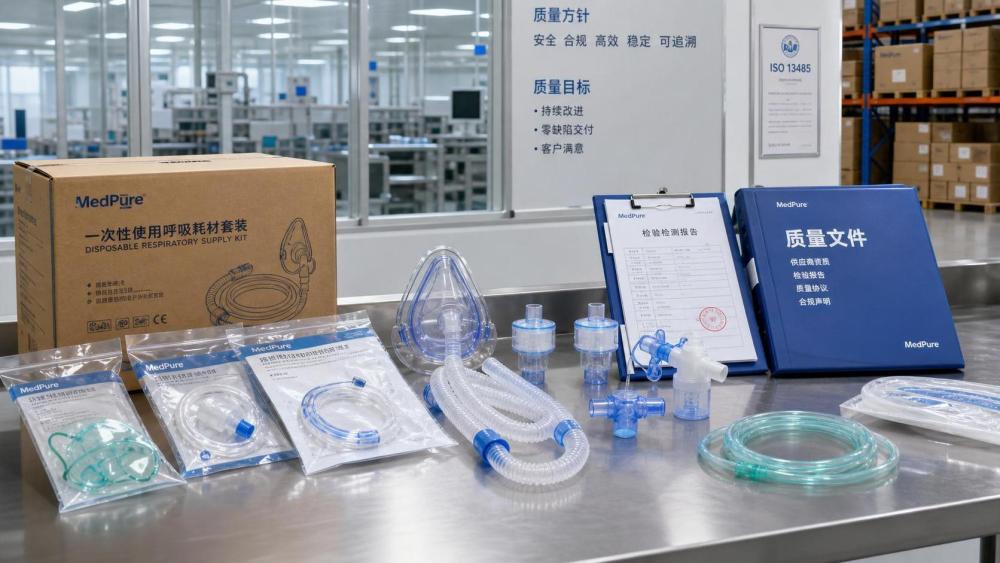
Before approving any supplier, it helps to review a fixed set of checkpoints.
That review reduces risk during tendering, contracting, onboarding, and repeat purchasing.
1. Confirm Product Scope and Clinical Fit
Start by checking what the respiratory consumables manufacturer actually makes.
Some suppliers focus on a narrow range.
Others cover masks, breathing circuits, filters, nebulizer kits, oxygen tubing, humidification accessories, and suction-related items.
A broad range can simplify sourcing.
Still, range alone is not enough.
The products must match your equipment, usage settings, and patient groups.
- Adult, pediatric, or neonatal application compatibility
- Single-use or reusable design logic
- Connection standards for ventilators and anesthesia machines
- Material suitability for oxygen flow, humidity, and pressure demands
A good respiratory consumables manufacturer should explain intended use clearly.
If product positioning is vague, future complaints usually follow.
2. Review Regulatory and Quality Documents
Documentation is one of the fastest ways to judge supplier maturity.
A qualified respiratory consumables manufacturer should provide complete, current, and traceable records.
Ask for documents before price negotiation moves too far.
- ISO 13485 certificate
- CE, FDA, or other market-specific registrations
- Declaration of conformity
- Biocompatibility and material safety reports
- Sterilization validation, where applicable
- Shelf-life and packaging validation data
- Labeling samples and instructions for use
Pay attention to document consistency.
Sometimes the certificate is valid, but the product list does not match the offered item.
That gap can delay import approval or hospital acceptance.
3. Check Manufacturing Consistency and Process Control
Respiratory products are sensitive to dimensional accuracy, material stability, and sealing performance.
For that reason, a respiratory consumables manufacturer needs strong process control, not just a nice brochure.
Ask how batches are monitored and released.
Ask whether incoming materials are inspected.
Ask how leaks, disconnections, and packaging defects are prevented.
Useful points to verify include:
- Batch traceability from raw material to final shipment
- In-process inspection records
- Finished product testing standards
- Nonconformity handling and CAPA process
- Cleanroom controls for relevant products
If sample quality varies from batch to batch, procurement risk rises immediately.
The stronger respiratory consumables manufacturer is usually the one with repeatable output, not the lowest quote.
4. Evaluate Sterilization, Packaging, and Shelf Life
This area often gets less attention than it should.
Yet packaging failure can turn a compliant product into unusable stock.
A respiratory consumables manufacturer should clearly define sterilization methods, packaging structure, and storage conditions.
Review whether the sterile barrier is practical for transport and warehouse handling.
Also check carton labeling and expiry management.
This is especially important for international procurement.
Long transit times can expose weak packaging very quickly.
5. Test Supply Stability and Delivery Capability
A respiratory consumables manufacturer may pass technical review and still fail operationally.
Supply reliability is often the deciding factor in repeat contracts.
Ask direct questions about output capacity, lead time, safety stock, and demand spikes.
This became much more important after recent disruptions in global healthcare supply chains.
Key procurement checks include:
- Monthly production capacity by product line
- Normal lead time and rush-order response
- Dependency on single-source raw materials
- Export experience and shipping document accuracy
- Back-order handling and communication speed
A dependable respiratory consumables manufacturer should answer these points with data, not general promises.
If lead times are unstable, low pricing loses its value fast.
6. Look Beyond Unit Price to Total Procurement Cost
Cost analysis should be wider than purchase price per piece.
The better respiratory consumables manufacturer may look more expensive at first glance.
But total cost can be lower when quality issues, replacements, delays, and complaints are reduced.
Review the full cost picture:
- Unit price by SKU and packaging level
- Freight, customs, and local handling costs
- Failure rate and replacement burden
- Expiry loss due to poor shelf-life planning
- Administrative cost from weak documentation
In real purchasing decisions, stable quality often protects margin better than aggressive discounts.
This is particularly true for distributors managing multiple hospital accounts.
7. Assess Technical Support and Commercial Responsiveness
Support quality says a lot about future cooperation.
A serious respiratory consumables manufacturer should respond quickly to technical questions, complaint analysis, and labeling requests.
This becomes more important when private labeling, distributor registration, or hospital tender documents are involved.
Check whether the supplier can provide:
- Prompt replies from sales and quality teams
- Complaint investigation reports
- Updated regulatory files when rules change
- Tender support and product comparison data
- Sample coordination for evaluation trials
A respiratory consumables manufacturer that communicates poorly during evaluation rarely improves after onboarding.
8. Use a Practical Supplier Evaluation Framework
A structured review makes supplier comparison easier and more defensible.
Instead of relying on price ranking alone, score each respiratory consumables manufacturer against the same criteria.
A simple framework may include technical fit, compliance status, production control, supply stability, and total cost.
You can also add complaint history and responsiveness as weighted factors.
This approach helps during internal review and supplier approval meetings.
More importantly, it improves consistency across future purchases.
Final Takeaway
Choosing the right respiratory consumables manufacturer is a procurement decision with clinical consequences.
The best supplier is usually not the one with the cheapest quotation.
It is the respiratory consumables manufacturer that can prove quality, document compliance, protect supply continuity, and support long-term cooperation.
A practical review should cover product fit, regulatory readiness, sterilization control, packaging integrity, delivery reliability, and total operating cost.
When these checks are done early, procurement becomes faster, cleaner, and less risky.
For the next supplier shortlist, use these checkpoints before discussing final price, contract terms, or order volume.