
On June 26, 2026, the Red Sea disruption was reflected not only in a sharp jump in Asia-Europe container freight rates, but also in a more explicit shipping rule change for medical equipment cargo. With carriers moving to tighten slot allocation for this category from July 1 and requiring earlier submission of packing lists, CE/FDA certificates, and proof of final destination, the issue matters directly to exporters, manufacturers, procurement teams, and logistics providers handling medical shipments where documentation readiness and delivery timing are commercially sensitive.
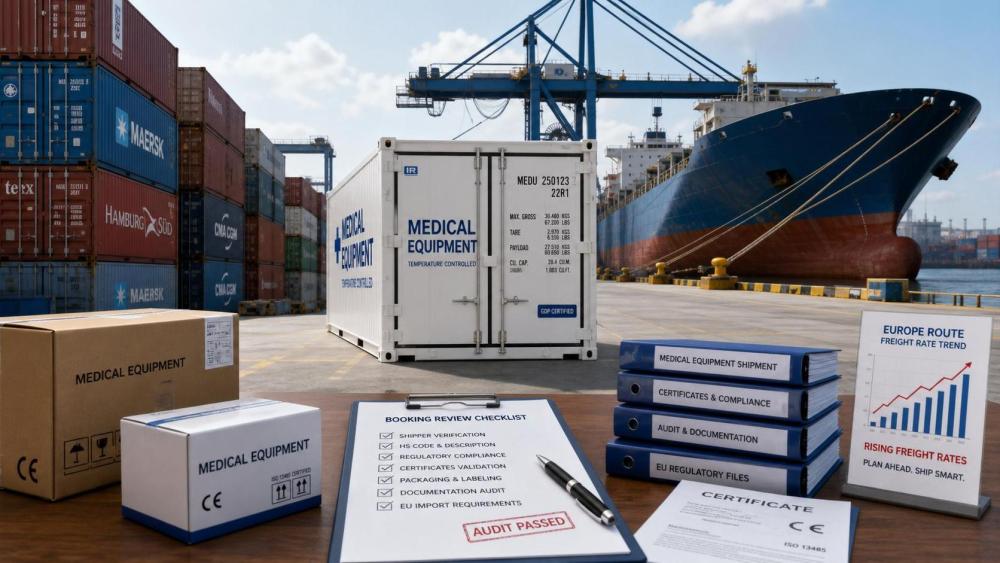
What Has Changed on the Route and in Booking Access
According to joint data cited from Alphaliner and the Shanghai Shipping Exchange, in the week of June 26, 2026, the spot rate for a 40HQ container on the Far East-Northwest Europe trunk route (FE2) reached $12,850. That level was 180% higher than in the first week of June.
At the same time, carriers including Maersk and MSC announced that, effective July 1, medical equipment cargo would be subject to slot-priority review. Exporters are required to submit a packing list, CE/FDA certificates, and proof of final destination 14 days in advance. If those materials are not provided within that timeframe, slot protection will not be guaranteed.
Where the Pressure Is Likely to Show First
Documentation-heavy exporters face a narrower booking window
From an industry perspective, exporters of medical equipment are likely to feel the change first because the new booking condition is tied directly to document completeness and lead time. The impact is not limited to freight cost; it also reaches the booking stage itself. What deserves closer attention is whether internal export teams can assemble packing details, certification materials, and destination evidence early enough to meet the 14-day requirement.
Manufacturers may see shipment planning move upstream
For manufacturers, the practical issue is that shipping readiness may now depend more visibly on compliance readiness. If product files, shipment data, or destination-related records are finalized late, production completion alone may no longer be enough to secure expected vessel space. The affected links are likely to include final packing confirmation, release timing, and coordination between factory, trade, and logistics teams.
Procurement and distribution teams may need to revisit delivery assumptions
Buyers, distributors, and channel operators linked to Europe-bound medical cargo may need to watch two variables at once: elevated freight rates and tighter access to protected slots. Analysis shows this can affect purchase timing, replenishment assumptions, and delivery commitments, especially where contracts or customer schedules rely on firm dispatch dates rather than flexible shipping windows.
Logistics providers and compliance support firms enter a more document-driven cycle
Supply chain service providers, including freight forwarders and compliance-related support teams, are likely to face more front-loaded verification work. The operational focus may shift toward earlier collection and review of packing lists, certificate validity, and destination proof before booking requests are submitted. The key issue is less about transport execution alone and more about whether cargo files are complete enough to pass carrier review in time.
What Companies Should Track Now
Check whether certification files are shipment-ready, not just product-ready
Analysis shows companies should distinguish between holding CE or FDA-related documentation in principle and being able to present the required documents in a booking-ready format within the carrier timeline. The current signal is practical: document possession and document submission timing now appear more closely linked to slot access.
Rework booking calendars around the 14-day filing requirement
What deserves closer attention is the shift in operational sequencing. Export teams may need to move internal deadlines forward for packing confirmation, document review, and destination proof collection. Where shipment plans were previously finalized closer to departure, that timing may now create avoidable exposure to loss of slot protection.
Watch how carriers apply review standards in practice
The announced requirement is clear on advance submission and on the consequence of losing guaranteed slot protection, but the available information does not set out broader execution details. Companies should therefore follow later carrier notices, booking instructions, and operational clarifications to understand how the review standard is being applied in practice.
Reassess delivery risk alongside freight cost risk
Observably, the headline freight increase and the tighter medical cargo review process should be assessed together rather than separately. For export businesses, the near-term issue is not only whether freight has become more expensive, but also whether shipping certainty now depends more heavily on documentary discipline, product classification handling, and earlier coordination across the order cycle.
Why This Looks Like an Execution Signal
From an industry perspective, this development is more than a rate spike. It also points to a change in how shipping access for a specific product category is being screened. It is more appropriate to understand this as an execution signal that carriers are adding a stricter operational filter for medical equipment cargo, while the full market effect still requires observation. The rate data shows immediate pressure; the booking rule shows where that pressure is being translated into carrier-side control.
Observably, the most important question is not whether the market has become volatile, but how quickly documentation, certification, and destination verification begin to influence day-to-day booking outcomes. That is why industry participants should continue watching actual implementation, not just the announcement itself.
How This Update Is Best Understood for Now
The June 26 development should be read as a combined freight and compliance-related logistics signal for medical equipment shipments on the Asia-Europe route. The confirmed facts indicate both a sharp rise in FE2 spot rates and a new carrier review requirement tied to slot protection from July 1. Analysis shows the immediate relevance lies in booking discipline, document preparedness, and delivery planning rather than in any settled conclusion about longer-term market structure. At this stage, it is more appropriate to treat the update as an already active execution change with further implementation details still worth monitoring.
Basis of This Article and What Still Needs Verification
This article is generated based on the user-provided news title, event date, and event summary. The confirmed factual basis used here is limited to the provided information on June 26, 2026 rate levels on the FE2 route and the announced July 1 slot-priority review requirements for medical equipment cargo.
For events of this type, relevant source categories typically include carrier announcements, regulator releases, customs or trade authority information, industry association updates, standards or certification documentation, and reporting by authoritative trade media. No specific official source link was provided in the input, so later verification is still needed.
Further observation should focus on subsequent rule wording, carrier execution standards, documentation review practice, booking acceptance criteria, procurement and tender document adjustments, and feedback from companies implementing these requirements in actual shipments.