
A laboratory may begin to question its manual preparation process when small errors start appearing in ways that are difficult to trace: an unexpected result after repeated pipetting, a sample loaded into the wrong tube position, inconsistent dilution between shifts, or a delayed batch because staff must repeat labeling and aliquoting steps. These events do not always indicate poor staff performance. They often arise when a workflow depends on many repetitive manual actions while sample volume, turnaround pressure, or method complexity has increased.
Automated sample preparation systems reduce handling errors when the preparation workflow contains repeatable, rule-based steps that can be controlled, recorded, and verified by the instrument. They are most valuable where manual pipetting, sample transfer, barcode identification, mixing, dilution, reagent addition, or plate setup creates opportunities for variation. Automation does not remove every laboratory risk; it shifts the focus from individual handling consistency to workflow design, method validation, maintenance, and exception management.
Situations where manual preparation becomes a measurable risk
Manual preparation can work well for low-volume testing, variable research protocols, or procedures requiring frequent judgment by an experienced operator. The risk profile changes when technicians repeat the same preparation sequence across many samples. Each transfer may be simple on its own, but the total number of touches, labels, tubes, and timing decisions can create a fragile process.
High-throughput molecular testing is one example. Samples may require accessioning, aliquoting, lysis, extraction, purification, elution, and transfer to a downstream assay plate. A missed mix step, an incorrect aspiration depth, or carryover from an improperly managed transfer can affect the quality of the prepared material. Similar pressure appears in clinical chemistry, immunoassay pre-treatment, microbiology workflows, biobanking, and research laboratories preparing repeated batches for analysis.
Automation becomes particularly relevant when a laboratory sees one or more of the following conditions:
- Multiple technicians prepare the same assay using slightly different habits or timing.
- Sample volumes are too small for reliable routine manual pipetting without frequent rework.
- Preparation requires serial dilutions, multi-step reagent additions, or repeated transfers between vessels.
- Specimen identity must remain linked to every aliquot, extraction plate, and downstream test result.
- Batch sizes have grown, but staffing and bench space have not changed at the same pace.
- Contamination control depends heavily on careful separation of clean and processed material.
- Errors are detected only after analysis, when the original preparation step is difficult to reconstruct.
The important distinction is between occasional inconvenience and a repeatable source of operational risk. A single delayed run may be resolved by scheduling changes. A pattern of preparation discrepancies, unlabeled secondary tubes, inconsistent recovery, or unexplained repeats usually requires a closer look at the process itself.
Error reduction comes from controlled steps, not from automation alone
An automated system can improve consistency because it executes a defined protocol in the same sequence each time. It can use programmed liquid volumes, fixed mixing cycles, controlled incubation timing, and assigned deck locations. When the workflow is appropriate, these controls reduce the number of decisions that must be made manually during a busy run.
However, the benefit depends on the quality of the underlying method. A poorly designed manual protocol does not become reliable simply because it is transferred to an instrument. Incorrect sample volume assumptions, unsuitable consumables, inadequate mixing, or unclear specimen acceptance criteria can be reproduced very consistently by automation. Before selecting a platform, laboratories should identify which errors stem from manual variability and which stem from method limitations, upstream collection issues, or downstream analyzer performance.
Where the reduction in handling errors is usually strongest
Repetitive pipetting and aliquoting
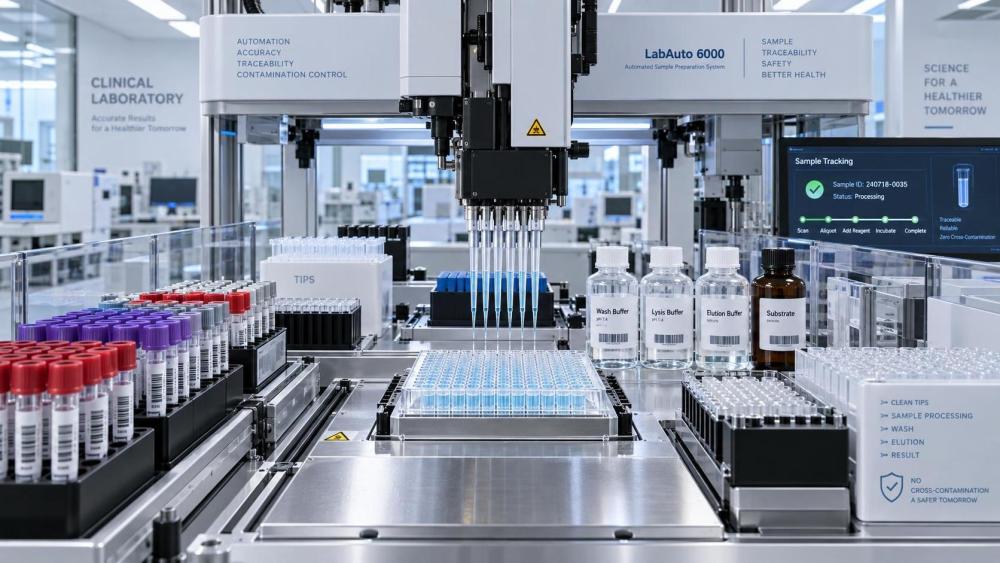
Repeated pipetting is often the clearest candidate for automation. Fatigue, interrupted concentration, pipette handling technique, and minor timing differences can influence manual work, especially when many samples require identical transfers. An automated liquid handler can carry out a programmed sequence without losing its place in the batch.
This is especially useful when aliquots must be created for several downstream instruments or retained samples. Instead of relying on a technician to manually track multiple secondary tubes, the system can associate a source location with assigned destination positions. Error reduction is meaningful only if the laboratory has clear rules for tube orientation, barcode readability, dead volume, clot detection where applicable, and failed barcode handling.
Multi-step extraction and purification workflows
Nucleic acid extraction and other purification processes often involve several sequential operations: adding lysis reagent, mixing, binding, washing, magnetic separation or centrifugation-related handling, drying, and elution. Small deviations may affect yield, purity, or consistency. Automated sample preparation systems are well suited to methods where these steps are stable and regularly repeated.
The laboratory should still evaluate how the platform manages viscous specimens, variable sample matrices, foaming reagents, magnetic beads, and evaporation-sensitive volumes. A protocol that performs well with standardized control material may need additional assessment with the specimen types actually received. Automation can reduce variation in execution, but it cannot eliminate variation intrinsic to the sample.
Plate-based assay setup
Preparing microplates by hand creates several opportunities for error: wells can be skipped, specimens can be placed in the wrong sequence, reagent distribution may differ across the plate, and manual records may not fully reflect the final layout. A system that reads source identifiers, applies a digital plate map, and records transfers can reduce these risks.
This is not only a speed benefit. In a repeat investigation, the ability to confirm where a sample was placed, which protocol was used, and whether an instrument alert occurred can be more valuable than the original time saved. Traceability is strongest when the sample preparation platform exchanges information reliably with the laboratory information system or middleware rather than relying on duplicate manual entry.
Signals that a laboratory may be automating the wrong problem
Automation should not be treated as the default response to every preparation issue. Some problems are better addressed by revising work instructions, improving specimen collection, reducing unnecessary handoffs, or training staff on a narrow technical weakness. Purchasing a system before identifying the failure point can create an expensive workflow that still produces avoidable exceptions.
For example, a high rate of rejected samples due to inadequate collection or transport will not be solved by automating extraction. Persistent reagent stock-outs cannot be corrected by a liquid handler. A method with frequent protocol changes may be poorly suited to a highly fixed system unless the platform supports practical method editing and the laboratory has adequate validation capacity.
Watch for these warning signs during assessment:
- The reported “handling errors” are not categorized, so no one knows whether they involve identity, volume, contamination, timing, or documentation.
- Sample arrival patterns are uneven, and the proposed batch workflow would delay urgent work rather than improve it.
- The existing assay has unresolved precision or recovery issues unrelated to preparation.
- Staff expect the instrument to make decisions about unsuitable, leaking, improperly labeled, or insufficient specimens.
- The laboratory has not defined what happens when a barcode cannot be read, a tip is missing, a deck position is empty, or a run stops mid-process.
These conditions do not rule out automation. They show that implementation planning must include exception pathways, not just the normal run. Manual intervention during exceptions is often where a well-controlled automated process can lose traceability unless the procedure is explicit.
Evaluate the workflow before evaluating the instrument
A useful assessment starts at the sample receipt point and follows the specimen through to analyzer loading or storage. Map every manual touch, every identifier change, every waiting period, and every point where the technician must remember a value or make a choice. The aim is not to document every motion in excessive detail; it is to identify which steps are error-prone, repetitive, and suitable for standardization.
- Define the error types. Separate misidentification, transcription error, incorrect volume, omitted reagent, carryover, timing variation, and sample loss. Each has different controls.
- Describe actual workflow variation. Include urgent samples, partial batches, repeat tests, unsuitable specimens, and runs that end outside normal staffing hours. A process map based only on the ideal batch will be incomplete.
- Set acceptance criteria for the automated output. Decide how prepared samples, extracts, dilutions, or assay plates will be checked before downstream testing. Include controls, expected volumes where measurable, and status review.
- Review interfaces and data ownership. Confirm how worklists enter the system, how sample status is updated, where run records are retained, and how identifiers are reconciled after an interruption.
- Plan verification under routine conditions. Evaluate the method with representative sample types, normal and difficult workload patterns, and authorized operators. Include recovery after common interruptions, not just uninterrupted runs.
This approach also helps distinguish platforms that merely automate transfers from those that can support the laboratory’s required traceability and workflow controls. The best fit is not necessarily the system with the largest deck or highest stated throughput. A smaller platform may reduce more real-world errors if it matches batch size, sample containers, assay timing, and staff responsibilities.
Integration determines whether traceability improves or fragments
Sample preparation is rarely an isolated process. It connects accessioning, sample storage, reagent management, analyzers, quality controls, and reporting. A standalone system may still be appropriate, but the laboratory must understand where manual transcription remains. Every manual re-entry of a sample identifier, plate map, dilution factor, or completion status creates another opportunity for mismatch.
During technical review, examine barcode formats, supported tube and plate types, barcode placement requirements, worklist import methods, audit trail content, user permissions, and behavior after communication loss. Ask whether the system records not only that a run occurred, but also the method version, sample positions, consumable status, error messages, and operator actions. These records are useful only when they can be retrieved and interpreted during a deviation review.
Integration should also be tested from both directions. It is not enough for the preparation system to receive a worklist. The downstream workflow must correctly recognize the prepared sample or plate, and the laboratory must have a clear process for samples that were queued but not completed.
Contamination control requires method-specific design
Automated handling can reduce contamination risk by limiting unnecessary open-tube manipulation and using controlled tip changes, deck positions, and transfer paths. Yet contamination control is not automatic. The system’s physical design, airflow environment, liquid handling behavior, cleaning access, and separation of pre- and post-amplification work all matter, particularly in sensitive molecular workflows.
Assess whether reusable components contact sample or reagent, whether aerosol-generating actions are minimized, how spills are detected and cleaned, and whether the deck layout prevents confused placement of high-positive material near low-level samples or controls. Procedures should define which parts are cleaned between runs, which consumables are single use, and how a suspected carryover event is investigated.
For laboratories handling a mixture of specimen types, the question is also whether one protocol and deck arrangement can safely accommodate them. A workflow optimized for clean, uniform tubes may not be suitable for specimens with variable viscosity, particulate material, or inconsistent fill volume.
Operational conditions that protect the error-reduction benefit
Once installed, an automated process needs routine control. Operators must understand the normal workflow, but they also need confidence in stopping a run, documenting an exception, and recovering samples without creating ambiguity. Training should cover loading discipline, consumable checks, barcode failures, reagent preparation, instrument prompts, cleaning, and escalation routes.
Maintenance has a direct connection to handling accuracy. Pipetting performance, probe condition, seals, grippers, sensors, and barcode readers can degrade or become obstructed. A maintenance plan should identify daily user checks, scheduled service tasks, performance verification, and the records needed to show that the platform remained suitable for its intended method. Ignoring these controls can turn an automated process into a source of repeated, less visible error.
Automation is most effective when it is introduced as a controlled redesign of a defined workflow. When the laboratory can identify repeatable manual steps, establish reliable specimen identification, validate the protocol with realistic materials, and manage exceptions clearly, the system can reduce handling variation while making investigations more traceable. Where the process is highly variable or the root cause lies outside preparation, targeted workflow correction should come before, or alongside, automation.