
Understanding sample preparation systems pricing is rarely as simple as comparing two equipment quotations. In a high-throughput laboratory, the purchase decision affects far more than capital expenditure: it shapes turnaround time, technician workload, contamination control, assay consistency, reagent consumption, and the laboratory’s ability to absorb future testing demand.
For procurement teams, the pressure often arrives in a familiar form. The laboratory wants more automation because manual preparation has become a bottleneck. Finance asks why one platform costs materially more than another. Clinical engineering needs to know what will be required for installation and support. Meanwhile, laboratory managers worry that an attractively priced system may create expensive dependency on proprietary consumables or leave too little flexibility for changing assay menus.
A useful evaluation therefore begins with a different question: not “What does the instrument cost?” but “What will this workflow cost to operate reliably at our expected volume?”
Why quoted prices can differ so widely
Sample preparation systems range from compact benchtop instruments for low- to moderate-volume molecular workflows to integrated automation lines handling extraction, aliquoting, barcode tracking, plate setup, and transfer into downstream analyzers. A price gap between systems may reflect meaningful differences in capability rather than supplier margin alone.
The main drivers of sample preparation systems pricing usually include automation depth, throughput, supported sample types, assay compatibility, software functionality, liquid-handling precision, contamination safeguards, and service scope. A system intended to prepare a limited range of specimens in batches will have very different engineering requirements from a platform designed for continuous operation in a central laboratory.
Buyers should also distinguish between a system’s list configuration and its usable configuration. A quotation may describe a base instrument, while a fully operational workflow requires additional modules, extraction kits, barcode readers, plate carriers, computer hardware, middleware interfaces, safety accessories, or initial validation support. Comparing base prices without mapping those additions can produce an unrealistic budget.
Automation level is often the largest cost variable
The level of automation has a direct effect on both purchase price and long-term labor economics. Manual or semi-automated systems may be appropriate when testing volumes are stable, batches are small, and experienced technologists are available. They generally require lower initial investment, but they may preserve repetitive pipetting steps, handwritten checks, and greater dependence on operator consistency.
Fully automated sample preparation systems cost more because they combine mechanics, fluidics, robotics, sensors, software, and workflow controls. Yet their value can be substantial when a laboratory faces large daily volumes, staffing shortages, variable specimen arrival times, or demanding turnaround targets.
- Manual-support systems may automate only selected actions, such as nucleic acid extraction or reagent dispensing.
- Batch automation typically processes a defined number of tubes or plates per run, making it suitable for scheduled molecular testing workflows.
- Walkaway automation allows staff to load samples and consumables, then redirect attention to verification, exception handling, or other laboratory duties.
- Integrated automation may connect pre-analytical preparation with analyzers, conveyors, laboratory information systems, or automated storage solutions.
Higher automation does not automatically mean a better procurement decision. A highly capable system can become an underused asset if actual sample volumes do not justify its capacity, if the laboratory lacks adequate space, or if its workflow is too rigid for the test mix. Conversely, buying a low-cost unit that requires constant staff intervention can become frustrating and costly in a busy laboratory.
Throughput should be evaluated as usable output, not brochure capacity
Manufacturers may state throughput in samples per run, samples per hour, or samples per day. These figures are useful, but they are not interchangeable. Procurement teams should ask how the stated capacity was calculated and whether it reflects the laboratory’s specimen types, extraction protocol, batch size, and required quality-control steps.
A platform capable of processing many samples in a large batch may not be ideal for urgent or unpredictable workloads. In contrast, a system with lower maximum batch capacity may provide better operational value if it supports frequent smaller runs, short setup time, and rapid loading of priority samples.
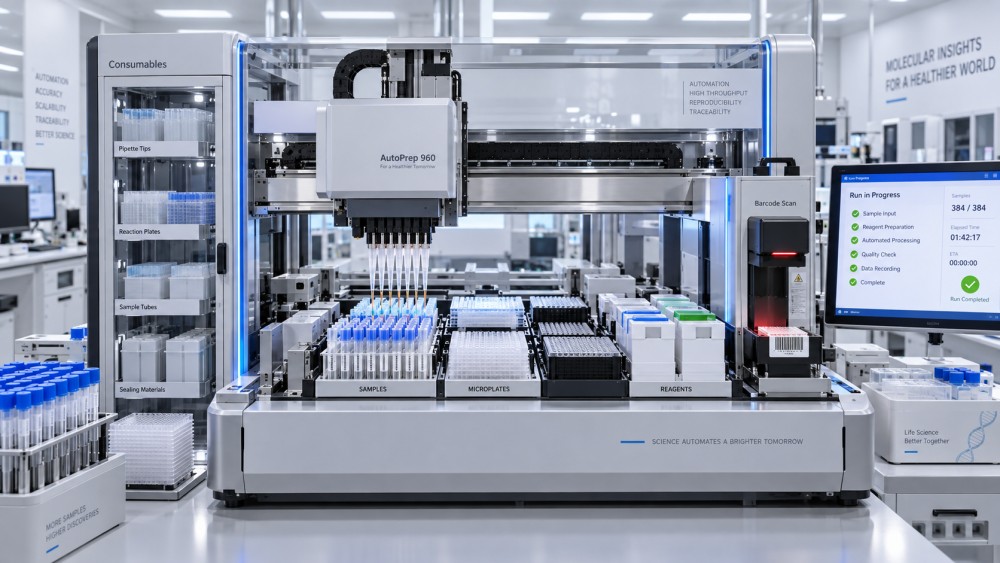
When assessing high-throughput laboratory automation, request a workflow map that shows the complete cycle: accessioning, sample loading, barcode reading, reagent loading, preparation, extraction or aliquoting, downstream transfer, result traceability, cleaning, and end-of-day maintenance. The meaningful metric is the number of valid, traceable samples delivered to the next stage—not simply the number of positions on a deck.
The recurring cost model matters as much as the instrument quote
The initial equipment price is visible and easy to negotiate. The recurring cost model is less visible, yet it can dominate total cost of ownership over the life of the system. For sample preparation systems, routine operating expenses may include consumable tips, tubes, plates, cartridges, extraction reagents, seals, filters, cleaning solutions, calibrators, quality-control materials, and waste-management supplies.
Some platforms are designed around closed consumable ecosystems. This can simplify validation and strengthen process consistency, particularly in regulated molecular diagnostics environments. However, it may also limit purchasing flexibility. Procurement professionals should understand whether third-party consumables are permitted, what validation implications they create, and whether supply continuity is realistic in their region.
A practical comparison is to calculate an indicative cost per prepared sample under more than one volume scenario. Consider normal workload, peak workload, and a lower-volume period. This prevents a system from appearing economical only under ideal utilization conditions.
Software, traceability, and integration are not optional details
In high-throughput settings, software is part of the laboratory workflow rather than a peripheral feature. A lower-priced system that creates manual transcription, separate worklists, or incomplete sample tracking may introduce hidden labor and quality risks. The purchasing team should examine how the platform handles barcode identification, user access, audit trails, error messages, run documentation, sample routing, and export of process data.
Integration with a laboratory information system (LIS), middleware platform, or downstream analyzer can add cost, particularly when custom interfaces or third-party involvement are needed. Still, a properly designed connection can reduce transcription errors and avoid the need for staff to reconcile multiple records across systems.
Ask suppliers to clarify what is included: interface licenses, implementation services, testing, cybersecurity requirements, remote connectivity, software updates, and responsibility for troubleshooting when multiple vendors are involved. A vague “LIS-ready” statement should not be treated as proof of seamless integration.
Installation conditions can change the real project budget
Not every sample preparation platform can simply be delivered to a bench and switched on. High-throughput systems may require dedicated electrical circuits, uninterrupted power supply arrangements, network ports, ventilation considerations, purified water, waste connections, environmental controls, or biosafety measures. Automated liquid-handling systems also need stable benches and sufficient clearance for loading, service access, and consumable storage.
Before issuing a purchase order, involve laboratory operations, facilities, IT, infection control where relevant, and clinical engineering. A site-readiness review is especially important for laboratories installing automation into already crowded spaces. The cost of bench reconstruction, electrical upgrades, data cabling, environmental monitoring, or workflow redesign can materially affect the project total.
Installation planning should also cover staff training and method verification. Even where the instrument itself is straightforward, the laboratory must establish acceptance criteria, train operators, document procedures, and confirm performance within its own workflow. These activities are necessary investments, not administrative extras.
Service coverage is a pricing issue because downtime has a cost
Service contracts are sometimes treated as a negotiable afterthought. For high-throughput laboratories, they should be evaluated alongside the instrument. A system that stops during peak demand can cause delayed results, manual fallback work, rerouting of samples, and pressure on staff who are already operating at capacity.
Review warranty duration, preventive maintenance frequency, included labor, replacement-part coverage, remote diagnostics, local engineer availability, and target response times. If the supplier operates through a distributor, confirm who owns the support obligation and whether technicians have formal training on the proposed model.
It is also worth asking about expected maintenance tasks that remain with the laboratory. Daily cleaning, weekly inspections, consumable path checks, decontamination cycles, and calibration procedures all consume time. A system may have an attractive service package while still requiring substantial routine attention from laboratory personnel.
Do not compare platforms without defining the intended workflow
Many procurement exercises become difficult because the laboratory’s requirements are expressed too broadly: “high throughput,” “automation,” or “molecular sample preparation.” Those descriptions do not provide enough information for a fair comparison.
Before requesting final quotations, prepare a concise requirement profile. It should identify expected sample volumes, peak-day demand, sample matrices, priority testing needs, target turnaround times, assay menu, biosafety conditions, acceptable batch sizes, preferred tube and plate formats, traceability requirements, available footprint, and downstream instruments. Include growth expectations, but avoid purchasing capacity based only on an uncertain future forecast.
This profile allows suppliers to configure systems against the same operational need. It also gives procurement teams a defensible basis for evaluating whether a premium-priced option solves a real problem or merely offers features that will not be used.
A disciplined way to compare sample preparation systems pricing
Instead of ranking vendors solely by equipment cost, use a weighted review that separates commercial and operational considerations. Capital price remains important, especially where budgets are constrained, but it should sit beside workflow fit, cost per sample, service resilience, integration readiness, consumable supply security, and implementation requirements.
During supplier discussions, request a transparent quotation with line items rather than a single bundled figure. Ask for a recommended configuration and a minimum viable configuration. The difference between the two often reveals which features are essential for the proposed workflow and which are optional enhancements.
Procurement teams should also request clarity on commercial assumptions: quote validity, delivery lead time, installation responsibility, training scope, warranty commencement date, annual service pricing after warranty, software upgrade policy, and conditions that may trigger additional charges. These details may feel routine, but they are where avoidable surprises tend to emerge.
The best value is the system that fits the laboratory’s operating reality
There is no universal benchmark for “good” sample preparation systems pricing. A compact platform with modest capacity may be the prudent choice for a specialized laboratory with predictable batches. A larger automated line may be justified where volumes are high, staffing is stretched, traceability expectations are strict, and delays create operational consequences across the diagnostic pathway.
The strongest procurement decision connects the system to a clear operational case. It accounts for what happens before preparation, during each run, after samples move downstream, and when the instrument needs support. It also recognizes that a low purchase price can be expensive if it creates manual work, supply risk, inconsistent preparation, or persistent downtime.
For buyers evaluating laboratory automation, the goal is not simply to obtain the lowest quote. It is to select a sample preparation solution whose capacity, consumable model, service support, software connectivity, and implementation needs can be sustained over time. That is the basis for reliable results, manageable operating costs, and a workflow that laboratory staff can trust on the busiest days.
- Last One:No more articles
- Next Article:When should medical device companies start planning market access?Sep 29, 2026