
On August 1, 2026, a new compliance threshold took effect for in vitro diagnostic products entering the U.S. market after the FDA issued its strengthened IVD import guidance on July 19, 2026 (Ref: FDA-CDRH-2026-07). The update puts electronic registration, machine-readable UDI-DI+PI labeling, and real-time batch-level traceability at the center of import readiness for reagents, including test kits, calibrators, and quality controls. For exporters, distributors, and system service providers, this is worth close attention because the change reaches beyond paperwork into labeling, data linkage, and inventory handling.
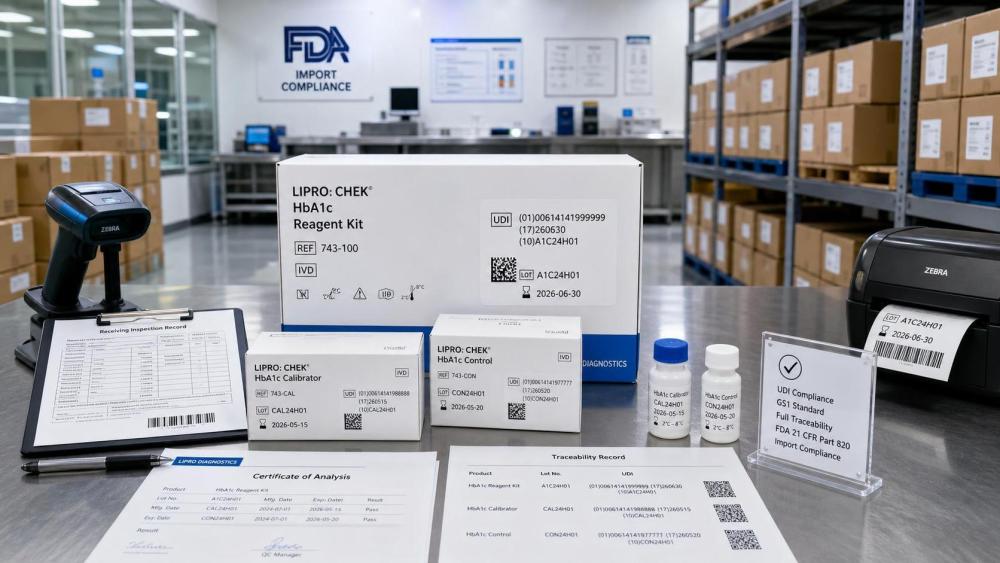
What the FDA guidance now requires
According to the information provided, the FDA released the IVD Import Compliance Reinforcement Guidance on July 19, 2026. The guidance states that from August 1, 2026, all in vitro diagnostic reagents entering the U.S. market must complete electronic registration through the FDA Unified Registration and Listing System (URLS).
The requirement applies to IVD reagents including reagent kits, calibrators, and quality control products. It also requires each batch of product to carry a machine-readable UDI-DI+PI combination in both product labeling and accompanying documentation.
In addition, each batch must include a real-time verifiable traceability link at the batch level. Based on the provided information, the requirement directly affects customs document preparation, label redesign, LIS connectivity, and distributor inventory management for Chinese IVD exporters.
Where the operational pressure is likely to appear
Export documentation moves from formal compliance to data consistency
From an industry perspective, direct trading companies are likely to be affected first because the guidance ties import access to electronic registration and traceable batch-level information. The immediate pressure point is not only whether documents exist, but whether registration, labels, and accompanying files present matching identifiers and traceability elements.
What deserves closer attention is the coordination between customs paperwork and product-specific batch information. Any mismatch between registration status, labeling content, and batch documentation could become an operational issue in shipment preparation.
Manufacturing and packaging teams face label redesign demands
For manufacturing and packaging functions, the impact is likely to center on how batch information is encoded and presented. The guidance requires a machine-readable UDI-DI+PI combination on labels and in accompanying documents, which means label design and document templates may need to be aligned more tightly than before.
Analysis shows that this is not only a regulatory wording issue. It also reaches packaging execution, batch release workflows, and the handoff between regulatory, production, and labeling teams.
System providers and laboratories may need cleaner data interfaces
The reference to LIS connectivity in the provided information suggests that service providers and downstream operational users may also be affected where product identification and batch traceability need to be recognized or verified in real time. In practical terms, the issue is whether systems can receive, display, and match the required identifiers and links without manual workarounds.
Observably, the business impact here is less about a single software change and more about whether identification data can move reliably across documents, labels, and operating systems.
Distributors will need tighter inventory visibility by batch
Channel and distribution participants are likely to feel the impact in stock management and product movement control. Because the guidance points to real-time verifiable batch-level traceability, distributors may need to pay closer attention to batch-based receiving, storage, and outbound processes.
The main concern is not simply holding inventory, but being able to connect inventory units to the required identification and traceability information in a way that supports U.S. market entry and downstream handling.
What companies should focus on now
Check whether registration status and shipment readiness are fully aligned
Companies shipping IVD reagents to the United States should closely review whether FDA URLS electronic registration status is fully consistent with the products and batches being prepared for export. The practical point is to avoid treating registration as a standalone filing step when the new requirement links it directly to import readiness.
Review label and document templates as one control set
What deserves closer attention is whether product labels and accompanying documents are being managed under the same identifier logic. Because the requirement explicitly covers both the label and the attached documentation, separate template control by different departments may create execution risk.
Assess whether traceability links are verifiable in real time
Analysis shows that the phrase "real-time verifiable" is operationally significant. Companies should therefore focus on whether the batch-level traceability link embedded in the product package flow can actually be accessed and checked when needed, rather than assuming that static reference information is enough.
Coordinate early with distributors and system partners
The provided information specifically points to distributor inventory management and LIS connectivity. That makes external coordination a near-term priority. Exporters, distributors, and technical service providers should pay attention to whether their current receiving, stocking, and data-matching processes can support the new identification and traceability requirements without delaying fulfillment.
Why this matters beyond a single filing update
Observably, this development is better understood as more than a short-lived documentation adjustment. The confirmed facts show that the FDA is connecting market entry for IVD reagents with electronic registration, machine-readable product identification, and batch-level traceability in a single compliance expectation.
Analysis shows that the most important signal is the shift from static compliance records toward verifiable operational data. That does not by itself establish how every enforcement scenario will unfold, but it does indicate that companies can no longer separate regulatory filing, packaging, and downstream data handling as loosely connected tasks.
It is more appropriate to understand this as an already effective compliance change with longer-term implications for process design, while still recognizing that some practical interpretation issues may need continued observation.
How the industry may need to read this update
At this stage, the update should be read as a concrete rule change with direct operational consequences rather than a distant policy signal. The confirmed requirements are already specific: electronic URLS registration, machine-readable UDI-DI+PI, and real-time batch traceability for IVD products entering the U.S. market from August 1, 2026.
A neutral reading is that the development raises the compliance threshold for execution quality across trade documents, labels, systems, and inventory processes. It does not by itself define every downstream outcome, but it clearly narrows the margin for fragmented compliance handling.
Basis of this article and points for continued verification
This article is based on the user-provided news title, event date, and event summary regarding the FDA update on IVD reagent import compliance and the August 1, 2026 start of mandatory electronic UDI and real-time batch traceability requirements.
For this type of industry development, commonly relevant source categories include official regulatory notices, company disclosures, industry association updates, authoritative media coverage, and standard-setting documents. The specific official source link was not provided in the input, so continued verification against the original FDA communication remains necessary.
Areas that still merit ongoing attention include any subsequent official wording, implementation clarifications, and how the stated requirements are reflected in actual documentation, labeling, system integration, and distribution workflows.