
On August 7, 2026, the European Commission formally issued Regulation (EU) 2026/1345, revising the IVD classification framework and shortening the transition deadline. For companies involved in IVD exports to the EU, especially Chinese manufacturers, importers, and authorized representatives, this is not just a regulatory update but an immediate operational issue because it affects product classification, registration routes, document depth, certificate validity review, and supply chain compliance checks.
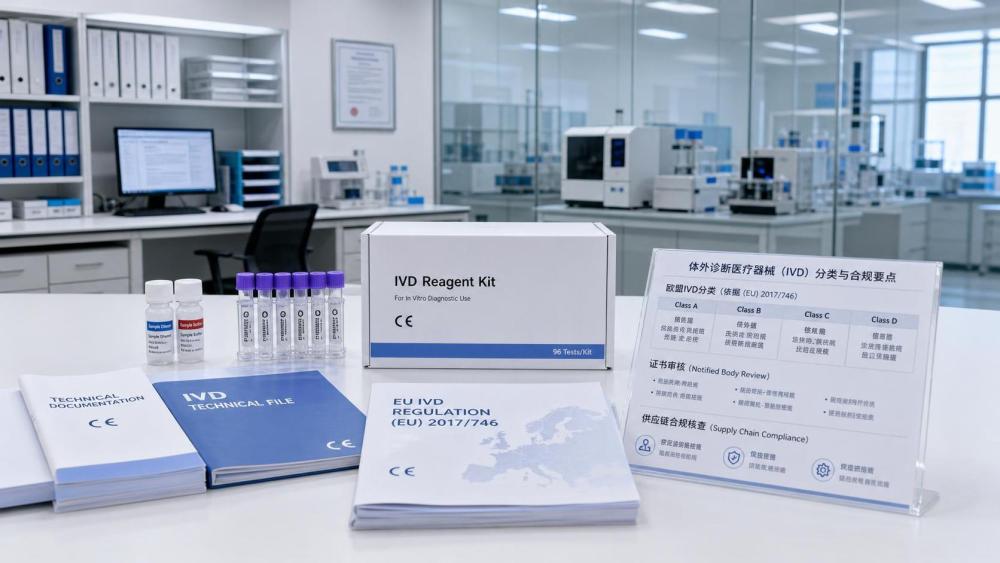
What the new regulation changes
According to the information provided, Regulation (EU) 2026/1345 was officially issued by the European Commission on August 7, 2026. The regulation makes a major revision to the IVD classification framework.
Approximately 35% of low- to mid-risk reagents, including routine biochemistry, urinalysis, and some POCT products, are moved from Class A to Class B.
The transition deadline, which had originally been set for May 26, 2027, is brought forward to December 1, 2026.
The update directly affects the registration pathway for Chinese IVD exporters, the required depth of technical documentation, and the scope of responsibility for EU authorized representatives. Importers are also required to immediately review the validity of existing CE certificates and the compliance status of their supply chains.
Where the pressure will show up first
Export registration routes are likely to change fastest
From an industry perspective, manufacturers exporting IVD products to the EU may be affected first where product classification determines the compliance path. A shift from Class A to Class B can mean that products previously managed under a lower-risk route now need closer regulatory handling, and the immediate point of attention is whether existing registration assumptions still hold.
Technical files will face closer scrutiny
Analysis shows that the stated increase in technical documentation depth is a practical issue for manufacturers and regulatory teams. The impact is likely to appear in dossier preparation, internal document review, and communication with external compliance partners. Products that were previously treated as lower-risk items may now require a more robust documentation approach under the revised framework.
EU authorized representatives may need to reassess responsibilities
What deserves closer attention is the explicit reference to the responsibility scope of EU authorized representatives. This suggests that representation arrangements are not only administrative but may need review in line with the revised classification and shortened transition timing.
Importers face immediate certificate and supply chain checks
For importers and distribution-side operators, the most direct impact is the need to verify whether current CE certificates remain valid under the new timeline and whether upstream compliance status remains aligned with market access requirements. In practice, this can affect product intake, shipment planning, and continuity of supply.
What companies should watch now
Recheck affected product portfolios without delay
Companies should first identify whether their routine biochemistry, urinalysis, or certain POCT products fall within the group moved from Class A to Class B. The core issue is not only classification itself, but whether internal timelines, customer commitments, and compliance planning were built around the previous deadline.
Separate legal text from operational readiness
Observably, the regulation is already a confirmed event, but business execution depends on how each affected product and document package lines up with the revised requirements. Companies should distinguish between the rule change as a legal fact and their own current readiness to meet it in registrations, filings, and market deliveries.
Review document depth and external coordination
Since the provided information specifically points to deeper technical documentation requirements, regulatory, quality, and market-access teams should check whether current files are sufficient for the adjusted classification route. Coordination with EU authorized representatives, importers, and downstream partners should also be reviewed against the shortened transition period.
Prepare for customer and supply chain communication
The shortened deadline raises an immediate communication issue across the supply chain. Importers, distributors, and exporters may need to confirm certificate status, product scope, and delivery expectations with one another to reduce disruption tied to compliance timing.
Why this matters beyond a simple date change
Analysis shows that this development should not be read only as a calendar adjustment. The combination of classification upgrades and a shorter transition period points to a more immediate compliance burden for affected IVD products. It is more appropriate to understand this as both a short-term operational change and a regulatory signal that lower-risk assumptions around some product groups may no longer be stable.
At the same time, this remains an area that still requires close observation in practical implementation. The confirmed facts establish the rule change and the deadline shift, but the full business effect will depend on how companies map product portfolios, document requirements, and partner responsibilities against the new framework.
How the market should read this update
For the IVD sector, the main significance of Regulation (EU) 2026/1345 is that compliance timing and classification status are now more closely linked for a meaningful share of products that had been treated as lower risk. The immediate takeaway is not to assume continuity under earlier timelines or earlier classification logic.
From an industry perspective, this is best understood as a confirmed regulatory change with near-term execution consequences, while its broader commercial impact still needs to be tracked through company-level responses, certificate reviews, and supply chain adjustments.
Basis of this article and follow-up verification
This article is based on the user-provided news title, event date, and event summary concerning Regulation (EU) 2026/1345 and the revision of the EU IVD classification framework.
For developments of this kind, source types typically relevant to ongoing verification include official announcements, company disclosures, industry association updates, authoritative media coverage, and standard or regulatory documents. A specific official source link was not provided in the input, so continued verification remains necessary.
Further attention should focus on any subsequent official clarifications, product-scope interpretation, and practical compliance implications for registration pathways, CE certificate review, authorized representative responsibilities, and supply chain status checks.