
How to evaluate medical device documentation services
Evaluate medical device documentation services by testing whether a provider can turn device-specific evidence into accurate, traceable, maintainable records for the intended market. A polished technical file is not enough: the stronger service can explain its regulatory assumptions, expose evidence gaps, link claims to supporting data, and control changes across the device lifecycle.
The right choice depends on the device’s risk profile, target jurisdictions, maturity of the underlying evidence, and the manufacturer’s internal capabilities. Compare providers against a defined sample of work and a documented scope, rather than treating submission experience or a promise of fast approval as proof of competence.
Define the documentation problem before comparing services
Documentation work can range from formatting existing records to building a regulatory evidence strategy. These are materially different assignments. A provider cannot resolve missing validation, clinical evidence, or manufacturing controls simply by writing a more complete document.
Prepare a short project brief covering the intended use, indications, users, operating environment, device variants, software and accessories, target markets, and current development stage. Include known changes since the last release and identify which source records are controlled, incomplete, or unavailable.
Decision boundary: if the central problem is missing evidence, select a provider that can identify and coordinate the work needed to generate it—or retain that work separately. Do not compare a writing-only quotation with a full remediation quotation as if they cover the same risk.
Compare medical device documentation services against the intended market
Ask each provider to explain the regulatory route it would assess, the assumptions behind that assessment, and the information needed to confirm it. Device classification, applicable requirements, and submission content depend on the product and jurisdiction; experience with one route does not automatically transfer to another.
For an EU project, ask how the provider would assess whether the device falls under the Medical Device Regulation or the In Vitro Diagnostic Regulation, and how it would structure the applicable technical documentation. For a US project, ask how it would determine the relevant regulatory pathway and distinguish submission content from records that must be maintained separately. Confirm the current requirements with qualified regulatory specialists and the relevant authority or conformity assessment body.
- Relevant device experience: Request examples involving comparable intended use, technology, software content, and risk profile—not only the same broad product category.
- Standards competence: Ask how the provider identifies applicable standards, assesses editions and jurisdiction-specific recognition or harmonization, and documents deviations or alternative methods.
- Evidence interpretation: Have the proposed technical lead explain what a test report proves, what it does not prove, and how its scope relates to the device configuration.
- Regulatory change control: Establish who monitors changes in requirements and who decides whether existing records need revision.
Credentials and past submissions are useful screening signals, but they do not demonstrate the quality of the people assigned to the project. Identify the named lead and reviewers, their responsibilities, and how substitutions are approved.
Test traceability with a representative document sample
Traceability is the practical link between what a device is claimed to do, the risks associated with it, the controls implemented, and the evidence that those controls and claims are supported. Ask a shortlisted provider to walk through a limited, sanitized sample using its own traceability method.
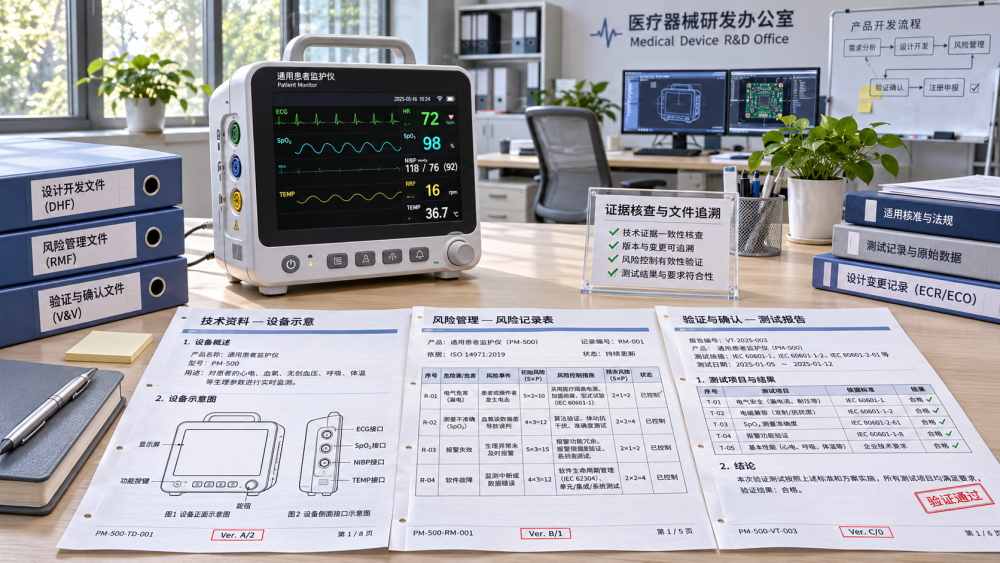
A useful demonstration follows one requirement or claim through the intended use, design input, risk assessment, verification or validation, and relevant labeling. The reviewer should be able to locate the controlled source, identify its revision, and explain any unresolved discrepancy. A matrix containing document titles alone is not sufficient if it cannot point to the relevant requirement, test result, or decision.
Consider a hypothetical patient monitor with a claimed alarm function. The documentation should connect the alarm-related requirements and foreseeable use conditions to the risk controls, software and system tests, and instructions or warnings where applicable. If a test covers an earlier software version, the provider should identify the configuration mismatch and assess whether additional evidence is needed rather than silently reusing the result.
- Can each material claim be traced to evidence for the correct device variant and configuration?
- Are acceptance criteria and test outcomes distinguishable from a general statement that testing passed?
- Are failed, inconclusive, or out-of-scope results visible and addressed?
- Do risk controls in the file match the implemented design and user information?
- Can the provider explain who owns each gap and how its closure will be reviewed?
Watch for circular evidence: a marketing claim should not be justified only by repeating it in a specification or declaration. The chain must reach appropriate underlying evidence, with a documented rationale for its relevance and adequacy.
Examine risk, clinical evidence, and labeling as connected records
A competent service does more than assemble separate sections. It checks whether the risk management file, clinical or performance evidence, usability information, and labeling describe the same product and intended use. The specific evidence required depends on the device and market, but contradictions between these records deserve investigation in any evaluation.
Risk management
Ask how hazards and hazardous situations are linked to risk controls, verification of those controls, residual risk decisions, and information supplied to users. For a service citing ISO 14971, request an explanation of how it applies the standard to the device rather than accepting a generic risk table as evidence of competence.
The provider should also distinguish drafting a risk analysis from approving risk acceptability. The manufacturer needs a defined process and authorized decision-makers for risk decisions; a consultant’s signature does not transfer that responsibility automatically.
Clinical or performance evidence
Ask how the provider assesses whether the available clinical or performance evidence supports each relevant claim, population, indication, and operating condition. For an IVD, that discussion may involve scientific validity, analytical performance, and clinical performance, as applicable to the product and jurisdiction.
A gap assessment should distinguish insufficient reporting from insufficient evidence. Better writing can clarify a study’s scope, but it cannot make an untested specimen type, patient population, or device configuration part of that study.
Labeling and instructions
Check how the service reconciles instructions for use, warnings, contraindications, maintenance information, and promotional claims with the evidence package. If translated materials are in scope, define how terminology, technical accuracy, version alignment, and review by qualified language and subject-matter specialists will be controlled.
Assess implementation, handover, and change control
A documentation package becomes less useful if it cannot be updated when software, components, suppliers, labeling, or the intended use change. Ask the provider to describe the workflow from change notification to impact assessment, document revision, review, approval, and release.
Use a hypothetical change request to test the process: a component substitution affects a critical measurement path. The provider should identify potentially affected design records, risk controls, verification evidence, labeling, and market-specific filings, then indicate which decisions require manufacturer input. It should not assume that every change requires a new submission—or that none does.
Confirm that the provider can work with the existing quality management and document-control processes, including electronic approval rules where applicable. If the provider uses its own platform, establish export formats, metadata availability, access after contract termination, and the cost of retrieving records.
Compare proposals using a controlled technical exercise
Give each shortlisted provider the same sanitized brief and ask for a short gap assessment, a proposed work breakdown, and one traceability example. Provide enough context to make the exercise meaningful, but avoid disclosing sensitive records until confidentiality and access controls are in place.
Score the responses against criteria agreed before reviewing prices. The following model is an illustrative starting point; adjust the weights to reflect the project’s actual risks.
Set minimum requirements for critical areas before applying the weighted score. A low price should not compensate for an inability to identify missing evidence or maintain confidentiality. Where a response depends on information not supplied in the exercise, reward a clear question or stated assumption rather than an invented conclusion.
Check the contract for work that falls between deliverables
Timelines should identify dependencies such as source-record availability, internal review, test completion, translation, and responses from external bodies. A fixed completion date is meaningful only when the parties agree on those inputs and the consequences of delays.
- Scope: List documents, device variants, markets, languages, and the depth of technical review included.
- Acceptance: Define review criteria, the number of revision cycles, issue resolution, and who can approve each deliverable.
- Exclusions: Identify testing, clinical work, regulatory fees, translations, and post-submission responses that require separate authorization.
- Ownership: Specify rights to use and edit deliverables, underlying templates, source materials, and work produced by subcontractors.
- Continuity: Agree on handover, open-item tracking, retention periods, and support after the initial project closes.
Be cautious of guaranteed approval or clearance, unsupported claims that a template alone makes a device compliant, and reluctance to disclose assumptions or unresolved gaps. The defensible choice is the provider that can show how its work connects to reliable evidence, respects the manufacturer’s responsibilities, and remains usable when the device or its regulatory context changes.
- Last One:No more articles
- Next Article:RSNA 2026 Announces Winners of Knee Abnormality Detection AI ChallengeNov 25, 2026
Have questions about the global trade trends discussed here, or planning your expansion and supply chain strategy? Leave a message below and let the trade experts at MTHH guide you.
We respect your privacy. Your information is strictly confidential.
Related News
- How to evaluate medical device documentation servicesNov 25, 2026Compare medical device documentation services with confidence. Learn how to assess regulatory expertise, evidence traceability, change control, and proposals.
- FDA Medical Device Inspections Shift From QSIT to QMSRNov 25, 2026FDA medical device inspections are shifting from QSIT to QMSR. Discover what manufacturers need to know about ISO 13485 alignment and inspection readiness.
- FDA Seeks Input on Autonomous and Remotely Operated Robotic Medical DevicesNov 25, 2026FDA seeks input on autonomous and remotely operated robotic medical devices. Explore the discussion paper and its potential impact on future regulations.
- WHO Calls for Clear Medical AI Liability Rules to Protect Patients and CliniciansNov 24, 2026Medical AI liability rules are in focus as WHO calls for clearer responsibility. Explore what this could mean for patient safety, clinicians and developers.