
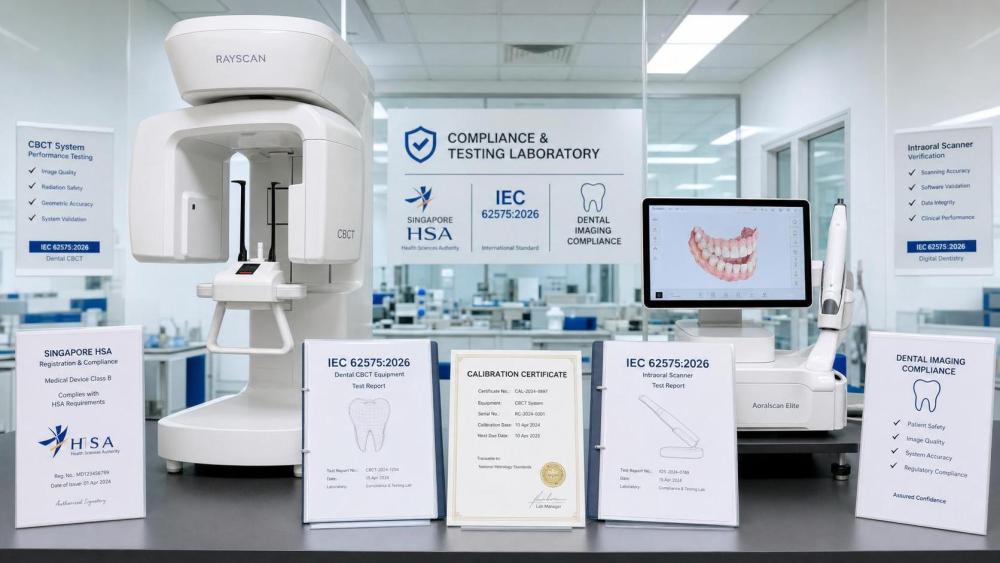
On July 7, 2026, Singapore's Health Sciences Authority (HSA) introduced a fast-track certification route for dental X-ray systems, CBCT units, and intraoral scanners, while also tightening the technical basis for submission. From that date, filings are accepted only when technical documentation is prepared under IEC 62575:2026, and older references such as IEC 62220-1 and ANSI/AAMI EC62a are no longer accepted. For manufacturers, exporters, testing partners, distributors, and procurement teams involved in dental imaging equipment, this is worth close attention because it changes the compliance entry requirements and directly affects document readiness, review timing, and delivery planning.
What the HSA announcement confirms
The confirmed change is limited but clear. HSA announced the launch of a fast-track certification channel covering dental X-ray machines, CBCT equipment, and intraoral scanners on July 7, 2026. Effective immediately, the authority will accept only technical files submitted in line with IEC 62575:2026, described in the input as the international standard for radiation safety and image quality consistency in dental digital imaging equipment. Submissions based on the older IEC 62220-1 or ANSI/AAMI EC62a standards are no longer accepted. The same announcement also indicates that this change is expected to speed up market access for compliant products, while requiring Chinese manufacturers to update EMC test reports, dose calibration certificates, and DICOM compatibility validation packages.
Where the new filing rule is likely to be felt first
Manufacturers preparing market entry dossiers
From an industry perspective, manufacturers are the first group affected because the rule change is tied directly to the technical submission package. The practical impact is concentrated in certification preparation, internal technical review, and document conversion. What deserves closer attention is whether existing submission files for dental imaging products still rely on older standards references, because those materials are no longer accepted under the new route.
Export and channel teams managing shipment timing
Exporters and distribution partners may feel the impact through order scheduling and launch planning rather than product design alone. Analysis shows that where a product was intended for filing using legacy technical references, shipment expectations, customer onboarding, and registration timelines may need to be adjusted until the file set is updated. The rule shift therefore touches not only compliance teams but also commercial teams that align delivery with approval readiness.
Testing and certification service providers handling supporting evidence
Testing laboratories, certification advisers, and documentation service providers are also likely to see immediate changes in workload. The reason is straightforward: the accepted standard has changed, and the announcement specifically points to updated EMC test reports, dose calibration certificates, and DICOM compatibility validation packages for Chinese manufacturers. In business terms, supporting evidence that was previously usable may now require revision, replacement, or reassembly before a filing can proceed.
Buyers and procurement functions reviewing technical qualification
Procurement teams, including buyers that screen supplier qualifications, may need to revisit how technical compliance is checked before ordering. Observably, when a regulator accepts only one standard basis for filing, technical bid alignment and supplier document review become more important at the pre-purchase stage. Even where contracts or tenders are not directly discussed in the announcement, purchasers should watch for whether requested document sets and compliance declarations need to be updated to match the new filing expectations.
What companies should check now
Review the standard references inside current submission files
Companies with products in scope should first verify whether their technical documentation for dental X-ray machines, CBCT units, or intraoral scanners still cites IEC 62220-1 or ANSI/AAMI EC62a as the core basis. Analysis shows that this is the most immediate compliance checkpoint because the acceptance rule now turns on IEC 62575:2026.
Reconfirm the status of supporting reports and certificates
What deserves closer attention is not only the main technical file but also the supporting evidence around it. The announcement specifically highlights EMC test reports, dose calibration certificates, and DICOM compatibility validation packages. Companies should therefore check whether these materials are current, internally consistent, and aligned with the updated filing basis before planning submissions or customer delivery commitments.
Align compliance timing with sales and delivery planning
From an operational perspective, firms should avoid treating certification updates as a purely regulatory task. Where market entry plans, distributor onboarding, or shipment schedules were built around older documentation, the new requirement may affect the order in which filing, supply, and customer handover are arranged. This is not yet evidence of a broader market disruption, but it is a practical coordination issue that companies should address early.
Monitor how the requirement appears in downstream documents
It is more appropriate to understand this stage as an execution signal that may flow into other commercial documents. Companies should continue watching for how the new standard reference is reflected in regulatory communications, tender specifications, customer qualification checklists, and distributor document requests. The input does not provide detailed implementation language beyond the acceptance rule, so any wider downstream effect still requires verification.
Why this reads as an execution signal, not just a technical update
Analysis shows that the importance of this development lies less in the existence of a fast-track route alone and more in the combination of acceleration and exclusion. HSA is not only opening a quicker path for the covered product categories; it is also making IEC 62575:2026 the sole accepted standard basis for submission under that route and rejecting older references. That makes this more than a routine standards update. At the same time, it would be premature to treat it as a fully mapped market shift, because the input does not provide further detail on review practice, transition handling beyond immediate effect, or downstream enforcement language in procurement and distribution settings.
How the market is likely to read the change for now
At present, this development is best understood as a landed compliance change with direct filing consequences for the affected dental imaging categories. The confirmed facts support a clear conclusion that documentation strategy must be updated immediately where products are intended for the Singapore route described. Beyond that, broader implications for procurement behavior, delivery cadence, and service workflows should be treated as areas for continued observation rather than fixed outcomes.
Basis of this article and points that still need verification
This article is based on the user-provided news title, event date, and event summary. For developments of this kind, the source types typically relevant to further verification include official regulatory announcements, notices issued by competent authorities, standard-setting organization documents, trade or customs information, industry association updates, and reporting by authoritative sector media. A specific official source link was not provided in the input, so that element still requires follow-up verification. Further observation is also needed on detailed implementation language, certification interpretation in practice, possible changes in tender documentation, industry feedback, and how companies execute updates to technical files and supporting compliance materials.