
Why needle selection deserves closer attention
Choosing needles is rarely a minor purchasing detail in healthcare settings.
Gauge, length, tip design, material quality, and packaging format all shape clinical performance.
A mismatch can affect insertion control, sample quality, medication delivery, patient comfort, and waste rates.
That is why needle selection should be tied to application scenario rather than unit price alone.
For organizations managing medical consumables at scale, the decision also influences storage complexity and supplier consistency.
MTHH often highlights this broader procurement logic across medical devices and hospital supplies.
The same thinking applies to needles: technical fit and operational fit need to be reviewed together.
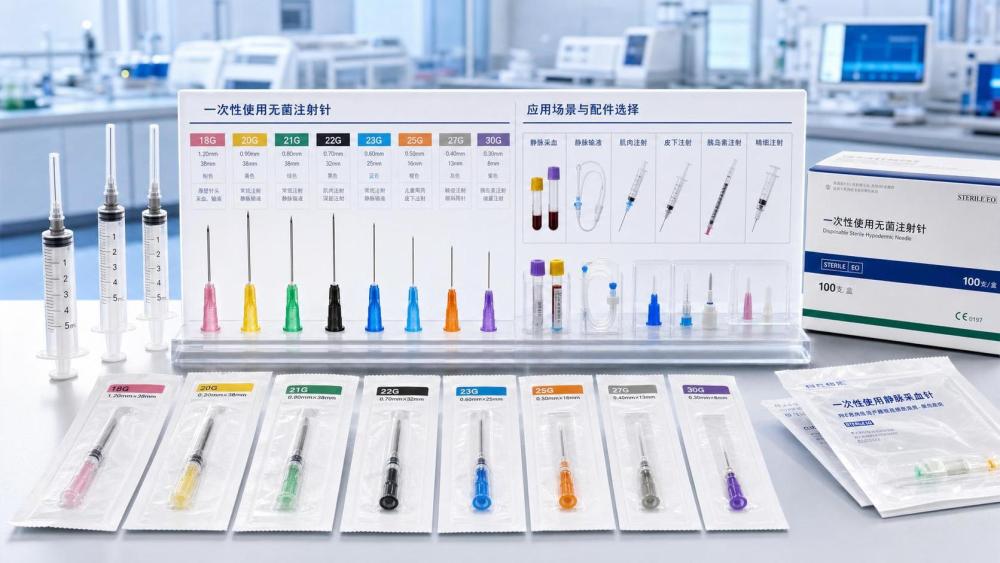
A simple specification sheet may look clear, yet real selection depends on how the product will actually be used.
What gauge, length, and application scenario really mean
Needle gauge refers to the outer diameter of the needle.
The numbering works in reverse.
A higher gauge means a thinner needle, while a lower gauge means a wider one.
That difference matters for flow rate, puncture force, tissue impact, and suitability for fluids of different viscosity.
Length affects depth reach and handling stability.
Short needles may work well for superficial injections.
Longer needles may be necessary when tissue depth, anatomy, or access path requires more reach.
Application scenario brings the technical details into context.
A needle for vaccination, venipuncture, local anesthesia, biopsy support, or laboratory aspiration cannot be judged by one dimension alone.
The intended device interface also matters.
Some needles are designed for syringes, some for collection systems, and others for specialized equipment.
A practical reading of the basic specifications
Why the market pays attention to these details
Needles may look standardized, yet purchasing conditions have become more demanding.
Healthcare providers expect better traceability, stable quality, and fewer usability complaints.
Distributors also face pressure to simplify portfolios without reducing clinical fit.
In many regions, attention has moved beyond sterile packaging and basic size labeling.
More review now goes into material quality, coating consistency, safety features, and documentation readiness.
This is consistent with the wider healthcare procurement environment covered by MTHH.
Consumables are no longer evaluated only as interchangeable items.
They are assessed for workflow impact, risk reduction, and long-term supply reliability.
Needles used in high-volume departments can influence training needs, stock turnover, and incident reporting patterns.
Different scenarios call for different needles
Application scenario is often the best starting point.
It helps narrow specifications before comparing brands or pricing structures.
Common use environments
- Vaccination and routine injection settings usually prioritize smooth penetration and predictable patient comfort.
- Venous blood collection often needs needles that balance flow performance with vein protection.
- Infusion preparation and drug delivery may require compatibility with specific syringes or administration sets.
- Dental, surgical, or anesthesia use may depend more heavily on reach, control, and specialty tip design.
- Laboratory and diagnostic workflows may focus on sample integrity, handling accuracy, and packaging convenience.
The same gauge may perform differently across these settings because fluid type, angle of entry, and operator technique vary.
That is why scenario-based comparison is more useful than general catalog comparison.
A scenario-led comparison approach
What to check beyond the basic size
A needle may match the requested gauge and still perform poorly in practice.
Several supporting factors deserve equal attention during evaluation.
Key review points during sourcing
- Sterility assurance and packaging integrity across shipping and storage conditions.
- Consistent siliconization or surface finish, which affects insertion smoothness.
- Mechanical strength, especially for needles exposed to repeated handling stress.
- Connector fit with syringes, holders, pumps, or other existing devices.
- Shelf life, lot traceability, and labeling clarity for stock control.
- Availability of safety-engineered needles where sharps injury reduction is a requirement.
These points matter because consumables affect daily operations, not only one-time capital budgets.
A low-cost option can become expensive if breakage, leakage, user dissatisfaction, or returns increase.
How to balance clinical fit with procurement efficiency
In practice, the best needle portfolio is rarely the largest one.
Too many SKUs can complicate inventory and training.
Too few can create clinical compromise.
A balanced approach starts with volume mapping.
Identify which needles support the highest-frequency procedures and which are needed for special use only.
Then compare suppliers on more than quotation terms.
Documentation quality, delivery reliability, complaint handling, and batch consistency should be reviewed together.
This mirrors broader medtech sourcing logic seen across imaging accessories, laboratory consumables, and patient care supplies.
Standardization works best when it respects real clinical variation.
Questions worth asking before approval
- Which procedures account for most needle consumption?
- Where do complaints or usage errors happen most often?
- Can one specification safely cover multiple routine scenarios?
- Are special needles supported by stable supply and correct regulatory documents?
- Will packaging format fit current storage, dispensing, and waste workflows?
Turning comparison into a better sourcing decision
Needles should be selected as working components of a healthcare system, not as isolated items.
Gauge explains diameter, length defines reach, and application scenario reveals whether those specifications truly fit the task.
When these three factors are reviewed together, it becomes easier to reduce mismatch and improve supply discipline.
A useful next step is to sort current needles by procedure type, annual volume, and compatibility requirements.
From there, compare shortlisted options against safety features, packaging practicality, and documentation completeness.
That kind of structured review supports better decisions across the same procurement framework used for broader medical technology evaluation on MTHH.