
Which critical care devices are essential for a new PICU?
Which Critical Care Devices Are Essential for a New PICU?
Planning a new pediatric intensive care unit requires more than selecting individual products—it demands a coordinated approach to safety, workflow, infrastructure, and long-term serviceability. From pediatric ventilators and patient monitors to infusion systems, defibrillators, and medical gas support, the right critical care devices PICU teams rely on can directly influence clinical responsiveness and project outcomes. This guide helps project managers identify essential equipment categories and key procurement considerations before installation begins.
A PICU is not simply an adult ICU with smaller beds. Pediatric patients range from infants to adolescents, and their respiratory volumes, medication doses, physiological limits, and emergency requirements can differ substantially. Equipment therefore needs to support age-appropriate use while allowing clinicians to act quickly under pressure. For a project manager, the central task is to ensure that devices, room layouts, utilities, digital systems, staff workflows, and maintenance arrangements work as one operating environment.
Start with the clinical model, not the equipment list
The equipment schedule for a new PICU should reflect the service scope agreed by the hospital. A unit that stabilizes critically ill children before transfer will need a different configuration from a tertiary PICU managing complex ventilation, post-operative cardiac care, neurological emergencies, renal replacement therapy, or oncology-related complications. Bed numbers alone are not enough to define procurement quantities or technical specifications.
Before tender documents are issued, the project team should clarify expected patient age groups, acuity levels, isolation capacity, access to operating theatres and imaging, transport pathways, laboratory turnaround, and the clinical team’s escalation model. These choices affect not only what is purchased, but also where it is installed and how many backup units are required. A single device may appear adequate on a spreadsheet yet be unavailable when it is undergoing maintenance, cleaning, patient transport, or urgent clinical use elsewhere.
Good planning separates equipment into three layers: bedside life-support devices, shared emergency and procedure equipment, and supporting infrastructure. This prevents a common mistake: funding visible bedside devices while underestimating the systems that make them usable around the clock.
Core bedside devices for every PICU bed
Pediatric-capable patient monitoring
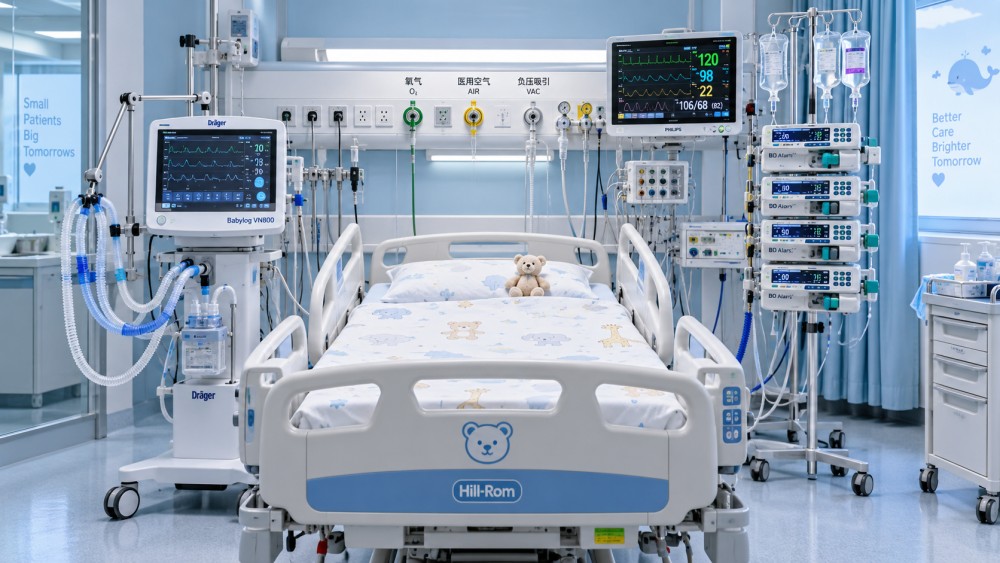
Multiparameter patient monitors form the observation backbone of the unit. At minimum, the intended configuration usually needs to support ECG, pulse oximetry, non-invasive blood pressure, respiratory rate, and temperature monitoring. Depending on the clinical model, invasive blood pressure, end-tidal carbon dioxide, and other modules may be required. The important question is not merely whether a monitor offers these parameters, but whether the sensors, cuffs, cables, alarm logic, and measurement ranges are appropriate for pediatric and neonatal-sized patients where required.
Central monitoring deserves early attention. A central station can improve visibility across beds, but only if alarm policies, network stability, screen placement, user access, and escalation processes have been considered. Alarm fatigue is a practical safety issue. Buyers should ask how alarms are prioritized, whether settings can be managed by patient category, how events are reviewed, and whether the system integrates with the hospital’s wider clinical IT environment.
Ventilators and respiratory support
Mechanical ventilation is among the most consequential device categories in a PICU. Pediatric ventilators need suitable low-volume performance, responsive triggering, leak management, reliable alarms, and modes consistent with the clinical team’s established practices. The specification should be reviewed jointly by intensivists, respiratory therapists where applicable, nursing leaders, and biomedical engineering. A ventilator may be technically capable, yet still create training and workflow risks if its interface differs sharply from equipment used elsewhere in the hospital.
Invasive ventilation should be considered alongside non-invasive support, high-flow oxygen delivery, humidification, suction, nebulization, and resuscitation equipment. These are often procured under separate packages, which can create interface gaps. For example, the availability of wall oxygen does not answer whether flow capacity, humidifier placement, consumable compatibility, and electrical outlets are sufficient for high-dependency respiratory care.
A new PICU also needs a realistic approach to device redundancy. The appropriate reserve level depends on bed count, expected occupancy, transport demand, service turnaround, and local contingency arrangements. It should be defined through clinical and engineering review rather than assumed from a generic ratio.
Infusion and syringe pump systems
Pediatric critical care often involves multiple continuous infusions, small dose volumes, and frequent treatment adjustments. Syringe pumps and volumetric infusion pumps are therefore not secondary accessories; they are central medication-delivery devices. Project teams should evaluate dose-error reduction features where available, drug library governance, pump stacking arrangements, battery operation, compatibility with existing consumables, and the practical number of channels required at each bed.
The physical arrangement matters. A crowded pump pole can restrict access to the patient, obscure labels, complicate line tracing, and increase cable congestion. Bedhead design should allow pumps to be securely mounted without blocking monitors, ventilation circuits, or emergency access. If a hospital intends to use a central infusion management platform, network readiness, cybersecurity review, software maintenance, and responsibility for library updates need to be addressed before go-live.
Beds, warming, and pressure-injury prevention
PICU beds must support safe positioning, imaging access where relevant, side-rail safety, emergency procedures, mobility around the bed, and cleaning protocols. The appropriate bed range depends on the age and size of the intended patient population. Some projects require a mix of pediatric beds, cots, and specialty surfaces rather than a single standard bed type.
Thermal management should be considered at the same time. Patient warming devices, warming blankets, fluid warmers, and temperature probes may be required according to clinical practice. Their power demand, storage, consumables, cleaning procedures, and staff competency requirements should be included in the implementation plan. These details rarely dominate early design meetings, but they affect everyday readiness.
Shared emergency and procedure equipment
A PICU needs rapid access to resuscitation equipment that is suitable for children. This commonly includes a defibrillator with appropriate pediatric capabilities, emergency carts, bag-valve-mask devices in appropriate sizes, suction equipment, airway management tools, and emergency medication storage defined by hospital policy. The team should decide whether this equipment will remain dedicated to the unit or be shared with adjacent pediatric services. Shared assets can reduce capital expenditure, but only where travel time, ownership, replenishment, and availability are reliably controlled.
Portable ultrasound is increasingly relevant to critical care workflows for vascular access, bedside assessment, and selected procedural support. Whether it is essential for a particular project depends on local practice and clinician competence. If included, procurement should cover transducer selection, infection-control accessories, image storage expectations, charging locations, and training—not simply the console itself.
Other shared technologies may include transport monitors, transport ventilators, blood gas analysis access, point-of-care testing devices, portable suction, and procedure lighting. These should be planned around actual patient routes. Moving a ventilated child to imaging, theatre, or another care area requires a coordinated transport package, not a collection of devices purchased by separate departments.
Infrastructure is part of the critical care device decision
Medical gas infrastructure is foundational. Each bedspace needs appropriate access to oxygen, medical air, and vacuum according to the clinical design and applicable local requirements. Capacity, pressure stability, outlet locations, backup supply arrangements, testing, labeling, and commissioning records all matter. A high-specification ventilator cannot compensate for an inadequately planned gas system.
Electrical design also needs more than a count of wall sockets. Critical care beds require normal and essential power provision, clear circuit identification, grounding arrangements where required, and enough outlets to prevent unsafe extension-cord practices. Teams should map the expected load from monitors, ventilators, pumps, warming equipment, diagnostic devices, workstation hardware, and chargers. Biomedical engineers can help identify hidden loads that are easily missed during architectural planning.
Bedhead units or ceiling pendants shape workflow and infection-control practice. Their configuration should provide safe access to gases, power, data, communication, and equipment mounting while preserving room for emergency teams around the patient. Ceiling systems may improve floor clearance in some settings, but they require early coordination with structural, mechanical, electrical, and clinical teams. Late changes can be expensive and disruptive.
How to compare suppliers beyond the headline specification
For critical care devices PICU procurement should not be decided by feature lists alone. The project team needs to assess the full operating model: installation requirements, delivery lead times, local technical support, preventive maintenance, calibration needs, software updates, spare-parts access, consumable continuity, warranty terms, and user training. A lower acquisition price may be less attractive if proprietary disposables, limited field service coverage, or delayed repairs create long-term operational exposure.
Interoperability should be tested rather than assumed. Ask suppliers to document network requirements, supported interfaces, alarm communication options, cybersecurity responsibilities, and data export capability. If the hospital expects integration with electronic medical records, nurse call systems, central monitoring, or asset management tools, involve the IT and clinical engineering teams before contract award. Retrofitting connectivity after installation is often harder than anticipated.
Documentation is another practical filter. Depending on the market, procurement teams may need to verify registration status, labeling, instructions for use, service manuals, electrical and installation requirements, risk-related documentation, and post-market support arrangements. The exact regulatory pathway varies by jurisdiction, so project teams should confirm local obligations rather than relying on documents prepared for another market.
Build commissioning into the procurement schedule
A PICU is not ready when cartons arrive. Readiness depends on site acceptance, asset registration, electrical and gas verification, network configuration, accessory availability, staff training, cleaning protocols, emergency drills, and service handover. The most common implementation gaps arise at the interfaces: a monitor is installed but not connected to the central station; pumps are delivered before drug libraries are approved; a ventilator arrives without the intended circuit or humidification setup; a bedhead unit is complete but lacks the mounting accessories specified by nursing staff.
A commissioning matrix can bring these dependencies into view. For each device category, identify the responsible owner, installation prerequisites, acceptance criteria, training status, required accessories, maintenance plan, and outstanding risks. This is especially useful when construction contractors, distributors, manufacturers, biomedical engineering teams, and clinical departments are working to different schedules.
Global MedTech & Healthcare Intelligence Hub (MTHH) supports this early evaluation process by organizing technical and commercial information across patient monitoring, ventilators, infusion systems, ICU infrastructure, emergency care equipment, and hospital planning. For project teams, the practical value lies in comparing not only device capabilities, but also application conditions, service expectations, documentation needs, and long-term operating considerations.
A safer procurement decision is a coordinated one
The essential devices for a new PICU generally include pediatric-capable monitoring, ventilation and respiratory support, infusion and syringe pumps, appropriate beds and thermal management, emergency resuscitation equipment, suction, and dependable medical gas and power infrastructure. Yet the final equipment plan should be shaped by the unit’s clinical scope and the hospital’s wider care network.
Before finalizing specifications, bring clinicians, nurses, biomedical engineers, facilities teams, IT, infection-control staff, and procurement into the same review. Confirm the patient pathways, utility interfaces, consumable strategy, device integration requirements, training plan, and service model. That discipline is what turns a set of critical care devices into a PICU that can open safely and remain operational after the project team has left.
Have questions about the global trade trends discussed here, or planning your expansion and supply chain strategy? Leave a message below and let the trade experts at MTHH guide you.
We respect your privacy. Your information is strictly confidential.
Related News
- How to choose diagnostic imaging equipment for small clinicsNov 14, 2026Choose diagnostic imaging equipment for clinics with confidence. Compare clinical needs, costs, space, workflows, and supplier support before you buy.
- How to size medical gas pipelines for peak demandNov 09, 2026Medical gas pipeline systems design starts with peak demand. Learn how to size pipes, calculate pressure loss, and check critical paths for reliable performance.
- What Trendelenburg angle should an operating table provide?Nov 05, 2026Compare operating tables Trendelenburg angles, load limits and accessories. Discover what to check before choosing the right table for your procedures.
- How to estimate the total cost of hospital imaging equipmentNov 04, 2026Plan hospital capital equipment imaging investments with confidence. Learn to estimate installation, service and operating costs and compare bids fairly.