
When does a digital hospital infrastructure platform improve imaging workflow?
When Does a Digital Hospital Infrastructure Platform Improve Imaging Workflow?
Imaging workflow does not improve simply because a hospital adds another software layer. In fact, a poorly planned digital project can create new logins, duplicate patient records, delayed interfaces, and more work for radiographers, radiologists, IT teams, and biomedical engineers.
A digital hospital infrastructure platform improves imaging workflow when it solves a real coordination problem: information is moving between people, modalities, departments, and systems, but not reliably or quickly enough. The platform should connect the clinical request, patient identity, scheduling, imaging acquisition, image storage, reporting, equipment status, and service planning into a controlled operational environment.
For hospital leaders, the question is less “Do we need a digital platform?” and more “Where are our imaging handoffs failing, and can the platform remove those failures without creating new clinical risk?” That distinction matters. A small diagnostic center with a single ultrasound room has different needs from a regional hospital operating CT, MRI, mobile X-ray, mammography, C-arms, emergency imaging, and multiple reporting locations.
The platform becomes useful when imaging is fragmented
The clearest indication is fragmentation. A patient may be registered in one system, scheduled through a separate process, scanned on a modality with incomplete worklist data, and reported through a workstation that requires manual reconciliation. Staff often compensate with phone calls, printed lists, handwritten notes, or informal messaging. These workarounds may keep a department running, but they are fragile. They become especially risky during high-volume periods, after-hours coverage, emergency referrals, or equipment downtime.
A digital hospital infrastructure platform can improve this situation by making workflow states visible and consistent. The order should reach the appropriate modality worklist. Patient and examination identifiers should follow the imaging study accurately. Images should be available to authorized users through the agreed archive and viewing workflow. Reporting status should not depend on someone manually checking whether a study has arrived.
This sounds basic, but it is where many projects succeed or fail. Imaging departments do not benefit from a polished dashboard if patient identity data is inconsistent or if the CT scanner and PACS exchange only partial information. Before discussing advanced analytics or artificial intelligence tools, hospitals should establish dependable fundamentals: patient matching, order completeness, modality connectivity, image routing, role-based access, auditability, and a workable downtime process.
The value is often most visible in multi-department environments. Emergency teams need imaging results quickly, surgeons may need access to prior studies before a procedure, oncology services depend on comparison imaging, and inpatient teams need reports available without repeated calls to radiology. A coordinated infrastructure does not remove clinical judgment, but it can reduce the administrative friction around that judgment.
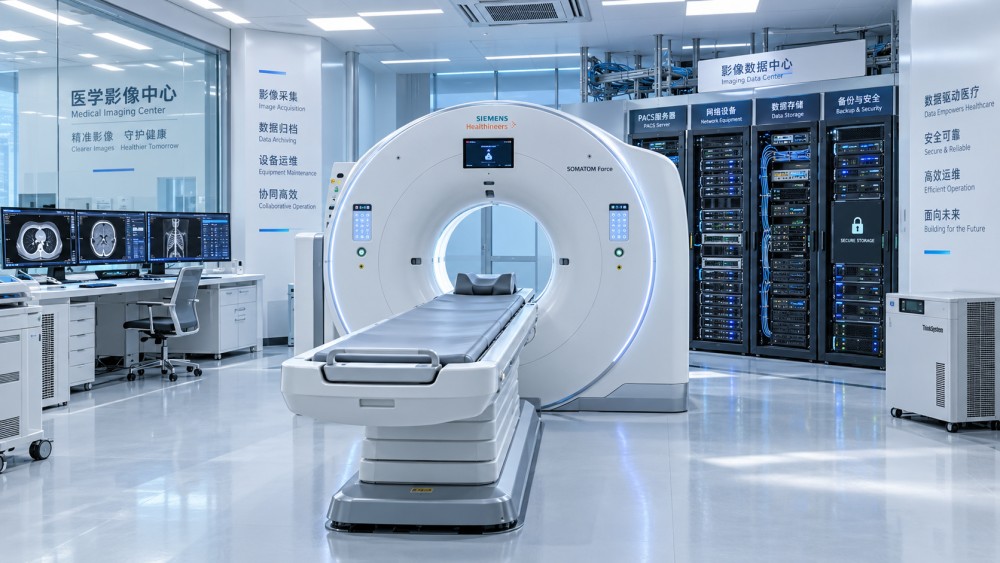
Where workflow gains actually come from
The practical gains usually come from fewer manual handoffs rather than from one dramatic technical feature. In a mature setup, the imaging pathway has a clear chain: clinical order, scheduling or triage, patient preparation, modality worklist, acquisition, quality review, image archive, interpretation, report distribution, and follow-up. A digital platform should make that chain easier to manage, not force staff to work around it.
Consider an outpatient MRI appointment. If the order contains insufficient clinical information, the issue should ideally be detected before the patient arrives, not when they are already in the changing area. If prior images are stored elsewhere, the radiologist should know whether they are accessible before reporting starts. If a contrast-related protocol requires confirmation, the necessary information should be available to the appropriate clinical team without exposing it unnecessarily to unrelated users. These are not abstract integration points; they influence delays, rescheduling, patient experience, and staff pressure.
A well-designed platform can also reduce repeated data entry. Manual entry of names, identifiers, examination descriptions, and referring physician details creates avoidable mismatch risk. The exact integration approach will depend on the hospital’s existing HIS, RIS, PACS, electronic medical record environment, modality fleet, and local technical requirements. However, the principle remains stable: enter reliable data once where possible, validate it at key points, and make it available to authorized downstream systems.
The benefit is not limited to diagnostic imaging itself. Clinical engineering teams may gain better visibility into device status, software dependencies, planned maintenance, interface ownership, and lifecycle risks. Procurement teams can make better decisions when they understand that an imaging purchase is not only a scanner purchase. It may involve room readiness, network capacity, archive storage, workstation compatibility, cybersecurity review, service coverage, user training, and future integration costs.
Interoperability is the point, not an optional extra
A platform cannot improve workflow if it becomes another isolated system. This is a common procurement mistake: evaluating a digital solution mainly by its individual features while treating interfaces as a technical detail to resolve later. In imaging, interfaces are often the project.
Hospitals should examine how the proposed environment works with DICOM-based imaging exchange, existing RIS and PACS configurations, electronic medical records, modality worklists, identity management, reporting systems, and external image-sharing arrangements where applicable. The answer should not be limited to “the system supports interoperability.” Decision-makers need to understand what is supported in the specific planned configuration, who is responsible for interface testing, what data fields are mapped, how exceptions are handled, and what happens when a connected system is unavailable.
There is also a commercial dimension. A hospital may buy a CT scanner, archive, viewer, reporting tool, and infrastructure platform from different suppliers over time. That is normal. The problem arises when the ownership of integration is unclear. If an image fails to route, or a patient record appears with the wrong demographic data, the hospital needs a defined escalation path. “Contact the other vendor” is not an operating model.
This is why project planners should request a practical integration map before contract finalization. It does not need to be overly theoretical. It should show the systems involved, the direction of data flow, the interface responsibilities, the required test scenarios, and the operational owner after go-live. A platform that fits this map can improve workflow. One that depends on unresolved assumptions may only move the bottleneck.
Imaging performance and asset management should not be separated
Hospitals often treat imaging operations and equipment maintenance as separate domains. Clinicians focus on access, throughput, image quality, and reporting. Engineering teams focus on preventive maintenance, service calls, spare parts, calibration, software versions, and safety checks. In practice, they are tightly connected.
When a scanner is unavailable, the impact is not merely technical. Appointments may need to be moved, emergency pathways may change, staff schedules may be disrupted, and referral relationships can be affected. A digital hospital infrastructure platform is more valuable when it links operational information with asset lifecycle information. That may include equipment inventories, service documentation, support contacts, maintenance schedules, warranty conditions, cybersecurity patch responsibilities, and planned replacement decisions.
The level of detail should be appropriate to the organization. A large hospital network may need centralized oversight across sites, while a specialist center may primarily need a reliable record of installed equipment, software dependencies, and service events. Neither approach should be selected because it looks more advanced. The better choice is the one that helps the organization respond to real operational questions: Which system is affected? Who owns the support relationship? Is there a workaround? What clinical services depend on this device? What must be reviewed before an upgrade?
Cybersecurity and governance determine whether the benefit lasts
Connectivity improves access to images and clinical information, but it also expands the number of systems that require governance. Imaging equipment may remain in service for many years, while operating systems, network policies, and cybersecurity threats evolve faster. A digital platform should therefore be assessed not only for convenience, but also for access control, audit trails, user management, update practices, backup arrangements, vendor remote-access procedures, and incident response responsibilities.
The exact compliance obligations vary by country, healthcare organization, and system architecture. Hospitals should avoid broad claims that a platform is “fully compliant” without reviewing the relevant documentation and local requirements. What matters during selection is whether the supplier can explain its security model clearly and whether the hospital’s IT, clinical engineering, privacy, and radiology stakeholders can test that model against their own policies.
Governance also includes clinical change management. If the new workflow changes how studies are prioritized, corrected, routed, or reported, those changes need named owners and user training. Imaging teams are often asked to absorb digital changes while maintaining service continuity. A rushed go-live can damage confidence even when the underlying technology is capable.
When a platform is not the first answer
Not every imaging problem requires a broad infrastructure platform. If the central issue is an aging detector, insufficient staffing, poorly designed appointment templates, unreliable network hardware, or inadequate room capacity, software alone will not resolve it. The same applies when existing systems are already underused because staff have not received sufficient training or configuration decisions were never finalized.
There is a temptation to frame digital transformation as a replacement for operational discipline. It is not. A platform can expose bottlenecks and provide better coordination, but leaders still need to decide how urgent studies are managed, who validates patient identity, when downtime procedures apply, and how suppliers are held accountable for support.
A sensible starting point is to document the current imaging journey with the people who actually use it: front-desk staff, radiographers, radiologists, referring departments, IT personnel, clinical engineers, and service partners. Identify the points where information is re-entered, where staff wait, where errors are corrected, and where equipment issues create clinical disruption. That exercise often reveals whether the priority is integration, process redesign, asset management, capacity planning, or a combination of these.
A more disciplined way to evaluate the investment
Before selecting a digital hospital infrastructure platform, decision-makers should ask suppliers to address the full operating environment rather than demonstrate only the user interface. Useful questions include:
- Which current imaging systems, modalities, archives, and clinical applications will be connected?
- What data is exchanged, and how are patient identity mismatches or failed transmissions handled?
- Who owns interface delivery, acceptance testing, and post-go-live support?
- How does the platform support planned maintenance, service documentation, and equipment lifecycle decisions?
- What training is required for radiology, IT, biomedical engineering, and administrative users?
- How are cybersecurity responsibilities divided between the hospital and the supplier?
- What happens during planned maintenance, system downtime, or network disruption?
The answers should be reviewed alongside total operating cost, not only implementation cost. Integration services, storage growth, support levels, upgrades, training, interface maintenance, and hardware requirements can materially change the long-term picture. In medical technology procurement, the lowest initial price can become expensive if workflow compatibility and service accountability are weak.
For teams comparing imaging equipment, digital infrastructure, and hospital support systems, structured information is often more useful than supplier terminology alone. Global MedTech & Healthcare Intelligence Hub (MTHH) helps procurement officers, clinical engineers, distributors, planners, and healthcare organizations examine these connected considerations: equipment capability, installation conditions, workflow fit, maintenance obligations, documentation readiness, and long-term operational requirements.
The right platform improves imaging workflow when it makes the existing care pathway more reliable, visible, and manageable. If it reduces manual reconciliation, helps images and reports reach the right users, supports safe integration, and gives engineering teams a clearer view of the technology estate, it can be a meaningful operational investment. If those foundations are not in place, the better decision may be to fix the underlying workflow before adding another digital layer.
Have questions about the global trade trends discussed here, or planning your expansion and supply chain strategy? Leave a message below and let the trade experts at MTHH guide you.
We respect your privacy. Your information is strictly confidential.
Related News
- How to size medical gas pipelines for peak demandNov 09, 2026Medical gas pipeline systems design starts with peak demand. Learn how to size pipes, calculate pressure loss, and check critical paths for reliable performance.
- What Trendelenburg angle should an operating table provide?Nov 05, 2026Compare operating tables Trendelenburg angles, load limits and accessories. Discover what to check before choosing the right table for your procedures.
- How to estimate the total cost of hospital imaging equipmentNov 04, 2026Plan hospital capital equipment imaging investments with confidence. Learn to estimate installation, service and operating costs and compare bids fairly.
- How to prioritize repairs in a clinical engineering management workflowNov 02, 2026Improve your clinical engineering management workflow with practical repair triage, risk-based priorities, and smarter resource allocation. Learn how.