
What affects the cost of computed tomography systems in Saudi Arabia?
What affects the cost of computed tomography systems in Saudi Arabia?
The cost of computed tomography systems Saudi Arabia hospitals procure extends well beyond the initial equipment quote. Detector configuration, clinical applications, installation requirements, and local service coverage influence both upfront spending and long-term operating costs. Comparing new and refurbished scanners also requires careful review of warranty terms, tube replacement exposure, software licensing, and applicable Saudi requirements.
There is no useful single price without a defined configuration and delivery scope. A scanner-only offer and a fully installed, clinically ready system are different purchases—even when the model name matches. The practical task is to establish what the hospital needs, identify what each supplier actually includes, and calculate the cost of keeping that system available for patients.
Clinical requirements set the starting price
Start with the examination mix rather than the largest specification available. Routine head, chest, and abdominal imaging places different demands on a scanner from coronary CT angiography, complex trauma, or advanced perfusion studies. Buying capacity that will remain unused ties up capital; under-specifying the scanner can create referral leakage, workflow limitations, or an early replacement requirement.
Slice count is a useful screening parameter, but it is not enough to compare platforms. Detector rows, reconstructed slices, and longitudinal coverage are not interchangeable measures. Ask suppliers to explain the detector geometry, coverage per rotation, rotation speed, tube capability, and patient table limits for the exact configuration quoted.
For cardiac work, temporal resolution and the complete cardiac workflow matter more than a headline slice number. For a busy emergency department, sustained throughput, reconstruction speed, and reliable operation under repeated scanning may be more relevant. Spectral capabilities and advanced reconstruction can add clinical value, but their cost needs to be assessed against expected use and radiologist requirements.
Define mandatory capabilities separately from optional upgrades. This gives suppliers a consistent base specification and makes it easier to see whether a higher quotation reflects necessary performance or simply a larger software bundle.
New and refurbished scanners carry different financial risks
A refurbished CT scanner can reduce acquisition spending, but “refurbished” does not describe a uniform process. A manufacturer-refurbished system, an independently rebuilt scanner, and used equipment sold with limited testing may have substantially different support arrangements. The label alone says little about remaining service life.
Request the manufacturing date, installation history, service records, refurbishment scope, replaced components, and evidence of completed testing. Check the operating system, cybersecurity support, software licence transferability, and manufacturer support horizon. A scanner that performs adequately today may still be a poor purchase if essential parts or supported software will become unavailable during the intended ownership period.
The X-ray tube deserves separate scrutiny. Ask for its installation date, available usage records, warranty status, and the basis used to assess its condition. Usage indicators help, but they do not guarantee remaining life. Heavy workloads and demanding protocols can affect tube wear differently.
A lower refurbished price becomes less persuasive if it comes with an uncertain tube, restricted software, and no dependable local service. Conversely, a documented system with appropriate clinical capability and credible support may suit a facility whose workload does not justify a premium platform. Confirm whether the proposed equipment is eligible for import and use under current Saudi requirements before committing funds.
The room can change the project budget
Installation costs depend on the building as much as the scanner. An existing imaging room is not automatically suitable for a replacement system. Equipment dimensions, service clearances, structural loading, electrical demand, cooling requirements, and radiation shielding all need review against the selected model and planned workload.
A pre-installation survey should establish the delivery route from unloading point to final position. Door openings, lifts, corridor turns, floor access, and any need for lifting equipment can affect both cost and schedule. In an operating hospital, temporary access restrictions and removal of the old scanner may also require careful coordination.
Saudi conditions make the quality of building services particularly relevant. Outdoor heat does not determine the scanner’s operating environment; the facility must maintain the manufacturer’s specified temperature and humidity. Confirm cooling capacity, operating hours, power quality, and any backup arrangements rather than assuming existing infrastructure is adequate.
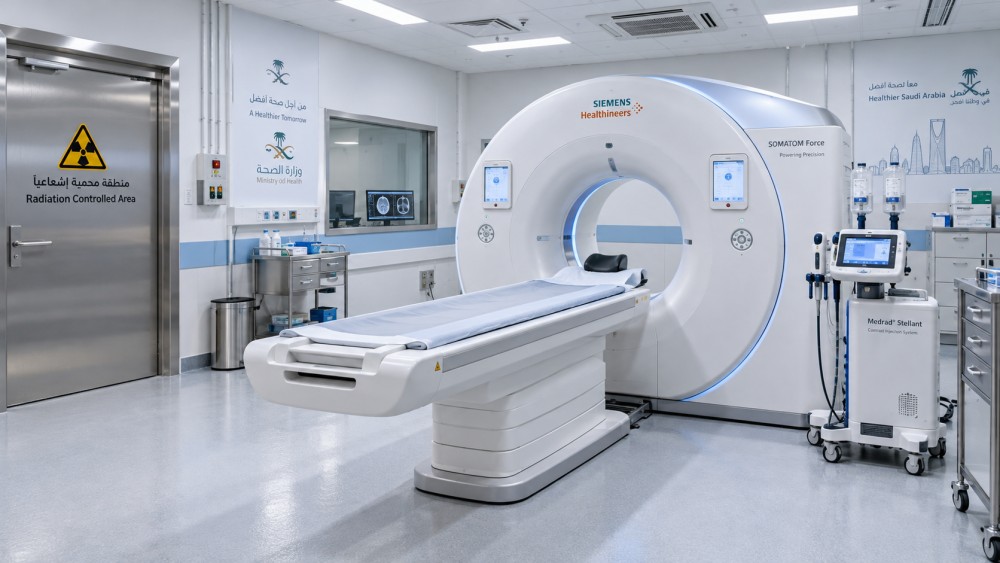
Shielding should be assessed by an appropriately qualified specialist using the room layout, surrounding occupancy, workload, and applicable requirements. Do not budget from a generic wall specification. The contract should identify who supplies the shielding design, performs the work, arranges verification, and resolves deficiencies discovered before clinical operation.
Separate the equipment price from the delivered, usable system
International quotations can use different delivery terms and currencies. Compare them on a common Saudi-riyal basis, documenting the exchange-rate assumption, quotation validity, freight, insurance, customs handling, and applicable tax treatment. Have the relevant finance or customs adviser verify taxes and any potential exemptions; neither should be assumed from a supplier’s headline price.
The following boundaries are worth resolving before commercial negotiation. Each can leave a hospital with additional spending even after the scanner has arrived.
Regulatory preparation also belongs in the delivery plan. Verify applicable Saudi Food and Drug Authority requirements for the device and relevant economic operators, alongside facility and radiation-related approvals required by the competent authorities. Product authorization should not be treated as permission to operate the completed imaging room. Allocate responsibility for each approval and confirm current requirements through official channels.
Service coverage determines how much risk stays with the hospital
Two maintenance offers described as “comprehensive” may cover very different risks. One may include the X-ray tube, detector components, labour, travel, and software support; another may exclude several of those items or apply usage limits. Compare exclusions before comparing annual fees.
Ask where qualified engineers are based, which parts are stocked locally, and how specialist escalation works. Coverage should be checked for the actual hospital location. A supplier’s presence in a major city does not establish its ability to restore service at a distant site within the required time.
Distinguish response time from repair time. A telephone response or engineer visit is not the same as restored scanning capability. Where uptime commitments are offered, examine how availability is calculated, what downtime is excluded, and what remedy applies. Planned maintenance windows should also fit clinical operations.
Warranty timing can create another gap. Establish whether coverage starts at shipment, installation, acceptance, or another milestone. If room preparation is delayed while the warranty clock is running, the hospital may receive less operational protection than expected.
Calculate lifecycle cost using realistic workload assumptions
A useful ownership model combines acquisition, site preparation, installation, financing where relevant, maintenance, uncovered repairs, software, utilities, quality assurance, and eventual decommissioning. Include staffing, contrast media, injector consumables, and other examination-related expenses when evaluating the economics of the CT service—not just the equipment asset.
Use the same evaluation period and assumptions for every shortlisted system. Avoid dividing costs by theoretical maximum throughput. Actual completed examinations depend on referrals, scheduling, patient preparation, staffing, cleaning, reporting arrangements, and downtime.
Estimated cost per completed examination = total relevant costs over the evaluation period ÷ expected completed examinations during that period.
Keep this calculation consistent: an equipment-only comparison should not be presented as the full cost of delivering a clinical examination. For longer-term financial evaluation, finance teams may also discount future costs to present value.
Test a few credible downside scenarios: lower referral volume, a major uncovered repair, delayed opening, or higher post-warranty service fees. Do not count a tube replacement twice if the service agreement already covers it. Similarly, treat resale value cautiously unless there is evidence supporting the estimate.
Make the final comparison auditable
Before selecting a supplier, ask radiology, clinical engineering, facilities, IT, and finance to review the same configuration and scope. Resolve technical deviations in writing. Tie payment milestones to documented deliverables, with acceptance criteria covering agreed performance, safety checks, connectivity, training, and handover records.
Global MedTech & Healthcare Intelligence Hub (MTHH) approaches equipment evaluation by connecting clinical capability with installation conditions, documentation, and long-term support. For CT procurement, that perspective helps expose a common problem: a low equipment price can conceal costs assigned to another department or deferred until after installation.
The next step is not simply to request a better discount. Request a revised, itemized offer against an agreed clinical specification, a verified site survey, and a clearly defined service scope. Those documents provide a defensible basis for deciding which CT system the hospital can afford to operate—not merely purchase.
Have questions about the global trade trends discussed here, or planning your expansion and supply chain strategy? Leave a message below and let the trade experts at MTHH guide you.
We respect your privacy. Your information is strictly confidential.
Related News
- How to choose diagnostic imaging equipment for small clinicsNov 14, 2026Choose diagnostic imaging equipment for clinics with confidence. Compare clinical needs, costs, space, workflows, and supplier support before you buy.
- How to size medical gas pipelines for peak demandNov 09, 2026Medical gas pipeline systems design starts with peak demand. Learn how to size pipes, calculate pressure loss, and check critical paths for reliable performance.
- What Trendelenburg angle should an operating table provide?Nov 05, 2026Compare operating tables Trendelenburg angles, load limits and accessories. Discover what to check before choosing the right table for your procedures.
- How to estimate the total cost of hospital imaging equipmentNov 04, 2026Plan hospital capital equipment imaging investments with confidence. Learn to estimate installation, service and operating costs and compare bids fairly.