
How to Compare Wireless Imaging Detectors by Battery Life, Drop Rating, and Image Transfer Speed
When comparing wireless imaging detector systems for clinical use, headline specifications alone are rarely enough. Technical evaluators usually see battery life, drop rating, and image transfer speed listed as separate features, but in daily hospital operations these three factors interact. A detector that lasts through a long shift but transfers images slowly can still create bottlenecks. A fast detector with weak mechanical protection may perform well in demonstrations and fail in mobile trauma use. A rugged panel with acceptable transfer speed may still become unpopular if charging routines are poorly matched to actual exam volume.
For teams assessing imaging detectors wireless options, the real task is not to find the best number in each column. It is to identify the detector that remains usable, reliable, and supportable under the hospital’s own workflow conditions.
Why these three specifications matter more than they appear
Wireless flat panel detectors are often evaluated on image quality, dose efficiency, detector size, and software compatibility. Those remain core criteria. Yet battery endurance, mechanical survivability, and transfer responsiveness directly affect whether the detector supports uninterrupted clinical throughput.
In fixed radiography rooms, battery runtime may seem secondary because charging opportunities are more predictable. In mobile DR, ICU bedside imaging, emergency overflow, operating room use, and satellite clinics, battery depletion can quickly turn into delayed exams or workflow workarounds. Drop rating matters for the same reason: panels are handled repeatedly across beds, carts, trauma bays, and transport routes. Transfer speed is equally practical. If image display is delayed by a few extra seconds across hundreds of exams, technologist efficiency, repeat positioning decisions, and physician response time are all affected.
These are operational specifications, not just engineering ones.
Battery life should be compared against workflow reality, not brochure claims
Manufacturers may state battery life in images per charge, hours of standby, or hours of operation. Those numbers are useful only when the test conditions are clear. A detector used in low-volume outpatient imaging behaves very differently from one used in a trauma center or mobile ward round.
Technical evaluation teams should ask how the battery figure was derived:
- How many exposures per charge were tested?
- What interval existed between exposures?
- Was wireless transmission active for every image?
- Were image previews displayed continuously?
- Did the test include standby time over a full shift?
- What was the battery age at the time of testing?
A claim such as “up to 800 shots” may not represent a real emergency department pattern, where detector wake cycles, repeated image review, intermittent idle periods, and variable network conditions all affect power consumption. In many hospitals, runtime consistency matters more than the peak number of exposures.
Another overlooked issue is battery swap design. Some wireless detectors use removable batteries; others rely on internal battery charging approaches. A removable battery system may be preferable in high-throughput departments, but only if swap time is short, chargers are well designed, and spare batteries are budgeted from the start. Otherwise, the apparent advantage disappears.
Battery evaluation should also include degradation over time. Lithium-based battery performance declines with usage cycles and environmental stress. A detector that meets operational needs in year one may become a source of interruption in year three if replacement batteries are expensive, have long lead times, or are vendor-restricted.
For procurement comparison, it is more useful to ask for:
- typical full-shift performance in comparable sites,
- battery cycle life,
- charging time from low to full,
- availability and cost of spare batteries,
- whether charging cradles are included or optional,
- recommended battery replacement interval.
If a department depends on one detector across multiple mobile routes, battery resilience becomes a risk-control issue rather than a convenience feature.
Drop rating is only meaningful when test conditions are understood
Drop rating is often treated as a simple ruggedness score, but the specification can be misleading if test conditions are not disclosed. A detector rated for a certain drop height may have been tested under very specific conditions: a particular orientation, a flat impact surface, no edge strike, no cable attachment, and a new housing.
For technical evaluators, the questions behind the number are more important than the number itself. Was the detector tested for flat drops, corner drops, or both? What surface was used: plywood, vinyl over concrete, steel, or another standardized material? Was functionality verified only after one impact, or after repeated drops? Was image performance checked after the event, or just power-on status?
That matters because real incidents rarely look like laboratory events. In bedside radiography, many detector accidents involve edge impacts against bed frames, cart rails, wheel bases, or transfer surfaces. In operating rooms, panels may be pinched, slid, or knocked from awkward angles rather than simply dropped flat to the floor.
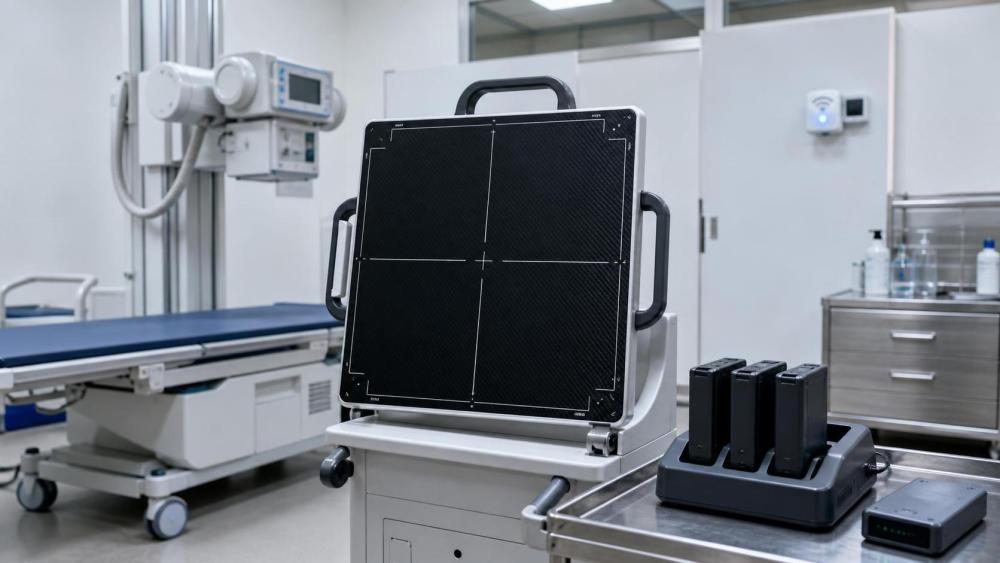
Ingress protection should be reviewed alongside drop rating. A detector that survives shock but is vulnerable to fluid ingress can still become a service problem in ICU, emergency, or surgical use. If the intended environment includes frequent disinfection, cleaning chemistry resistance also deserves attention. Mechanical survival is not only about falling; it is about repeated stress in demanding clinical handling.
Weight and ergonomics are part of this discussion. Heavier detectors sometimes feel more robust, but they may also increase handling fatigue and raise the chance of accidental drops during long mobile rounds. Grip design, edge contour, anti-slip surfaces, and center-of-mass balance can affect survivability as much as the formal drop test rating.
When comparing vendors, ask for field failure data if available, though suppliers may only provide limited information. Service records from reference sites can be more informative than marketing claims. If multiple sites report cracked housings, latch failures, or battery door damage, that is more relevant than an impressive nominal drop specification.
Image transfer speed should be measured as workflow responsiveness
Image transfer speed is often presented as a technical transmission parameter, but clinicians and technologists experience it as waiting time. For evaluation purposes, the key issue is not simply raw wireless bandwidth. It is the time from exposure to usable image availability at the workstation or console.
This interval includes several elements:
- detector readout time,
- onboard processing,
- wireless network transmission,
- console-side processing and rendering,
- possible delays caused by network congestion or roaming.
Vendors may advertise rapid transfer speeds under ideal wireless conditions, but hospital environments are rarely ideal. RF interference, competing network traffic, architectural shielding, and movement between rooms can affect consistency. In a mobile DR context, stable transfer performance matters more than best-case speed in a showroom.
Technical teams should separate three related but different concepts:
- Preview speed: how fast a first image appears for positioning or quality check.
- Full diagnostic image availability: when the image is fully processed and ready for interpretation or archive workflow.
- Recovery speed between exams: how quickly the detector is ready for the next exposure cycle.
A detector may appear fast because preview images load quickly, while the actual exam cycle remains slower due to background processing or transmission delay. For high-volume rooms, the recovery interval is especially important. For critical care and trauma, preview responsiveness may have greater value.
Evaluators should also ask whether wired fallback is available and practical. In facilities where wireless congestion is unpredictable, a detector that supports efficient wired transfer during troubleshooting may reduce downtime risk.
These criteria should not be assessed independently
Battery life, drop rating, and transfer speed influence one another through the detector’s design trade-offs. For example, a manufacturer may optimize for lighter weight and faster handling, which can improve mobility but reduce impact tolerance. A larger battery may support longer use but add weight, increasing fatigue and accidental drop risk. Aggressive wireless performance can consume more power, reducing real-world battery endurance.
That is why a weighted comparison model usually works better than a direct feature checklist.
In a mobile ward imaging environment, battery performance and rugged handling may deserve higher priority than extreme transfer speed. In a busy emergency imaging station, speed and drop resilience may outweigh battery duration if swap batteries are readily available. In a fixed room with occasional overflow portable use, all three may be secondary to detector compatibility with the installed imaging chain.
Technical evaluation becomes more accurate when the detector is mapped to actual use profiles rather than to generic department labels.
How to build a practical comparison matrix
A useful evaluation matrix should combine vendor specifications with use-case testing. Instead of comparing only published numbers, create scenarios that reflect actual hospital conditions.
Typical scenarios may include:
- mobile morning rounds with continuous transport between wards,
- emergency department peak-hour exam cycles,
- ICU use with frequent cleaning and constrained handling space,
- general radiography backup use when fixed systems are overloaded,
- operating room usage with strict turnaround expectations.
For each scenario, score the detector on practical questions:
- Can it complete the expected exam volume without battery intervention?
- How disruptive is the battery swap or recharge process?
- Does handling feel secure with gloved hands and rapid patient turnover?
- How quickly does the image appear under actual network conditions?
- Does response time remain stable when moving across coverage zones?
- What is the likely service consequence of accidental impact?
Site trials, even short ones, often reveal more than formal demonstrations. If a full trial is not possible, request a supervised operational simulation using the hospital’s own workflow and network environment.
Common selection mistakes
One frequent mistake is treating battery life as a simple count of exposures. In practice, idle behavior, wake cycles, software state, and transport patterns can reduce usable runtime significantly.
Another is assuming drop rating equals durability. It does not account for repeated minor impacts, cleaning-related wear, housing seal integrity, or long-term handling stress.
A third mistake is overvaluing headline transfer speed without testing network dependency. In hospitals with complex wireless infrastructure, variability may matter more than speed.
Technical evaluators also sometimes underweight service logistics. A detector with acceptable performance can become problematic if spare batteries, replacement parts, or local technical support are slow to obtain. In cross-border procurement, this becomes even more important. Documentation, service training, regulatory readiness, and post-sale parts supply can affect uptime as much as detector hardware.
Questions worth sending to suppliers before final comparison
Well-structured supplier questions usually improve selection quality more than requesting another brochure revision. Useful requests include:
- documented battery test conditions and expected cycle degradation,
- drop-test methodology and post-impact functional verification,
- image transfer timing under standard and congested network conditions,
- recommended number of spare batteries per detector for specific workloads,
- service turnaround time for cracked panels or wireless module faults,
- cleaning compatibility documentation,
- reference installations in comparable clinical environments,
- software and console compatibility details,
- warranty coverage exclusions related to accidental damage.
The warranty point is especially important. Some detectors carry strong ruggedness claims but limited accidental damage coverage. That gap should be visible before procurement, not after the first service event.
What a sound decision usually looks like
For most hospitals, the right wireless detector is not the one with the strongest single specification. It is the one whose battery behavior, physical resilience, and transfer responsiveness remain acceptable under routine stress, with support conditions that match the institution’s maintenance reality.
If the intended use is mobile and intensive, prioritize operational endurance, battery logistics, and real-world handling durability. If the detector will support high-throughput exam turnover, focus on end-to-end image availability rather than nominal transmission claims. If the site has inconsistent wireless conditions, insist on testing stability instead of relying on advertised speed.
Wireless detector selection works best when technical teams move the discussion away from isolated features and toward sustained workflow performance. That is the level at which battery life, drop rating, and image transfer speed become meaningful procurement criteria rather than attractive marketing specifications.
Have questions about the global trade trends discussed here, or planning your expansion and supply chain strategy? Leave a message below and let the trade experts at MTHH guide you.
We respect your privacy. Your information is strictly confidential.
Related News
- How to choose diagnostic imaging equipment for small clinicsNov 14, 2026Choose diagnostic imaging equipment for clinics with confidence. Compare clinical needs, costs, space, workflows, and supplier support before you buy.
- How to size medical gas pipelines for peak demandNov 09, 2026Medical gas pipeline systems design starts with peak demand. Learn how to size pipes, calculate pressure loss, and check critical paths for reliable performance.
- What Trendelenburg angle should an operating table provide?Nov 05, 2026Compare operating tables Trendelenburg angles, load limits and accessories. Discover what to check before choosing the right table for your procedures.
- How to estimate the total cost of hospital imaging equipmentNov 04, 2026Plan hospital capital equipment imaging investments with confidence. Learn to estimate installation, service and operating costs and compare bids fairly.