
China Tightens Export Controls on Medical Helium, Raising Pressure on MRI Cooling Supply Chains
China's joint announcement on August 14, 2026 to place temporary export controls on medical-grade helium-3 and high-purity helium adds a new point of pressure to the supply chain behind advanced medical imaging and superconducting treatment systems. Under the notice, export licensing will apply from September 1, 2026 to medical helium meeting the stated purity and isotope concentration thresholds, directly affecting equipment makers and after-sales service providers that rely on liquid-helium-based low-temperature cooling.
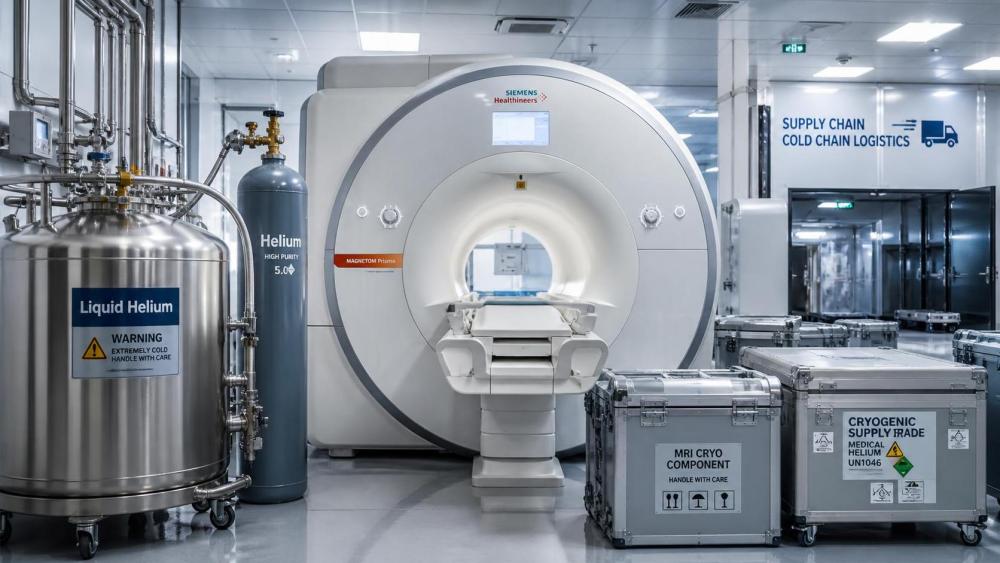
The immediate industry relevance is less about a broad change in hospital demand and more about a narrower but critical operating dependency: cooling support for MRI, PET-MRI, and superconducting proton therapy systems. These platforms depend on stable cryogenic conditions, which means any new licensing step around qualifying helium could translate into longer procurement cycles, more cautious spare-parts planning, and added uncertainty in maintenance response for installed equipment outside China.
Why the policy matters to the equipment chain
Based on the information provided, the measure targets medical-grade helium with very high purity and a defined helium-3 concentration threshold. That makes the announcement especially relevant to high-end imaging and superconducting device ecosystems rather than to the healthcare sector in general. In practice, the most exposed links may be manufacturers managing production schedules, service organizations responsible for uptime commitments, and parts distributors coordinating cross-border replenishment.
Short term, the first effects may appear in service logistics rather than in headline equipment deliveries. After-sales teams typically depend on predictable access to cooling-related materials and replacement support. If export approvals add time or procedural complexity, maintenance planning could become less flexible, particularly for systems that require fast intervention to avoid downtime.
What companies will likely watch next
From a market perspective, the key question is not only whether exports remain possible under license, but how smoothly the licensing process functions in practice. Companies across the supply chain will likely focus on several points: the pace of permit review, the operational definition applied at customs and compliance stages, and whether existing service inventories are enough to absorb any transition period after the September 1 start date.
For manufacturers and service providers, this development may also push a broader reassessment of where cooling-related supply risk sits inside their installed-base support model. That does not by itself imply an immediate disruption, but it does suggest that procurement, compliance, and field service teams may need tighter coordination than before.
A signal beyond one material category
This announcement also carries a wider industry signal. When a highly specialized input tied to advanced medical equipment moves under export-license management, companies may read it as a reminder that critical performance materials can become a policy variable, not just a sourcing variable. For sectors built around superconducting systems, that can reshape how resilience is evaluated, especially for cross-border service commitments.
At this stage, the confirmed facts are limited to the joint policy release, its effective date, the specified helium criteria, and the categories of affected equipment referenced in the source information. The extent of downstream impact will still depend on how the licensing regime operates after implementation and how companies adjust inventory, compliance, and maintenance planning in response. Further clarity will likely come from subsequent official notices, regulatory information, and public disclosures from affected equipment and service businesses.
Have questions about the global trade trends discussed here, or planning your expansion and supply chain strategy? Leave a message below and let the trade experts at MTHH guide you.
We respect your privacy. Your information is strictly confidential.
Related News
- How to choose diagnostic imaging equipment for small clinicsNov 14, 2026Choose diagnostic imaging equipment for clinics with confidence. Compare clinical needs, costs, space, workflows, and supplier support before you buy.
- How to size medical gas pipelines for peak demandNov 09, 2026Medical gas pipeline systems design starts with peak demand. Learn how to size pipes, calculate pressure loss, and check critical paths for reliable performance.
- What Trendelenburg angle should an operating table provide?Nov 05, 2026Compare operating tables Trendelenburg angles, load limits and accessories. Discover what to check before choosing the right table for your procedures.
- How to estimate the total cost of hospital imaging equipmentNov 04, 2026Plan hospital capital equipment imaging investments with confidence. Learn to estimate installation, service and operating costs and compare bids fairly.