
How to assess a gauze products supplier’s quality control process
Start with the intended clinical use and product claim
A gauze products supplier should be assessed against the risk created by the specific product being purchased, not against a generic idea of “good quality.” A non-sterile gauze roll used for routine dressing preparation, a sterile gauze sponge placed on a wound, and an X-ray detectable surgical gauze used in an operating theatre do not carry the same failure consequences. The supplier’s controls should match the product’s intended use, packaging configuration, and claims.
For quality and safety managers, the first question is whether the supplier can clearly define what each product is designed to do and what it is not designed to do. Ambiguous descriptions such as “medical-grade,” “high absorbency,” or “sterile use” are not enough. The product specification should state material composition, ply count, dimensions, thread or fibre characteristics where relevant, absorbency requirements, radiopacity if claimed, sterility status, and single-use or reusable designation.
A supplier that cannot maintain a stable, controlled specification creates risk before production is even considered. A change in cotton source, fibre preparation, mesh construction, adhesive, folding method, or packaging film can affect linting, absorbency, tensile behavior, sterility maintenance, or clinical handling. Procurement teams should therefore ask which changes require customer notification, internal quality review, or revalidation.
Traceability should run from raw material to the shipment received
Gauze may appear to be a simple consumable, but a finished pack is the output of several linked processes: raw material sourcing, bleaching or treatment, weaving or nonwoven conversion, cutting and folding, packaging, sterilization where applicable, storage, and distribution. Quality control is credible only when the supplier can connect these steps through lot-level records.
Review how the supplier identifies and releases incoming materials. For cotton gauze, the assessment should cover the source and identity of the fibre or fabric, material acceptance criteria, supplier qualification practices, and controls for contamination or unintended material substitution. For blends, coated products, or products with radiopaque threads, the bill of materials should show each component and its approved source.
Traceability should also extend to packaging materials. A sterile product can meet its finished-product test requirements and still fail in use if the pouch seal, peel strength, barrier material, or carton protection is inconsistent. In practical terms, the supplier should be able to identify the packaging batch used for a given finished-product lot and identify every customer shipment affected if a defect is found later.
Ask the supplier to demonstrate this process with a recent batch record rather than relying only on a written procedure. A useful demonstration starts with a finished product lot number and works backward to its production date, raw material lots, packaging lots, in-process inspection results, sterilization records where applicable, final release decision, and shipping destination. It should also work in the opposite direction: from a questionable raw-material lot to all affected finished goods.
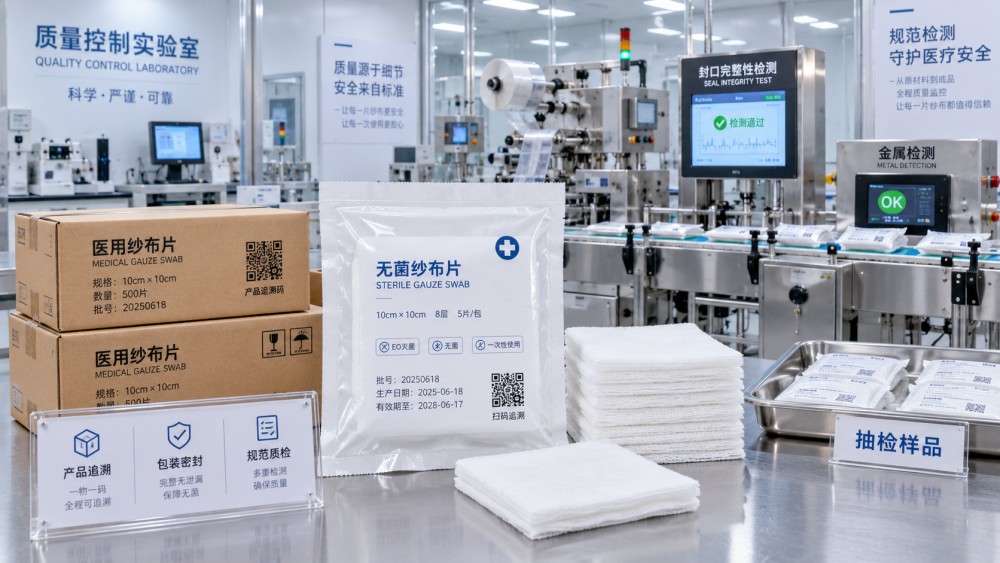
Examine the controls at the points where gauze quality can change
Finished-product inspection matters, but it cannot compensate for weak process control. If the only evidence offered is a final certificate or a visual check of packed gauze, the buyer has limited assurance that variation was identified before product release. The assessment should focus on the steps most likely to alter clinical performance.
For woven gauze, these points may include fabric construction, cutting, edge finishing, folding, counting, and detection of foreign material. For nonwoven products, web formation, bonding, cutting, and material consistency may be more important. The exact process differs, yet the control logic is similar: the supplier should define acceptable limits, monitor them at appropriate intervals, document the result, and respond when a result falls outside tolerance.
Inspection criteria should be linked to practical product risks. Consider whether the supplier checks for loose fibres, holes, stains, oil marks, incomplete folds, incorrect ply count, size variation, foreign matter, damaged edges, and incorrect piece counts. Where absorbency, tensile strength, or lint performance is part of the specification, obtain clarity on how those characteristics are tested and how often testing is performed.
Do not assume that a sample from a sales representative proves batch consistency. Pre-purchase samples are useful for clinician handling assessment, but their value is limited unless they are representative of normal production and accompanied by a defined specification. The stronger question is whether routine lots are tested to the same requirements and whether exceptions are visible in the release records.
Sampling plans must fit the risk of the defect
Suppliers often use sampling inspection because testing every unit would be impractical or destructive. That approach can be appropriate, but the buyer should understand the sampling plan rather than accept the phrase “100% quality checked” without definition. A 100% visual inspection for obvious contamination does not prove sterility, absorbency, packaging seal integrity, or correct material composition.
Ask which attributes receive full inspection, which receive statistical sampling, and which are validated through process controls. The answer should distinguish between critical defects, such as contamination, a wrong sterility label, or a packaging breach, and lesser defects such as minor cosmetic variation that does not affect use. A supplier’s acceptance criteria should reflect that distinction.
Sterile gauze requires evidence beyond a sterilization certificate
For sterile gauze products, the assessment needs to cover the full sterile barrier system and the validated sterilization process. A sterilization certificate alone is a narrow piece of evidence. It may confirm that a particular cycle was completed, but it does not establish that packaging was intact before sterilization, that the validated load configuration was followed, or that the product will remain sterile through its stated shelf life.
Review the supplier’s sterilization arrangements, whether the process is carried out in-house or by a qualified external provider. The documentation should identify the sterilization method used and show that the process is validated for the relevant product and packaging configuration. Any material, packaging, load, or facility change that could influence sterilization effectiveness or package performance should be controlled under formal change management.
Packaging controls deserve equal attention. Seal integrity, seal width, seal location, pouch material, label adhesion, and carton protection all affect whether the sterile barrier survives handling and transport. Buyers should ask how the supplier verifies package integrity during routine production, how it handles seal failures, and how it assesses transport-related damage.
Shelf-life claims should be supported by a documented approach appropriate to the product and target market. Avoid treating a long expiry date as a commercial advantage in isolation. The practical issue is whether the supplier can maintain product performance and packaging integrity through warehousing, shipping, and normal hospital stock rotation. This matters especially when products will pass through a distributor network or be stored in variable environmental conditions.
Assess the quality system through its response to failure
Many suppliers can present certificates, procedures, and clean production photographs. A more revealing assessment asks what happened when their controls did not work as planned. The quality system should show how nonconforming product is identified, physically segregated, investigated, dispositioned, and prevented from entering released stock.
Request examples of the types of deviations the supplier records, without requiring confidential commercial detail. The useful evidence is the structure of the response: a clear problem description, containment action, root-cause analysis, corrective action, responsibility assignment, effectiveness review, and closure. Repeated problems with the same cause, or corrective actions that consist only of retraining without addressing process conditions, are warning signs.
Complaint handling is equally important for a gauze products supplier serving healthcare channels. The supplier should be able to receive a complaint with a lot number, assess whether other lots may be affected, communicate findings, and initiate field action where necessary. A slow or informal complaint process can turn an isolated quality issue into a broader patient-safety or inventory-management problem.
- How are returned goods, customer complaints, and internal defects coded and trended?
- Who has authority to stop release or place stock on hold?
- How quickly can the supplier identify customers who received a specified lot?
- How are corrective actions checked for effectiveness after implementation?
- What is the escalation path when a defect could affect sterility, contamination control, or clinical use?
These questions also help separate a supplier with an operating quality system from one that has documentation mainly for qualification purposes.
Confirm that documentation matches the market and the product
The documents required for gauze products depend on the product classification, claims, sterility status, destination market, and the role of the buyer in the supply chain. A certificate that is acceptable for one market or one product configuration may not support another. Quality managers should therefore review the documentation against the exact stock keeping unit, label, intended use, and country of sale.
The review should include the current product specification, labeling and instructions where supplied, batch or lot identification format, declaration of materials where relevant, manufacturing and release records, and evidence supporting claims made on the label. For sterile products, confirm that the documentation clearly identifies sterile status, packaging configuration, expiry format, storage instructions, and the circumstances in which a pack must be discarded.
Certification of a quality management system can be a useful starting point, but it should not replace product-specific evaluation. The scope of certification should be relevant to the supplier’s actual operations. A trading company, converter, contract packer, and sterilization provider may each have different responsibilities. The buyer needs a clear map of who performs which activity and who holds final responsibility for release, technical documentation, complaints, and corrective action.
Put quality requirements into the purchasing controls
A supplier audit has limited value if the purchase order permits uncontrolled substitution or if incoming inspection has no practical way to identify a changed product. The approved specification, quality agreement, and receiving controls should translate the assessment into enforceable supply conditions.
For higher-risk or sterile gauze products, purchasing controls should define the approved product configuration, lot documentation required on delivery, notification expectations for material or process changes, treatment of out-of-specification goods, complaint response expectations, and traceability information required on cartons and shipping documents. Requirements should be proportionate. Imposing extensive audit obligations on a low-risk non-sterile commodity may consume resources without improving safety, while relying on basic commercial terms for sterile wound-care products leaves a meaningful gap.
Cost should be considered within that risk framework. A lower unit price can be outweighed by frequent receiving failures, missing lot records, high complaint handling effort, product wastage from damaged packaging, or the need to hold larger buffer inventory because supply consistency is uncertain. Conversely, a higher-priced source is not automatically lower risk. The supplier must show that its controls are repeatable and that quality performance can be verified.
A practical approval decision is usually based on three forms of evidence: documents that define the product and system, records that show routine control, and samples or audit observations that confirm the written process reflects actual operations. When those three sources align, the buyer has a defensible basis for qualification. When they conflict, the unresolved gap should carry more weight than the supplier’s price or marketing claims.
Have questions about the global trade trends discussed here, or planning your expansion and supply chain strategy? Leave a message below and let the trade experts at MTHH guide you.
We respect your privacy. Your information is strictly confidential.
Related News
- How to verify CE marking on rehabilitation consumables in GermanyNov 13, 2026Buying rehabilitation consumables in Germany? Learn how to verify CE marking, check MDR documents and spot supplier red flags before ordering.
- How to assess a medical consumables management supplier's ability to prevent stockoutsNov 11, 2026Evaluate a medical consumables management supplier with practical checks for forecasting, inventory visibility and contingency plans to reduce stockout risk.
- FDA Alert: Arrow Removes Guidewire Products Over Coating Shedding RiskNov 11, 2026FDA alert: Arrow guidewire products face voluntary removal over potential coating shedding. Explore the risks and key checks for buyers and healthcare providers.
- How does order volume affect disposable medical supplies cost?Nov 07, 2026Discover how order volume affects disposable medical supplies cost and learn to balance bulk discounts, storage, expiry risk, and reliable supply.