
Hospital Disposable Products Wholesale: How to Compare MOQ, Lead Time, and Quality Risk
Why does hospital disposable products wholesale need more than a price comparison?
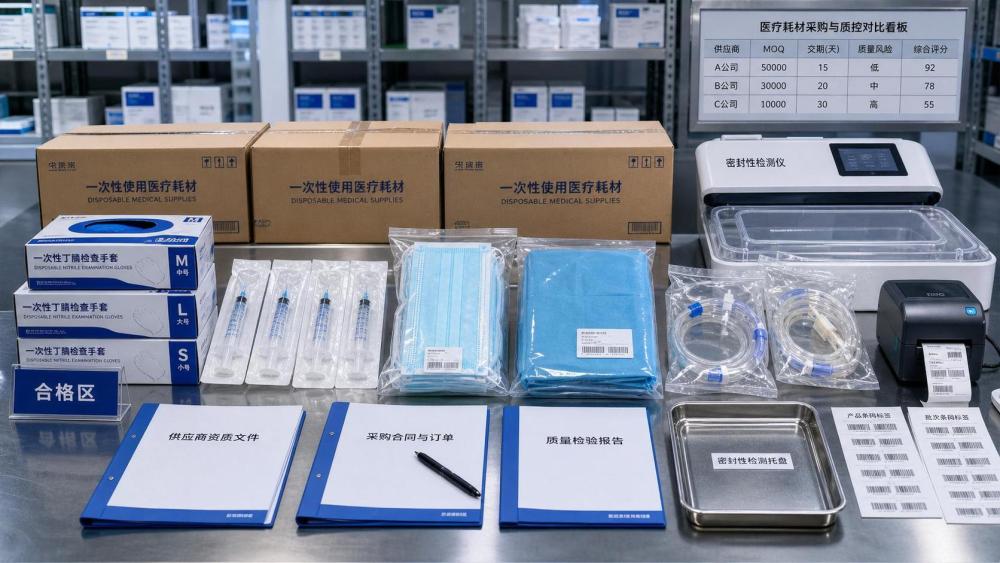
In hospital disposable products wholesale, a low unit price can be misleading.
Gloves, syringes, drapes, tubing, masks, specimen consumables, and infection control items move quickly, but the buying risk is not simple.
A small pricing gap may look attractive today, yet unstable supply or weak documentation can create much larger costs later.
That is why hospital disposable products wholesale is usually judged through three linked factors: MOQ, lead time, and quality risk.
MOQ affects inventory pressure and cash flow.
Lead time affects continuity, stock planning, and emergency response.
Quality risk affects clinical safety, complaint rates, and compliance exposure.
In practice, these factors should be reviewed together, not one by one.
A supplier with a higher MOQ may still be acceptable if production is stable and defect control is strong.
Likewise, a fast lead time means little if batch consistency keeps changing.
This is also where structured industry sources become useful.
MTHH often frames medical procurement around real operating conditions, documentation quality, and long-term value rather than quote-only comparison.
That approach fits hospital disposable products wholesale especially well, because routine consumables directly influence daily clinical workflow.
How should MOQ be judged without overbuying or underbuying?
MOQ is not just a negotiation number.
It reflects factory scheduling, raw material planning, packaging setup, and sometimes the supplier’s confidence in future order continuity.
The common mistake is treating low MOQ as automatically better.
A very low MOQ can mean fragmented production, unstable cost control, or reduced priority during peak demand.
A very high MOQ creates the opposite problem.
It ties up budget, increases storage burden, and raises expiry risk for products with shorter shelf-life windows.
A better way to compare hospital disposable products wholesale suppliers is to ask four practical questions:
- Is MOQ based on one SKU, mixed SKUs, or one container load?
- Can trial orders be separated from regular purchase terms?
- Does MOQ change for private label, custom packaging, or special sterilization needs?
- What stock level is realistic based on actual monthly consumption?
In hospital disposable products wholesale, flexibility often matters more than the headline number.
A supplier offering moderate MOQ with mixed-carton options may be more valuable than one quoting a slightly lower price on rigid volume terms.
This is especially relevant when usage patterns change across wards, labs, outpatient settings, or emergency stock reserves.
More careful buyers also compare MOQ against reorder frequency.
If reorder cycles are predictable and supply is dependable, a somewhat larger MOQ may reduce administrative cost and freight inefficiency.
When a supplier promises fast lead time, what should be checked first?
Lead time in hospital disposable products wholesale is often discussed too loosely.
Some quotations refer only to production days.
Others include packaging, sterilization, inspection, export paperwork, and shipping release.
Without clarification, “20 days” may mean very different things.
The first check is whether lead time is standard, rush, or best-case timing.
The second is whether the supplier measures from PO confirmation, artwork approval, deposit receipt, or raw material availability.
The third is whether the lead time has been stable across previous batches.
That last point matters most.
A 30-day lead time delivered consistently can be easier to manage than a nominal 15-day promise that regularly slips.
For hospital disposable products wholesale, delay risk should be reviewed at both factory and logistics level.
- Factory constraints: resin, nonwoven fabric, paper-plastic packaging, EO sterilization slots, labor scheduling.
- Logistics constraints: port congestion, booking shortages, customs documents, destination clearance.
- Market constraints: seasonal infection-control demand, tender spikes, policy-driven stockpiling.
MTHH’s broader healthcare procurement perspective is useful here.
It repeatedly shows that reliability in medical supply chains depends on process visibility, not only factory capacity claims.
In other words, hospital disposable products wholesale works better when lead time is verified with evidence, not sales language.
What quality risks are most often missed in disposable medical purchasing?
Quality risk is rarely limited to visible defects.
In hospital disposable products wholesale, risk often appears through small inconsistencies that become serious at scale.
Examples include weak sealing, puncture variation, poor fit, labeling mismatch, sterile barrier damage, and carton-level traceability gaps.
Some issues affect workflow before they trigger complaints.
A glove with unstable sizing slows routine use.
A syringe plunger with inconsistent resistance creates user dissatisfaction.
A drape with poor folding logic wastes preparation time.
That is why document review should sit beside sample review.
Useful checks usually include:
- Product specifications matched to actual clinical use.
- Quality system records, batch traceability, and change-control discipline.
- Sterilization validation, biocompatibility, and shelf-life support where applicable.
- Labeling consistency across unit pack, inner box, and outer carton.
- Complaint handling speed and CAPA responsiveness.
For cross-border hospital disposable products wholesale, documentation readiness matters even more.
A technically acceptable product can still become unusable if registration files, declarations, or labeling requirements are incomplete.
This mirrors the larger medical technology logic that MTHH emphasizes across devices, diagnostics, infrastructure, and consumables.
Is there a practical way to compare MOQ, lead time, and quality risk side by side?
Yes, and it should be simple enough to use before final negotiation.
The table below works as a quick judgment tool for hospital disposable products wholesale.
This kind of side-by-side view makes hospital disposable products wholesale more measurable.
It also prevents one attractive quote from overshadowing operational weaknesses.
Which mistakes make total cost look lower than it really is?
The most expensive error is focusing on ex-works price while ignoring handling cost around it.
Hospital disposable products wholesale should be evaluated through total supply cost, not purchase price alone.
Hidden cost often appears in five places.
- Excess inventory caused by oversized MOQ.
- Emergency freight caused by unstable lead time.
- Inspection and complaint processing caused by quality variation.
- Relabeling or document correction caused by compliance gaps.
- Clinical workflow inefficiency caused by poor usability.
This is why some buyers keep a simple landed-cost model beside the supplier comparison sheet.
It does not need to be complex.
A realistic model can include unit price, freight, local clearance, inspection cost, average delay cost, and expected nonconformity cost.
In actual use, hospital disposable products wholesale becomes easier to defend internally when cost assumptions are visible and documented.
That discipline also aligns with the broader MTHH view that healthcare procurement should connect technical suitability with commercial practicality.
What should be done before placing the next order?
A workable next step is to build a short supplier decision sheet.
Keep it focused on usage volume, acceptable MOQ range, verified lead time, required documents, and batch-level quality expectations.
Then test each supplier against the same questions.
For hospital disposable products wholesale, consistency in evaluation is often more valuable than adding more suppliers too quickly.
It also helps to separate routine items from critical-use items.
Routine consumables may allow broader MOQ and lead time flexibility.
High-risk or sterile products usually deserve tighter review and stronger documentation checks.
The central lesson is straightforward.
Hospital disposable products wholesale works best when price, supply continuity, and quality control are judged together.
Before confirming the next order, review actual consumption, compare reorder flexibility, verify lead time assumptions, and stress-test quality documents against the intended market.
That process creates a better basis for stable purchasing decisions and fewer surprises after delivery.
Have questions about the global trade trends discussed here, or planning your expansion and supply chain strategy? Leave a message below and let the trade experts at MTHH guide you.
We respect your privacy. Your information is strictly confidential.
Related News
- How to verify CE marking on rehabilitation consumables in GermanyNov 13, 2026Buying rehabilitation consumables in Germany? Learn how to verify CE marking, check MDR documents and spot supplier red flags before ordering.
- How to assess a medical consumables management supplier's ability to prevent stockoutsNov 11, 2026Evaluate a medical consumables management supplier with practical checks for forecasting, inventory visibility and contingency plans to reduce stockout risk.
- FDA Alert: Arrow Removes Guidewire Products Over Coating Shedding RiskNov 11, 2026FDA alert: Arrow guidewire products face voluntary removal over potential coating shedding. Explore the risks and key checks for buyers and healthcare providers.
- How does order volume affect disposable medical supplies cost?Nov 07, 2026Discover how order volume affects disposable medical supplies cost and learn to balance bulk discounts, storage, expiry risk, and reliable supply.