
What the IVDR implementation date means for legacy IVD devices
What the IVDR Implementation Date Means for Legacy IVD Devices
The IVDR implementation date is a critical milestone for manufacturers, distributors, laboratories, and healthcare procurement leaders managing legacy IVD devices in the EU market. Understanding the transition timelines, eligibility conditions, and documentation expectations can help decision-makers reduce supply disruption, protect market access, and plan compliant product portfolios.
For many businesses, the question is no longer simply whether a diagnostic product is “IVDR-ready.” The practical question is whether each assay, instrument, software component, calibrator, control material, or sample collection device can remain legally available while the manufacturer completes its transition from the In Vitro Diagnostic Medical Devices Directive (IVDD) to the In Vitro Diagnostic Medical Devices Regulation (IVDR).
That distinction matters because the EU in vitro diagnostics market is built around connected systems. A laboratory analyzer may depend on proprietary reagents, consumables, middleware, service support, and quality-control materials. If a single product in that ecosystem loses market access, laboratories may face validation work, procurement changes, inventory pressure, and potential disruption to established testing pathways.
The implementation date was not the end of the transition
The IVDR became applicable on 26 May 2022. This was the formal implementation date, but it did not mean that every IVDD-certified or IVDD-compliant IVD device had to disappear from the EU market on that day. EU legislators introduced transitional provisions because the diagnostic industry faced a major shift in classification, conformity assessment, clinical evidence expectations, and notified body involvement.
Under the IVDD, many IVD products could be placed on the market through manufacturer self-declaration. Under the IVDR, a much larger share of devices requires notified body involvement. This includes products that are now classified as Class B, C, or D under the IVDR risk-based system. The change affects not only high-risk infectious disease assays or blood screening tests, but also a broad range of routine laboratory diagnostics.
The extended transition periods are therefore best understood as controlled market-access bridges. They are not a blanket exemption from IVDR. A legacy device may continue to be supplied only if it meets specified conditions and remains within the relevant transitional pathway.
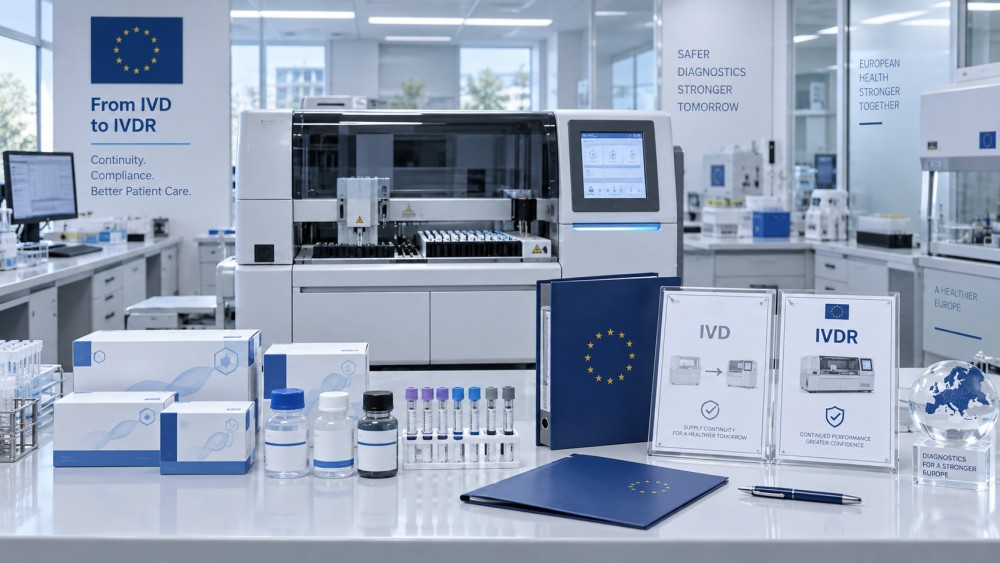
Which devices are considered legacy IVD devices?
In broad terms, a legacy IVD device is an IVD that was lawfully placed on the market under the IVDD and is eligible to remain available during the IVDR transition. However, the exact eligibility position depends on how the device was certified or declared under the old framework, its IVDR classification, and whether the manufacturer continues to meet the conditions set out in the Regulation.
A device supported by an IVDD certificate issued by a notified body before 26 May 2022 may follow one route. A device that was self-declared under the IVDD but now requires notified body involvement under the IVDR may follow another. The dates are important, but the underlying documentation history is equally important. A product portfolio cannot be assessed reliably from its commercial name alone.
For decision-makers, this means that a supplier statement saying “IVDR transition ongoing” is not enough. The useful questions are more specific: Was the device legally placed on the EU market under the IVDD? What is its IVDR class? Is its current configuration unchanged in a regulatory sense? Has the manufacturer entered the notified body process where required? What evidence supports continued supply after each deadline?
The transition deadlines depend on IVDR classification
The IVDR transition timetable has been amended to give manufacturers more time, while still prioritizing higher-risk devices. For eligible legacy devices, the relevant end dates are generally linked to IVDR classification:
These dates should not be treated as a reason to defer preparation. A manufacturer that misses earlier procedural milestones may lose the benefit of the later transition end date. In addition, the transition period concerns placing a device on the market under the applicable conditions; commercial inventory planning and national implementation practices should be reviewed separately with appropriate regulatory advice.
The conditions behind the extended timelines
The extended deadlines are conditional. In general, legacy devices must continue to comply with the IVDD requirements that apply to them, and manufacturers cannot make significant changes in design or intended purpose during the transition. This is one of the areas most likely to create misunderstanding.
A change that appears commercially minor may be more consequential from a regulatory perspective. A revised intended use, a new patient population, an expanded specimen type, a substantially altered assay workflow, or a software change affecting diagnostic performance may require careful evaluation. The same caution applies to changes in manufacturing arrangements, reagent formulation, performance claims, and instrument compatibility. Whether a change is “significant” should be assessed against the applicable regulatory guidance and the device’s own technical documentation.
For devices that require notified body certification under IVDR, manufacturers also need to observe the transition milestones introduced by the amended Regulation. In general, the IVDR quality management system should be in place by 26 May 2025. Manufacturers seeking a notified body route generally need to submit a formal application by that date and conclude a written agreement with a notified body by 26 September 2025, subject to the specific conditions and exceptions that may apply.
This is why a portfolio review should distinguish between a distant market deadline and an immediate internal deadline. The end of 2028 or 2029 may look comfortably far away, but notified body capacity, technical file remediation, performance evaluation work, and quality-system alignment can take substantial time.
Why the market impact reaches beyond manufacturers
The IVDR implementation date affects commercial planning throughout the diagnostic supply chain. Manufacturers must decide which products justify transition investment, which product families can share evidence or technical infrastructure, and which low-volume assays may be difficult to sustain. These decisions can reshape portfolios, especially where older products have limited sales but remain clinically relevant.
Distributors need a more disciplined view of supply continuity. It is no longer sufficient to assess an analyzer or reagent line by price, territory rights, and expected demand. Distributors may need confirmation of the manufacturer’s transition plan, regulatory contact arrangements, labeling updates, stock management assumptions, service obligations, and the future availability of associated consumables.
Laboratories and hospital procurement teams face a different operational risk. Replacing a discontinued assay can involve method comparison, verification or validation activity, staff training, LIS or middleware configuration, changes to reference ranges, and communication with clinicians. A late supplier notification may turn a regulatory timetable into a laboratory continuity problem.
This is particularly relevant for integrated diagnostic environments. A hospital may have a long-established chemistry, immunoassay, hematology, coagulation, molecular, or microbiology workflow. Changing one component may affect sample routing, turnaround times, reagent storage, maintenance schedules, quality-control procedures, and service planning. Procurement teams should therefore treat regulatory status as part of total operational value, not as a document to collect after the technical selection is complete.
A practical portfolio review before supply is affected
A useful first step is to build a device-level register rather than reviewing products only by brand or analyzer platform. Each entry should identify the legal manufacturer, IVDD status, IVDR classification, notified body pathway where relevant, transition end date, current certificate or declaration status, and the product’s role in the laboratory workflow.
The next step is commercial prioritization. Products with high testing volume are obvious candidates for close monitoring, but they are not the only concern. A low-volume assay may support a specialist clinical pathway with few alternatives. A reagent may be commercially modest yet essential to keeping an installed instrument base productive. Conversely, a high-volume routine test may have multiple validated alternatives and a more manageable replacement route.
Questions worth documenting include:
- Is the device eligible for the legacy transition period, and on what basis?
- What IVDR classification and deadline apply to the specific product?
- Has the manufacturer confirmed its notified body application and agreement status where required?
- Are there planned changes to intended use, software, assay claims, manufacturing, or labeling that could affect legacy status?
- What happens to instruments, consumables, service contracts, and laboratory workflows if the product is withdrawn?
Documentation is becoming a procurement issue
For healthcare organizations, regulatory documentation was once often handled as a supplier qualification item. Under IVDR, it increasingly influences purchasing timing and equipment lifecycle decisions. Buyers may need greater clarity on declarations of conformity, certificate validity, labeling, vigilance arrangements, post-market surveillance responsibilities, and the regulatory status of connected software or accessories.
This does not mean procurement departments should try to replace regulatory specialists. It means procurement, laboratory leadership, clinical engineering, quality teams, and distributors should work from a shared set of questions before contracts or long-term supply commitments are finalized. A technically capable analyzer has limited value if its reagent menu becomes uncertain; similarly, a compliant assay can still create operational problems if service, training, and integration support are weak.
Platforms such as Global MedTech & Healthcare Intelligence Hub (MTHH) can help structure these early discussions by connecting technical equipment information with procurement, documentation, maintenance, reagent dependency, and workflow considerations. For IVD decision-makers, the point is not to turn every buyer into a regulatory expert. It is to ensure that regulatory transition risk is visible before it becomes a supply interruption.
The strategic message behind the IVDR transition
The IVDR implementation date should be viewed as part of a longer market reset. Manufacturers are reassessing which diagnostic products to transition, notified bodies are managing complex certification workloads, and healthcare providers are asking more detailed questions about continuity of supply. Over time, this may influence assay availability, distributor portfolios, tender specifications, and the economics of niche testing.
For business leaders, the most sensible response is not broad reassurance or last-minute stockpiling. It is a documented, product-by-product assessment that links regulatory status to clinical need, demand forecasts, alternative options, and contract commitments. The deadlines are known; the exposure usually lies in the details of a specific device, its documentation history, and its place in the diagnostic workflow.
Before renewing a distribution agreement, committing to a laboratory platform, or relying on a legacy assay for future service delivery, confirm the applicable IVDR transition route with the legal manufacturer and review the latest EU requirements. That conversation is far more valuable when it happens before the transition date becomes an urgent operational problem.
Have questions about the global trade trends discussed here, or planning your expansion and supply chain strategy? Leave a message below and let the trade experts at MTHH guide you.
We respect your privacy. Your information is strictly confidential.
Related News
- Abbott Launches Next-Generation Whole-Genome Sequencing Oncodetect MRD TestOct 27, 2026Explore Abbott’s Oncodetect MRD test, using whole-genome sequencing to track up to 5,000 ctDNA variants. Discover key clinical evidence and procurement considerations.
- SCIEX Starts Beijing Plant Project, Danaher's Tenth Manufacturing Site in ChinaOct 24, 2026SCIEX's Beijing plant project marks Danaher's tenth manufacturing site in China. Explore how its RMB 100 million-plus investment could strengthen local mass spectrometer supply.
- How laboratory workflow solutions reduce sample processing delaysOct 23, 2026Discover how laboratory workflow solutions reduce sample processing delays, improve tracking, and streamline reporting. Explore practical steps to cut waiting times without compromising quality.
- How to evaluate a web-based LIMS for lab instrument integrationOct 22, 2026Evaluate a web based LIMS for reliable lab instrument integration. Learn how to verify connectors, test failure recovery, and compare costs before choosing your system.