
What Training Do Staff Need for a New Laboratory Information System?
A new laboratory information system (LIS) changes more than the screen used to enter results. It changes how specimens are identified, how work is routed, who may release a report, where critical values are documented, how instruments exchange data, and what the laboratory can do when connectivity fails. Training must therefore be treated as a controlled operational transition, not as a short software demonstration before go-live.
The central question is not whether staff can navigate menus. It is whether each person can perform their assigned tasks correctly under normal workload, recognize exceptions, protect patient and test data, and follow a safe fallback process when the system or an interface is unavailable. A laboratory can have a technically successful installation and still create reporting, traceability, or turnaround-time risks if role-based competency has not been established.
Training should follow the laboratory’s real roles and decisions
One generic training session rarely works because an LIS is used differently across the testing pathway. Reception staff, phlebotomy teams, laboratory technicians, section supervisors, pathologists, quality personnel, IT support, and external report users do not need the same depth of training. They do need a shared understanding of where an action in one area affects another.
For example, a registration error may prevent an analyzer result from matching the intended patient record. An incorrectly configured autoverification rule may release a result that should have been reviewed. A poorly understood user-permission model can allow inappropriate changes to a test order, reference range, or report status. Training plans should map these dependencies before they map software functions.
A useful approach is to define training around the tasks that staff must be authorized to perform in the live environment. This produces clearer evidence of readiness than attendance records alone. Someone may have attended a session on result entry, but that does not demonstrate they can resolve a duplicate patient record, manage a rejected specimen, interpret an interface exception, or document a manual correction according to laboratory procedure.
Front-end workflow: patient, order, specimen, and chain of custody
Staff who create or receive orders need training in the identity and specimen controls built into the new workflow. The specific sequence varies by laboratory and by the systems connected to the LIS, but the training should cover the decisions that create downstream risk:
- searching for an existing patient before creating a new record;
- applying the correct patient identifiers and handling demographic discrepancies;
- entering, receiving, amending, and cancelling orders under defined authorization rules;
- printing and applying specimen labels at the correct point in the collection and receipt process;
- recording collection time, receipt time, specimen condition, and rejection reasons where required;
- linking aliquots, add-on tests, recollect requests, and referral specimens to the correct original sample;
- using barcode and location-tracking functions without assuming that a successful scan proves correct specimen identity.
The important training point is that the LIS records an event; it cannot independently prove that the event was physically correct. A label can be scanned successfully after being placed on the wrong tube. A specimen can be marked as received even though its integrity is unsuitable for the requested test. Staff need to understand the distinction between system status and real-world verification, especially where high sample volumes encourage rapid, repetitive work.
Training should also address exception handling rather than only the ideal pathway. Common examples include unlabeled or mislabeled samples, duplicate orders, patients with similar names, specimens received without an electronic order, collection times entered retrospectively, and tests added after the original specimen has moved to storage or another section. These scenarios should be practiced in a training environment using realistic laboratory rules, not merely described in slides.
Bench-level training: worklists, instrument interfaces, and result handling
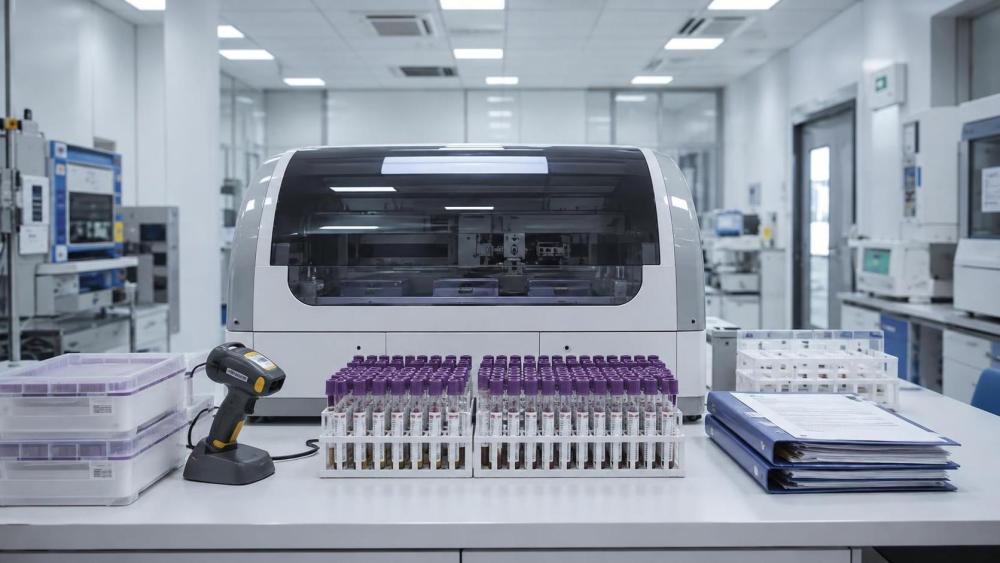
Analytical staff need practical instruction on how the LIS organizes daily bench work. This includes worklists, specimen routing, pending queues, repeat testing, dilution requests, reflex or reflective testing rules where applicable, and the handling of samples sent to another department or an external referral laboratory.
Instrument connectivity needs particular attention. When an analyzer sends results automatically, staff should know which system is the source of record for each data element, how results are matched to orders, and what an interface exception looks like. A result held in an instrument middleware queue, a failed message transmission, and a result displayed in the LIS with an error flag are different conditions. Treating them as interchangeable can leave a result unreviewed or generate unnecessary manual entry.
Manual result entry deserves dedicated competency assessment even in highly automated laboratories. Staff must understand unit selection, decimal placement, qualitative result conventions, comments, result correction procedures, and the audit trail created by each change. A manual entry process should not become an informal workaround for an interface problem. Training needs to make clear when manual entry is permitted, who may perform it, what independent check is required, and how the underlying technical issue is escalated.
Quality control information, calibration status, instrument maintenance records, and reagent lot data may sit partly in the LIS, in middleware, in an analyzer, or in a separate quality system. Staff need to know where the authoritative status is checked before patient results are released. It is unsafe to assume that a result reaching the LIS means all analytical release conditions have been met.
Result validation is a clinical control, not a click-through task
The most sensitive LIS training concerns result review and authorization. The system may apply reference intervals, delta checks, critical-value rules, interpretive comments, or autoverification logic. Each function can improve consistency, but each depends on local configuration and disciplined user behavior.
Authorized personnel should be trained to distinguish between technical validation and clinical authorization where the laboratory assigns these responsibilities separately. They need to recognize flags that require investigation, understand what an autoverified result means in that laboratory, and know when a result must be withheld, repeated, amended, or discussed with the requesting clinician.
Critical and significantly abnormal results require more than an alert on screen. Training should cover the full local communication procedure: confirming the result where necessary, identifying the appropriate recipient, documenting the communication, recording time and recipient details, and escalating when acknowledgement cannot be obtained. The LIS may support this documentation, but it does not remove the need for an agreed clinical escalation pathway.
Report amendment is another area where a simple interface can obscure significant consequences. Staff should know the difference between correcting an entry before release, issuing an amended report after release, and cancelling an invalid result. The visible report history, notification process, reason for amendment, and audit trail should be aligned with the laboratory’s quality procedures. Users must not regard deletion as an acceptable substitute for a documented correction.
Configuration awareness matters even for non-IT users
Not every laboratory employee needs administrator-level knowledge, but key users and supervisors need enough configuration awareness to recognize whether a problem is caused by workflow, user practice, master data, or system settings. Test dictionaries, sample types, reference ranges, units, reflex rules, report templates, and user roles are not background technical details. They directly influence the meaning and release of laboratory information.
Training for designated key users should include controlled change management. They should understand which changes require clinical or quality approval, how changes are tested before production use, how version history is maintained, and how staff are informed when a workflow changes. A request to add a new test code, modify a reference interval, or alter an autoverification condition should not be treated as an ordinary service request without documented review.
This is particularly important when the LIS supports multiple sites, specialties, or client laboratories. A configuration that is valid for one assay method, patient population, or reporting location may not be valid elsewhere. Training must make staff cautious about assuming that similar-looking test names or result formats are interchangeable.
Data security and user permissions require behavioral training
Laboratory information is sensitive clinical data, and access controls are only effective when users understand their purpose. Training should cover individual account use, password and multi-factor authentication requirements where deployed, secure workstation practice, session locking, and the prohibition on sharing credentials. Shared generic accounts make audit trails weak precisely when an investigation is needed.
Users also need to understand role-based access. The ability to view a patient record, edit demographics, enter a result, validate a result, alter a test definition, or create a new user should be separated according to local responsibilities. Staff should know how to request additional access and why it should not be granted informally during a busy shift.
Privacy training should include practical situations: discussing cases at shared workstations, printing reports, exporting data for audit or research, sending results by email, using screenshots for support requests, and handling access from remote locations. If supplier support personnel require temporary access, the laboratory should have a controlled process that defines approval, scope, duration, and auditability.
Security training is not limited to intentional misuse. Phishing messages, unexpected password-reset requests, misplaced printouts, and an unattended terminal can all expose information or interrupt operations. Staff need a clear route for reporting suspected incidents without delaying because they are unsure whether an event is serious enough.
Downtime procedures need rehearsal, not acknowledgement
An LIS implementation is incomplete if staff know only the online workflow. Downtime can involve a complete LIS outage, loss of network connectivity, analyzer interface failure, printer failure, or loss of connectivity to the electronic medical record. Each condition may require a different response.
Training should define how orders are received, how specimens are labeled and tracked, where results are recorded, how urgent results are communicated, who authorizes manual reports, and how data are reconciled after service is restored. The recovery process is critical: handwritten or locally recorded results must be entered or reconciled in a controlled way so that no specimen, test, correction, or critical communication is lost.
Paper forms alone do not constitute a downtime process. Staff must know where they are kept, which version is current, which identifiers are mandatory, and who coordinates the transition back to normal operation. Short simulation exercises reveal ambiguities that are hard to detect in a policy document, such as whether specimens collected during downtime receive temporary numbers and how those numbers are linked to the restored LIS record.
Competency assessment should test exceptions and workload conditions
Training completion should be separated from competency authorization. A robust assessment combines observed performance, scenario-based questions, supervised transactions in a training system, and review of role-specific documentation. The assessment should test more than routine navigation.
Relevant scenarios may include a rejected sample, a duplicate patient record, an instrument result that does not transmit, a failed delta check, a critical result requiring communication, an amended report, a user who cannot access a required function, and a partial downtime event. These are the moments when workflow knowledge becomes a patient-safety control.
Retraining should be planned after major configuration changes, new interfaces, revised reporting rules, or recurring error patterns. Refresher training can be narrower than initial implementation training, but it should be tied to real changes in responsibility or risk. Laboratories operating within accredited quality systems should also ensure that training, competence, authorization, and retraining records support their applicable management and technical requirements, including the information-management expectations relevant to ISO 15189:2022 where that standard applies.
Go-live readiness depends on support arrangements as much as course content
During early live use, staff need visible escalation routes. They should know who can resolve a workflow question, who can assess a possible configuration defect, who contacts the LIS supplier, and who has authority to approve a workaround. Uncontrolled workarounds are a common source of inconsistent records: unofficial spreadsheets, handwritten notes kept outside the approved downtime process, or verbal instructions that never reach other shifts.
At the same time, support teams need enough laboratory context to distinguish an inconvenience from a result-reporting risk. A missing shortcut is not equivalent to a failed order interface or a report released under an incorrect patient identity. Incident reporting and triage training should reflect that difference.
The strongest implementation training does not aim to turn every employee into an LIS specialist. It makes each user reliable within a defined role, clear about the limits of that role, and able to recognize when the normal electronic workflow can no longer be trusted. That is the practical standard for a new LIS: staff can protect specimen traceability, reporting accuracy, confidentiality, and continuity of service even when the process becomes non-routine.
Have questions about the global trade trends discussed here, or planning your expansion and supply chain strategy? Leave a message below and let the trade experts at MTHH guide you.
We respect your privacy. Your information is strictly confidential.
Related News
- Abbott Launches Next-Generation Whole-Genome Sequencing Oncodetect MRD TestOct 27, 2026Explore Abbott’s Oncodetect MRD test, using whole-genome sequencing to track up to 5,000 ctDNA variants. Discover key clinical evidence and procurement considerations.
- SCIEX Starts Beijing Plant Project, Danaher's Tenth Manufacturing Site in ChinaOct 24, 2026SCIEX's Beijing plant project marks Danaher's tenth manufacturing site in China. Explore how its RMB 100 million-plus investment could strengthen local mass spectrometer supply.
- How laboratory workflow solutions reduce sample processing delaysOct 23, 2026Discover how laboratory workflow solutions reduce sample processing delays, improve tracking, and streamline reporting. Explore practical steps to cut waiting times without compromising quality.
- How to evaluate a web-based LIMS for lab instrument integrationOct 22, 2026Evaluate a web based LIMS for reliable lab instrument integration. Learn how to verify connectors, test failure recovery, and compare costs before choosing your system.