
Urine Analyzers CE IVDR: What to Check Before Market Entry
Entering the EU market with urine analyzers is no longer a matter of placing a CE mark and moving forward. Under the current regulatory environment, urine analyzers CE IVDR readiness depends on a wider business review that includes evidence quality, labeling control, technical files, supply chain alignment, and post-market responsibility.
That shift matters because urine testing sits inside routine laboratory workflows where reliability, traceability, and reporting consistency directly affect purchasing decisions. For companies planning market entry, regulatory clearance and commercial readiness now need to be assessed together.
Why urine analyzers CE IVDR deserves closer attention
Urine analyzers are widely used in hospitals, clinics, independent laboratories, and screening programs. They support fast assessment of parameters such as glucose, protein, blood, ketones, leukocytes, and pH.
In business terms, these systems look straightforward. In practice, they combine hardware, software, consumables, calibration logic, user instructions, and result interpretation rules. That complexity is exactly why urine analyzers CE IVDR review needs to be thorough.
For platforms such as MTHH, this is a typical example of how medical technology decisions extend beyond the device itself. Buyers and commercial partners increasingly compare operational reliability, documentation quality, maintenance burden, and long-term support before they compare price.
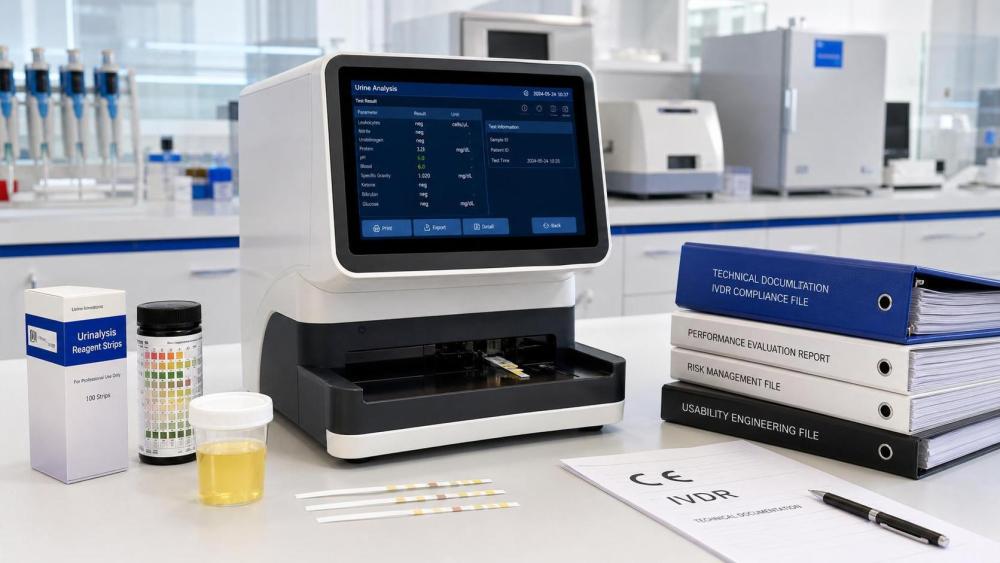
The market question is not only whether the analyzer works. It is whether the product can stand up to review by notified bodies, distributors, laboratories, and procurement teams without creating avoidable risk.
Start with classification and intended purpose
A strong market entry review begins with intended purpose. This statement influences classification, evidence requirements, labeling language, performance studies, and the scope of post-market follow-up.
For urine analyzers CE IVDR, the intended purpose should explain what the instrument measures, the patient sample type, the testing environment, the target users, and any limitations tied to reagents or strips.
Small ambiguities here can cause large downstream problems. A broad commercial claim may look attractive at launch, but it can expand the documentation burden and create conflicts with actual performance data.
This is also the stage where companies should confirm whether the analyzer is being placed as a standalone instrument, a system linked to branded consumables, or part of a wider laboratory workflow package.
Technical documentation must match the real product
Technical documentation is often treated as a submission exercise. That is too narrow. For urine analyzers CE IVDR, the file should reflect the real product configuration that will be sold, serviced, and supported in the field.
That means version control matters. Instrument firmware, software modules, strip compatibility, accessories, and user manuals need to align across the file set.
A notified body or distribution partner will quickly notice when one document describes a benchtop workflow and another describes a semi-automated system with different limitations.
Useful checkpoints include the following:
- device description and system boundaries are clearly defined
- risk management files reflect actual use conditions
- performance claims match supporting studies
- instructions for use are consistent with labeling and training material
- software lifecycle records are available where software affects results
A clean document package does more than satisfy compliance. It shortens partner due diligence and reduces friction during commercialization.
Performance evidence should be judged from a commercial angle too
Analytical and clinical performance are central under IVDR, but the practical question is whether the evidence supports market claims in real operating conditions.
For urine analyzers CE IVDR, reviewers usually look beyond sensitivity or repeatability alone. They want to know how stable results remain across strip lots, operators, lighting conditions, throughput levels, and routine maintenance intervals.
This matters especially when the analyzer is positioned for decentralized use, multi-site networks, or export distribution. A product that performs well in controlled validation may still struggle in mixed field conditions.
A commercially useful evidence package should answer the concerns of both regulators and laboratories. If it only satisfies one side, market entry can still stall.
Labeling and IFU errors can slow down launch
Labeling is often underestimated because it appears administrative. In reality, labeling failures are among the fastest ways to create review delays, distributor hesitation, and post-market complaints.
For urine analyzers CE IVDR, labels and instructions should clearly present intended use, test limitations, storage conditions, maintenance expectations, symbols, warnings, and traceability information.
More importantly, the wording should reflect the real installation and operating environment. If the analyzer depends on specific strips, cleaning procedures, or ambient conditions, those points need to be visible and unambiguous.
In multilingual EU distribution, translation control also becomes a business issue. A weak translation can distort a technical claim, trigger customer confusion, or expose the local distributor to avoidable support cases.
Post-market obligations begin before the first sale
One of the biggest shifts under IVDR is that compliance does not end with certification. Companies need a credible post-market structure before the first shipment reaches the EU market.
For urine analyzers CE IVDR, that includes complaint handling, trend analysis, vigilance reporting, corrective action processes, and post-market performance follow-up where relevant.
This has direct commercial implications. Distributors, hospital buyers, and laboratory groups increasingly ask who owns field feedback, who updates technical documents, and how fast service actions can be coordinated.
When these responsibilities remain vague, the product may still enter the market, but scale becomes difficult. Expansion across multiple countries usually exposes every weakness in support planning.
Questions worth settling early
- Who receives and triages field complaints?
- How are software updates documented and communicated?
- What is the escalation route for performance concerns?
- Which partner maintains local training records?
- How are consumable shortages managed without affecting claims?
Distributor readiness is part of urine analyzers CE IVDR readiness
In the EU, market entry often depends on local commercial partners. That makes distributor readiness more than a sales topic. It is part of operational compliance.
A distributor handling urine analyzers should understand installation conditions, routine maintenance, operator training needs, and the boundaries of approved product claims.
This is where structured healthcare intelligence becomes valuable. MTHH-style evaluation is useful because it connects regulatory files with practical procurement questions, service expectations, and total operating cost.
A launch plan is usually stronger when the following elements are aligned:
- document access for local commercial and support teams
- clear rules for promotional language and technical claims
- spare parts and consumable continuity planning
- defined installation and onboarding responsibilities
- service response expectations after placement
Without those basics, even a compliant product can underperform commercially.
A practical market entry review framework
Before launch, it helps to review urine analyzers CE IVDR from five connected angles rather than as separate departments.
The first is regulatory solidity. The second is technical consistency across instrument, software, and consumables. The third is evidence quality. The fourth is field support. The fifth is partner execution.
When one area is weak, the others absorb the cost. A commercial team may spend months answering questions that should have been resolved in the technical file. A distributor may face complaints caused by unclear IFU language. A laboratory may delay adoption because maintenance planning is incomplete.
A disciplined review before market entry usually saves more time than it costs. It also creates a better foundation for tender participation, group purchasing discussions, and long-term EU expansion.
Where to focus next
The immediate next step is to test whether the market story and the regulatory story are fully aligned. For urine analyzers CE IVDR, that means checking if claims, evidence, documentation, and service planning all describe the same product reality.
After that, review the product the way a laboratory buyer or distribution partner would. Look at workflow fit, consumable dependence, support readiness, and documentation clarity alongside certification status.
A stronger launch usually begins with sharper questions, not faster promotion. In the EU IVD market, the most reliable route to commercialization is a product file, support model, and partner network that can withstand detailed scrutiny from day one.
Have questions about the global trade trends discussed here, or planning your expansion and supply chain strategy? Leave a message below and let the trade experts at MTHH guide you.
We respect your privacy. Your information is strictly confidential.
Related News
- Abbott Launches Next-Generation Whole-Genome Sequencing Oncodetect MRD TestOct 27, 2026Explore Abbott’s Oncodetect MRD test, using whole-genome sequencing to track up to 5,000 ctDNA variants. Discover key clinical evidence and procurement considerations.
- SCIEX Starts Beijing Plant Project, Danaher's Tenth Manufacturing Site in ChinaOct 24, 2026SCIEX's Beijing plant project marks Danaher's tenth manufacturing site in China. Explore how its RMB 100 million-plus investment could strengthen local mass spectrometer supply.
- How laboratory workflow solutions reduce sample processing delaysOct 23, 2026Discover how laboratory workflow solutions reduce sample processing delays, improve tracking, and streamline reporting. Explore practical steps to cut waiting times without compromising quality.
- How to evaluate a web-based LIMS for lab instrument integrationOct 22, 2026Evaluate a web based LIMS for reliable lab instrument integration. Learn how to verify connectors, test failure recovery, and compare costs before choosing your system.