
How often should biomedical engineering calibration be done for lab instruments
For most laboratory instruments, biomedical engineering calibration should not be treated as a once-a-year routine by default. The practical answer is that calibration frequency must be set according to risk, instrument function, usage intensity, manufacturer instructions, internal quality requirements, and the regulatory environment the laboratory operates under. For quality control and safety managers, that distinction matters. A chemistry analyzer, pipette, incubator, centrifuge, blood gas analyzer, thermometer, pressure gauge, balance, and temperature-mapping sensor do not carry the same clinical risk or drift in the same way. Applying one interval to all of them may create the appearance of control while leaving real exposure unaddressed.
That is usually what people are trying to clarify when they search this question. They are not only asking, “What is the standard interval?” They are trying to decide whether their current schedule is defensible, whether they are over-calibrating low-risk devices, under-calibrating critical ones, and what an auditor, accreditation body, or incident review would expect to see if results are challenged.
There is no single universal calibration interval
In healthcare and laboratory operations, calibration is often confused with preventive maintenance, performance verification, quality control, and inspection. These activities are related, but they are not interchangeable. A biomedical engineering calibration program is specifically concerned with confirming and adjusting measurement accuracy against a traceable reference where applicable. That means the right interval depends on how measurement drift could affect test validity, patient safety, release decisions, or compliance status.
In practice, many organizations begin with the manufacturer’s recommendation and then modify the interval using a risk-based review. That is generally the most defensible starting point. If a manufacturer specifies six-month calibration for a critical measuring function, extending that to two years without trend data and documented rationale is difficult to justify. On the other hand, if a low-risk instrument remains stable over repeated cycles and is supported by strong internal verification records, some organizations may justify a different schedule, subject to their quality system and applicable standards.
The weak assumption to avoid is that “annual calibration is always enough.” In some labs, annual calibration is reasonable for selected devices. In others, it is merely a habit inherited from procurement paperwork or vendor contract cycles. The real question is whether the interval matches the instrument’s performance risk.
What should drive calibration frequency in real laboratory settings
Quality and safety teams usually get better decisions when they stop asking for a universal number and instead review five variables together.
1. Clinical or operational risk of the measurement
If an instrument’s measurement directly influences diagnosis, treatment, release of results, or safety-critical decisions, the calibration interval should be more conservative. Blood gas analyzers, some temperature-controlled storage systems linked to specimen integrity, and measuring channels used in regulated workflows deserve more attention than equipment with only indirect workflow impact.
2. Frequency and intensity of use
High-throughput instruments and devices used across multiple shifts are exposed to more wear, more environmental variation, and more operator interaction. A heavily used balance or pipette fleet may need a tighter schedule than identical units in low-volume departments. Usage-based calibration planning is often more realistic than calendar-only planning.
3. Drift history and service records
Past behavior is one of the strongest indicators of future scheduling needs. Instruments that repeatedly fail tolerance, require frequent adjustment, or show instability after transport or maintenance should not remain on a relaxed interval. Conversely, a device with several calibration cycles showing stable performance may support a more refined schedule, provided the quality system permits it.
4. Environmental and installation conditions
Laboratory instruments do not operate in a vacuum. Temperature fluctuation, humidity, vibration, unstable power supply, dust, poor bench conditions, and relocation all influence measurement stability. The same model may need different calibration attention in a tertiary hospital core lab than in a smaller facility with less controlled infrastructure.
5. Regulatory and accreditation expectations
Calibration intervals should also be aligned with the laboratory’s compliance framework. Depending on jurisdiction and laboratory type, requirements may be shaped by ISO-based management systems, national accreditation criteria, ministry of health rules, internal hospital policy, or customer contract requirements. The exact clause and interval requirement may vary by market and application, so local review is essential【待核实】. What matters operationally is that the laboratory can show a documented rationale, traceability where required, acceptance criteria, records of results, and action taken when tolerances are exceeded.
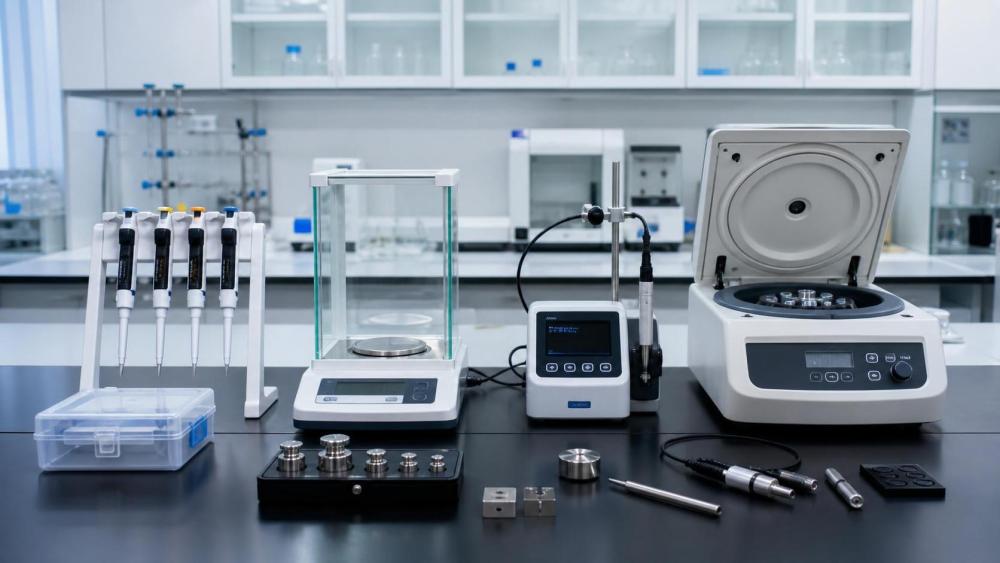
Typical calibration timing by instrument category
There is no single schedule that fits every lab, but broad patterns are common. These should be treated as starting references for internal evaluation, not as substitute requirements.
The table highlights an important operational point: some instruments are calibrated on a fixed periodic basis, while others depend on event-based calibration triggers. In many IVD systems, calibration is not only an annual engineering activity. It may be tied to reagent lot changes, maintenance actions, replacement of parts, software changes, or built-in manufacturer procedures. Quality managers should not assume that a vendor-managed analyzer is “covered” unless they understand exactly which parameters are calibrated, by whom, and with what documentation.
Annual calibration alone is usually not a complete control strategy
This is where many laboratories become exposed. A yearly certificate may satisfy a paperwork expectation, but it does not guarantee measurement reliability across the full year. Instruments can drift between service visits. Some can be knocked out of tolerance after relocation, shock, power events, failed repairs, or operator misuse. That is why mature laboratories combine scheduled calibration with interim verification, daily or per-shift QC where relevant, and clear trigger rules for unscheduled calibration.
For quality control personnel, the stronger question is not “Do we have a certificate?” but “How do we know the instrument remained fit for use between certificates?” Auditors and incident investigators often look for that chain of evidence. If a lab only produces an annual certificate but has no routine checks, no trend review, and no investigation process for abnormal readings, the control system may appear thinner than expected.
Event-based calibration is often more important than calendar-based calibration
Some of the highest-risk situations are not tied to the date on the sticker. They happen after a change event. Biomedical engineering calibration should typically be reviewed or repeated after:
- major preventive maintenance or corrective repair
- replacement of critical components
- software or firmware changes affecting measurement functions
- instrument relocation or transportation
- exposure to mechanical shock, power instability, or environmental upset
- repeated QC failures or unexplained result shifts
- long periods of inactivity before return to service
In other words, the calendar sets the baseline, but change events often create the real need.
How standards and accreditation shape expectations
In standard and certification discussions, organizations often ask whether a regulation explicitly mandates a fixed interval. In many cases, the more common expectation is not a universal number but a controlled process. Laboratories are expected to identify measuring equipment that affects validity or safety, define calibration or verification needs, maintain traceability where necessary, set acceptance criteria, keep records, and respond properly to failures. ISO 15189 is often central in medical laboratory quality discussions, while ISO/IEC 17025 concepts may also influence calibration and traceability thinking depending on the organization’s structure and service model【待核实】.
For hospital-based laboratories, biomedical engineering teams and quality teams should also align with broader hospital risk management, device maintenance programs, and any local health authority requirements. Calibration cannot sit in isolation from asset management. If a device’s calibration status is unclear, the issue quickly becomes a patient safety and operational governance matter, not just a technical defect.
What quality and safety managers should review before setting intervals
The most useful calibration program is one that can be explained clearly in an audit, after an incident, or during procurement review. That usually requires more than a vendor proposal. Before approving intervals, teams should review:
- manufacturer recommendations and service manuals
- whether the device produces or influences reportable results
- actual utilization rate, including peak workload periods
- historical drift, failure, and adjustment data
- internal QC trends and nonconformance history
- installation and environmental conditions
- required traceability level and reference standard availability
- who performs calibration and whether competency is documented
- how out-of-tolerance findings are escalated and impact-assessed
This is also where procurement decisions matter. Laboratories often compare instruments by purchase price and throughput, but not by calibration burden, downtime implications, service accessibility, and documentation quality. In reality, those factors affect total operating cost and compliance exposure. Two instruments with similar analytical capacity may create very different lifecycle demands if one requires frequent specialized calibration with limited local support.
Common mistakes that create hidden compliance risk
Several patterns appear repeatedly across healthcare facilities and independent labs.
- Treating preventive maintenance reports as calibration evidence when they are not equivalent.
- Relying on vendor visits without confirming measurement traceability, acceptance limits, and as-left/as-found records.
- Applying identical intervals to all instruments for administrative simplicity.
- Ignoring interim verification after repairs, relocation, or repeated QC deviation.
- Failing to assess whether past patient or test results were affected when an instrument is found out of tolerance.
- Keeping calibration records, service records, and QC records in separate silos with no combined review.
These issues matter because calibration is not only a technical exercise. It supports defensibility. If a result is challenged, the organization must show that the instrument was controlled in a way consistent with the risk of the measurement.
A practical decision model works better than a fixed rule
For most laboratories, the best answer to calibration frequency is a tiered model. High-risk, high-use, measurement-critical instruments should have tighter intervals and stronger interim checks. Moderate-risk instruments may remain on standard manufacturer intervals, supported by verification data. Lower-risk devices can often be managed with a longer documented cycle if stability is demonstrated and the quality system allows it. That approach is easier to defend than either extreme: calibrating everything too often without purpose, or stretching every interval to reduce service cost.
So how often should biomedical engineering calibration be done for lab instruments? Often enough that the organization can reasonably trust the measurement, detect drift before it affects decisions, and demonstrate control under audit or incident review. In many facilities that means annual calibration for some devices, semiannual or quarterly attention for others, and immediate recalibration after specific events. The interval itself is only the visible part of the system. What matters more is whether the laboratory can explain why that interval exists, what evidence supports it, and what happens when the instrument no longer stays within control.
Have questions about the global trade trends discussed here, or planning your expansion and supply chain strategy? Leave a message below and let the trade experts at MTHH guide you.
We respect your privacy. Your information is strictly confidential.
Related News
- Abbott Launches Next-Generation Whole-Genome Sequencing Oncodetect MRD TestOct 27, 2026Explore Abbott’s Oncodetect MRD test, using whole-genome sequencing to track up to 5,000 ctDNA variants. Discover key clinical evidence and procurement considerations.
- SCIEX Starts Beijing Plant Project, Danaher's Tenth Manufacturing Site in ChinaOct 24, 2026SCIEX's Beijing plant project marks Danaher's tenth manufacturing site in China. Explore how its RMB 100 million-plus investment could strengthen local mass spectrometer supply.
- How laboratory workflow solutions reduce sample processing delaysOct 23, 2026Discover how laboratory workflow solutions reduce sample processing delays, improve tracking, and streamline reporting. Explore practical steps to cut waiting times without compromising quality.
- How to evaluate a web-based LIMS for lab instrument integrationOct 22, 2026Evaluate a web based LIMS for reliable lab instrument integration. Learn how to verify connectors, test failure recovery, and compare costs before choosing your system.