
How laboratory workflow solutions reduce sample processing delays
How laboratory workflow solutions reduce sample processing delays
When samples pile up, laboratory teams face more than longer queues: manual handoffs, labeling errors, and uneven analyzer workloads can delay results and increase rework. Effective laboratory workflow solutions connect sample tracking, preparation, testing, and reporting into a more coordinated process. The aim is not simply to move tubes faster. It is to prevent avoidable waiting without weakening specimen integrity, quality control, or result review.
For operators, the useful question is practical: where does a sample stop moving, and why? A faster analyzer will not resolve a receiving backlog. Automated sorting will not correct missing orders. Improving daily sample flow starts with separating these problems before choosing equipment or changing procedures.
Find the waiting time before adding capacity
Turnaround time is often discussed as one number, but it contains several different intervals. Collection-to-receipt time depends on transport and collection practices. Receipt-to-analysis includes accessioning, preparation, and queuing. Analysis-to-release includes technical review, repeat testing, and authorization. A laboratory should define which interval it is measuring; otherwise, teams may attribute transport delays to instrument performance.
Follow representative samples through a busy period and a quieter shift. Record when they arrive, become ready for testing, enter an analyzer, and receive final authorization. Include urgent specimens, routine work, and samples requiring special preparation. Electronic timestamps help, but direct observation can reveal unrecorded waits on benches or between departments.
Look especially for work that arrives in waves. A laboratory may have enough daily capacity yet still struggle when ward collections reach reception together. Comparing hourly arrivals with staffed preparation capacity is often more useful than comparing daily test volume with an analyzer’s advertised throughput.
Do not classify every pause as waste. Required clotting, validated centrifugation, incubation, and quality checks must remain intact. The opportunity is usually the idle time around those steps—not shortening a process that protects result reliability.
Make specimen identity and status visible
Barcode identification reduces repeated manual entry and helps connect each specimen to its order. Its value depends on how consistently it works across the full route: collection, receipt, aliquoting, analyzer loading, storage, and retrieval. A barcode read at reception alone does not provide end-to-end traceability.
Label placement, print quality, tube dimensions, and scanner compatibility need testing with the containers actually used. When aliquots are created, the parent–child relationship must remain traceable. Unreadable labels and order mismatches need an exception process that prevents uncertain specimens from moving into testing.
Status visibility also reduces interruptions. Instead of calling several benches to locate a specimen, staff should be able to distinguish “received,” “awaiting preparation,” “on instrument,” and “held for review,” where the system supports those events. These labels must reflect real activities. A specimen marked “in progress” for hours is not meaningfully tracked.
A practical workflow map should show both the normal path and the exception path, including who owns each unresolved issue.
Remove preparation bottlenecks without moving them downstream
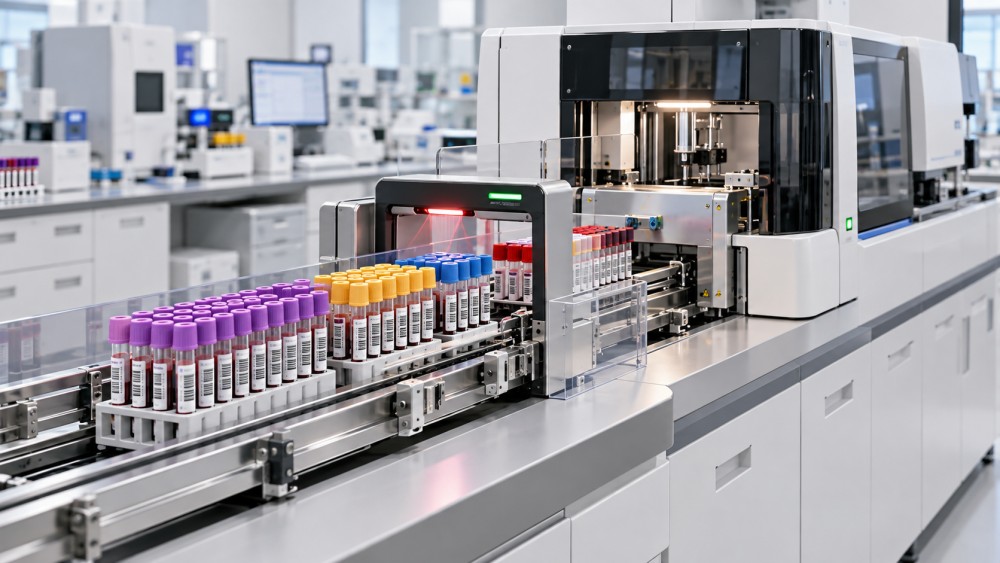
Pre-analytical work often combines repetitive handling with decisions that still require trained staff. Sorting, centrifugation, decapping, and aliquoting can create queues, especially when one operator covers several stations. Laboratory workflow solutions may involve revised bench layouts, clearer routing, standalone automation, or an integrated track. Full automation is not the necessary starting point.
For example, separating specimens by preparation requirement at receipt can prevent ready-to-test tubes from waiting behind specimens that need additional processing. A scheduled transport round between reception and testing benches may be more dependable than waiting until someone is free. These changes require clear ownership, not necessarily new hardware.
Where automation is appropriate, assess the entire sequence. A faster decapper may simply fill the next queue if aliquoting or analyzer loading remains constrained. Check supported tube types, minimum volumes, cap compatibility, centrifuge requirements, and handling of exceptions. Shared preparation must also respect assay-specific specimen requirements; not every sample can follow the same route.
Staff still need safe access for spill response, jam clearance, and manual recovery. If clearing one blocked tube requires stopping an entire line, downtime behavior deserves as much attention as normal operating speed.
Balance analyzer workloads around real operating conditions
Nominal throughput is not the same as sustained throughput in a working laboratory. Assay mix, calibration, quality control, reagent replacement, repeat testing, and maintenance all affect when a specimen can be processed. An instrument may appear available while lacking the reagent or valid calibration needed for a particular request.
Routing rules can help direct eligible specimens toward available capacity. However, sending work between analyzers requires more than matching test names. The laboratory must establish that the method, specimen requirements, reporting configuration, and quality processes support that routing. Relevant comparability checks and local validation should precede routine use.
Urgent access needs similar care. Priority loading may shorten emergency turnaround, but frequent manual interruptions can leave routine samples waiting indefinitely. Define how urgency is assigned, how it reaches the instrument worklist, and when aging routine specimens should be escalated. Operators should not have to reconstruct clinical priority from telephone calls and handwritten notes.
Reagent availability belongs in the same discussion. Reviewing stock, onboard stability, and replenishment responsibilities before peak periods can prevent a queue that no routing algorithm can solve.
Connect testing and reporting, but keep exceptions under control
Laboratory information system integration can reduce transcription and make orders, instrument results, and specimen status available across the workflow. Middleware may add routing, rule management, and consolidated worklists. Neither connection should be treated as a plug-and-play guarantee: test codes, units, flags, order changes, and result corrections must be mapped and verified.
An interface can transmit a result successfully while conveying it incorrectly. Acceptance testing should therefore cover meaning as well as message delivery. Confirm patient and specimen identifiers, reference intervals where applicable, abnormal flags, dilution results, canceled tests, and corrected reports. Also establish what happens when the connection drops and queued messages are resent.
Validated autoverification can reduce review queues for results meeting laboratory-approved criteria. It should not mean releasing everything within a reference interval. Depending on the assay and local procedures, rules may consider quality-control status, instrument flags, specimen interference, analytical limits, and changes from previous results. Exceptions need a visible review queue with a responsible operator.
Critical-result communication remains a separate safety process. Electronic release alone does not establish that the responsible clinical team received and acknowledged a critical finding according to local policy.
Choose improvements operators can sustain
The right scope depends on the bottleneck. A smaller laboratory with manual accessioning problems may benefit more from reliable identification and order connectivity than from a transport track. A high-volume service with repeated handling queues may have a stronger case for pre-analytical automation. Neither choice is useful if it creates more exceptions than the team can resolve.
During evaluation, ask suppliers to demonstrate ordinary disruptions, not only uninterrupted operation:
- How does an operator recover an unreadable barcode or an unsupported tube?
- Can urgent samples enter safely while routine processing continues?
- What remains operational during maintenance, network loss, or a track stoppage?
- How are pending orders and sample locations reconciled after recovery?
- Which tasks require specialist service rather than locally trained staff?
Installation constraints can change the answer. Floor space, utilities, network access, biosafety arrangements, and service clearance affect whether a proposed configuration will work. Consumable supply and service response also influence sustained sample flow, particularly when a system depends on proprietary components.
Global MedTech & Healthcare Intelligence Hub (MTHH) organizes information on laboratory systems, diagnostic equipment, workflow integration, and maintenance considerations to support this kind of early evaluation. Its practical relevance is in helping operators, clinical engineers, and procurement teams connect technical specifications with daily operating conditions—not treating headline throughput as the complete business case.
Pilot one change and measure the long waits
Start with a defined specimen stream and a documented baseline. Train staff on both normal operation and exceptions, then assess performance across representative shifts. A pilot limited to a quiet morning can miss the conditions responsible for most delays.
Track median turnaround alongside a high percentile, such as the 90th percentile, so improvement in typical cases does not hide persistent long waits. Keep measurement boundaries consistent and separate urgent from routine work. Include specimen rejection, repeat testing, manual interventions, and unresolved interface messages as balancing measures. Faster release is not progress if identification errors or rework increase.
Review the remaining outliers with the people handling them. If the queue moves from reception to centrifugation, the change has exposed the next constraint rather than completed the job. If delays remain concentrated after testing, more preparation capacity is unlikely to help.
Before expanding laboratory workflow solutions, confirm that staff can maintain the process during a busy shift and recover it during downtime. The strongest next step is usually specific: remove one documented source of waiting, verify that quality remains controlled, and use the resulting workflow data to decide what needs attention next.
Have questions about the global trade trends discussed here, or planning your expansion and supply chain strategy? Leave a message below and let the trade experts at MTHH guide you.
We respect your privacy. Your information is strictly confidential.
Related News
- Abbott Launches Next-Generation Whole-Genome Sequencing Oncodetect MRD TestOct 27, 2026Explore Abbott’s Oncodetect MRD test, using whole-genome sequencing to track up to 5,000 ctDNA variants. Discover key clinical evidence and procurement considerations.
- SCIEX Starts Beijing Plant Project, Danaher's Tenth Manufacturing Site in ChinaOct 24, 2026SCIEX's Beijing plant project marks Danaher's tenth manufacturing site in China. Explore how its RMB 100 million-plus investment could strengthen local mass spectrometer supply.
- How laboratory workflow solutions reduce sample processing delaysOct 23, 2026Discover how laboratory workflow solutions reduce sample processing delays, improve tracking, and streamline reporting. Explore practical steps to cut waiting times without compromising quality.
- How to evaluate a web-based LIMS for lab instrument integrationOct 22, 2026Evaluate a web based LIMS for reliable lab instrument integration. Learn how to verify connectors, test failure recovery, and compare costs before choosing your system.