
FDA Tightens Pre-Shipment Review for China LDT IVD Exports
On June 29, 2026, the U.S. FDA released a memorandum on the LDT compliance transition period that changes how China-based manufacturers ship LDT-related reagents, calibrators, and quality control products to the U.S. market. The immediate requirement to submit a complete technical documentation package through the FDA Gateway within 72 hours after order confirmation is not just a paperwork update; it directly affects export timing, document readiness, and compliance coordination across IVD manufacturing and delivery workflows.
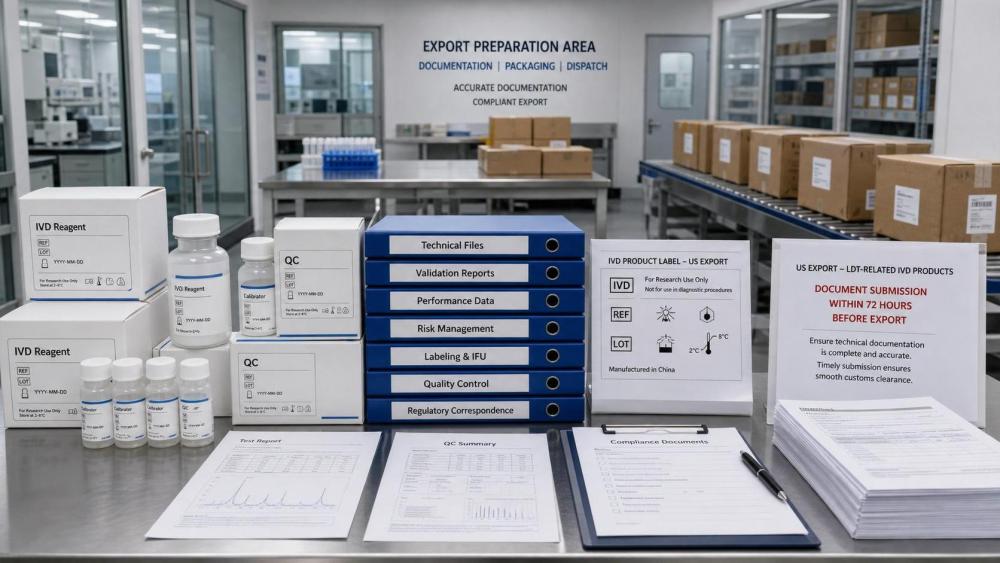
A new documentation deadline now sits inside the order cycle
The confirmed facts are limited but clear. The FDA issued the "LDT Compliance Transition Period Enforcement Memorandum" on June 29, 2026. From that date, all Chinese manufacturers exporting products related to laboratory developed tests, including reagents, calibrators, and quality control materials, must submit a complete technical documentation package through the FDA Gateway within 72 hours after an order is confirmed.
According to the provided summary, the required package includes analytical performance validation reports, stability data, an ISO 13485:2025 certificate, and English label drafts. The stated direct effect is on the delivery rhythm and compliance response capability of IVD exporters.
Where the pressure is likely to appear first
Export execution moves closer to compliance preparation
From an industry perspective, exporters are likely to feel the first impact because the 72-hour window starts after order confirmation rather than at a later shipping stage. That means document completeness becomes part of order execution, not a separate back-office task. What deserves closer attention is whether the technical file, English labeling materials, and certificate status can be aligned fast enough to avoid disrupting shipment scheduling.
Manufacturing and quality teams face tighter internal coordination
For manufacturers, the practical pressure point is likely to be internal document control. Analysis shows that analytical performance validation records, stability materials, and certification documents now matter not only for quality systems but also for export responsiveness. Any gap in version control, document readiness, or English-language packaging content could affect release timing for orders tied to the U.S. market.
Procurement and buyers may see changes in lead-time assumptions
Buyers, sourcing teams, and downstream channel participants may also be affected because the new requirement can influence confirmation-to-delivery timing. Observably, procurement planning may need to pay closer attention to whether suppliers can assemble the required technical package within the stated window. In practice, supplier qualification discussions may place more weight on documentation readiness, certification validity, and labeling preparedness.
Compliance service and testing support functions may become more time-sensitive
Certification-related service providers and testing support functions are not named in the rule summary as regulated parties, but they may still be affected operationally. It is more appropriate to understand this as an execution issue: where supporting documents are incomplete or not current, outside support tied to validation, document review, or file preparation could become more time-sensitive within the export process.
What companies should review now
Check whether technical files are submission-ready before orders are locked
Analysis shows that companies serving the U.S. LDT-related segment should review whether analytical performance validation reports, stability data, ISO 13485:2025 certificates, and English label drafts are already organized in a form suitable for rapid submission. The key issue is not only document existence, but submission readiness within the 72-hour period described in the memorandum summary.
Reassess order confirmation and shipping handoff procedures
What deserves closer attention is the point at which an order is formally confirmed. If the submission clock starts at that moment, commercial, regulatory, and logistics teams may need a clearer internal handoff. This is not yet a conclusion about how all shipments will be processed in practice; it is a practical area to monitor based on the stated timing requirement.
Track certificate status and English labeling consistency
The inclusion of the ISO 13485:2025 certificate and English label drafts means companies should pay close attention to document validity and cross-document consistency. Observably, any mismatch between product information, labeling language, and technical documentation could become a source of delay if the submission package is assembled under time pressure.
Watch for follow-on clarification in execution language
The summary confirms the new filing expectation, but it does not provide fuller detail on review practice, acceptance criteria, or downstream handling after submission. For that reason, companies should continue monitoring official wording, practical enforcement signals, and any changes in customer-facing document requests. At this stage, those points should be treated as areas for continued observation rather than settled outcomes.
Why this looks like an execution signal, not just a formal notice
In editorial observation, this development is more than a general compliance reminder because it inserts a defined submission deadline directly into the export process. The most important signal is procedural: technical documentation for certain China-origin LDT-related products now appears tied more closely to order timing. At the same time, the available facts do not yet justify broader claims about market access outcomes, shipment rejection patterns, or long-term trade effects. It is more appropriate to understand this as an implemented execution signal with details that still require verification through practice.
How the market is likely to read this for now
The immediate significance of this update lies in the shift from static compliance possession to time-bound compliance response. For the IVD export chain, the issue is not only whether documents exist, but whether they can be delivered in the required format and within the stated deadline after order confirmation. A neutral reading is that this is a live procedural change with direct operational implications, while its broader commercial impact still depends on how consistently it is applied and how market participants adapt.
Basis of this article and what still needs verification
This article is based on the user-provided news title, event date, and event summary. For developments of this kind, commonly relevant source types may include official regulatory announcements, notices issued by supervisory authorities, trade administration updates, industry association communications, standard-setting documents, and reporting by authoritative industry media.
No specific official source link was provided in the input, so the original publication channel and any supporting documentation still need ongoing verification. Observably, the next points worth tracking include any further policy detail, enforcement wording, certification interpretation, procurement document changes, market feedback, and how affected companies implement the requirement in actual export operations.
Have questions about the global trade trends discussed here, or planning your expansion and supply chain strategy? Leave a message below and let the trade experts at MTHH guide you.
We respect your privacy. Your information is strictly confidential.
Related News
- Abbott Launches Next-Generation Whole-Genome Sequencing Oncodetect MRD TestOct 27, 2026Explore Abbott’s Oncodetect MRD test, using whole-genome sequencing to track up to 5,000 ctDNA variants. Discover key clinical evidence and procurement considerations.
- SCIEX Starts Beijing Plant Project, Danaher's Tenth Manufacturing Site in ChinaOct 24, 2026SCIEX's Beijing plant project marks Danaher's tenth manufacturing site in China. Explore how its RMB 100 million-plus investment could strengthen local mass spectrometer supply.
- How laboratory workflow solutions reduce sample processing delaysOct 23, 2026Discover how laboratory workflow solutions reduce sample processing delays, improve tracking, and streamline reporting. Explore practical steps to cut waiting times without compromising quality.
- How to evaluate a web-based LIMS for lab instrument integrationOct 22, 2026Evaluate a web based LIMS for reliable lab instrument integration. Learn how to verify connectors, test failure recovery, and compare costs before choosing your system.