
FDA Tightens IVD Export Traceability for China Suppliers
On July 10, 2026, the U.S. FDA updated its export compliance guidance for IVD reagents, requiring Chinese manufacturers shipping to the United States to use an electronic traceability log system that supports batch-level UDI linkage and real-time upload, while also connecting to the CDRH Gateway. This is not just a documentation change: it directly affects customs clearance speed for importers, inventory handling for distributors, and purchasing decisions at laboratory level, which is why exporters and supply-chain participants need to treat it as an immediate compliance issue.
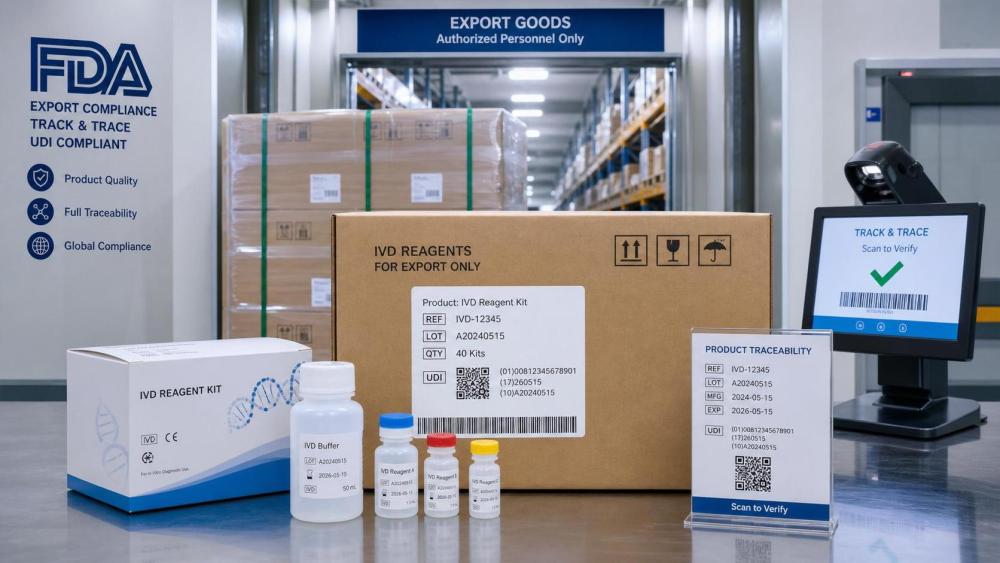
What the FDA change now requires
The confirmed facts are limited but clear. The FDA formally updated its IVD export compliance guidance on July 10, 2026. Under that update, all Chinese manufacturers exporting IVD reagents to the U.S. are required, from that date, to activate an electronic traceability log system capable of batch-level UDI binding and real-time data upload. The requirement also includes synchronized connection to the FDA's CDRH Gateway. According to the event summary provided, the change has a direct effect on importer clearance efficiency, distributor inventory management, and laboratory purchasing decisions. Companies that do not comply face the risk of import refusal and suspension of market access.
Where the pressure is likely to appear first
Export operations face a new traceability threshold
For manufacturers and direct exporters, the main impact is that traceability is now tied more closely to shipment readiness. Analysis shows that the operational focus is no longer only on product shipment itself, but on whether batch-level UDI data and upload capability are in place before goods move through the trade channel. What deserves closer attention is the alignment between internal batch records, export documentation, and the electronic log process required by the updated guidance.
Importers and channel partners may see friction in clearance and stock flow
Importers and distributors are affected because the summary explicitly links the new rule to customs clearance timing and inventory management. From an industry perspective, this suggests that downstream participants may need to pay closer attention to the compliance condition of upstream suppliers, especially where inventory planning depends on predictable release and receipt of goods. In practice, the key issue is whether traceability records can support uninterrupted movement through import and distribution stages.
Laboratory buyers may weigh compliance readiness in procurement decisions
Terminal laboratories are also identified as affected parties in the event summary. Observably, once traceability obligations become part of market access conditions, procurement teams may place more weight on supplier readiness, delivery reliability, and documentation consistency. This does not confirm a new purchasing rule by itself, but it does indicate that supplier qualification discussions may increasingly overlap with traceability and regulatory execution capability.
What companies should watch in day-to-day execution
Review whether current systems truly support batch-level UDI linkage
Analysis shows that companies should not assume existing record systems automatically meet the updated requirement. The practical question is whether current workflows can connect batch information with UDI records in a form that supports the required electronic logging structure.
Check readiness for real-time upload and CDRH Gateway connectivity
The event summary makes real-time upload and CDRH Gateway access part of the rule change. What deserves closer attention is whether internal compliance, IT, quality, and export teams are working from the same operating assumption about that connection requirement. If internal processes are fragmented, shipment execution and regulatory consistency may be exposed to avoidable risk.
Reassess documents used in trade, purchasing, and supplier review
From an industry perspective, the update may affect how companies prepare or review transaction documents, technical files, and supplier qualification materials linked to export and procurement decisions. The input does not provide detailed document lists, so this should be treated as a compliance review point rather than a confirmed documentary checklist.
Track official wording and market implementation closely
Because the provided information defines the obligation but does not include further enforcement detail, companies should continue monitoring how the requirement is described and applied in practice. Observably, the areas worth watching include implementation language, review expectations, and how market participants reflect the change in procurement or acceptance processes.
How this change is best understood at this stage
Analysis shows that this development is more appropriately understood as an effective compliance signal rather than a distant policy discussion. The requirement is described as taking effect from the date of the guidance update, and the stated consequences for non-compliance are concrete. At the same time, it is still necessary to observe how execution standards, review consistency, and market responses evolve, because the input does not provide detailed enforcement mechanics.
Why the market should read it as an active rule change
The industry significance of this update lies in its position between regulation and transaction execution. It links traceability capability directly to export access, import handling, and buyer confidence. A neutral reading is that the change should currently be treated as a live operating requirement with immediate compliance relevance, while some aspects of implementation still require continued observation through official clarifications and market practice.
Basis of this article and points for further verification
This article is based on the user-provided news title, event date, and event summary. For developments of this type, relevant source categories typically include official regulatory notices, regulator-issued guidance, customs or trade administration updates, industry association communications, standards documentation, and reporting by authoritative trade media. A specific official source link was not provided in the input, so the exact official publication path still needs to be verified. Further observation is also needed on detailed implementation language, certification and compliance interpretation, procurement document changes, market feedback, and how affected companies carry the requirement into daily execution.
Have questions about the global trade trends discussed here, or planning your expansion and supply chain strategy? Leave a message below and let the trade experts at MTHH guide you.
We respect your privacy. Your information is strictly confidential.
Related News
- Abbott Launches Next-Generation Whole-Genome Sequencing Oncodetect MRD TestOct 27, 2026Explore Abbott’s Oncodetect MRD test, using whole-genome sequencing to track up to 5,000 ctDNA variants. Discover key clinical evidence and procurement considerations.
- SCIEX Starts Beijing Plant Project, Danaher's Tenth Manufacturing Site in ChinaOct 24, 2026SCIEX's Beijing plant project marks Danaher's tenth manufacturing site in China. Explore how its RMB 100 million-plus investment could strengthen local mass spectrometer supply.
- How laboratory workflow solutions reduce sample processing delaysOct 23, 2026Discover how laboratory workflow solutions reduce sample processing delays, improve tracking, and streamline reporting. Explore practical steps to cut waiting times without compromising quality.
- How to evaluate a web-based LIMS for lab instrument integrationOct 22, 2026Evaluate a web based LIMS for reliable lab instrument integration. Learn how to verify connectors, test failure recovery, and compare costs before choosing your system.