
FDA Sets New Multilingual E-Label Rule for IVD Imports
On July 21, 2026, the U.S. FDA released the revised Guidance for Labeling Compliance of Imported IVD Products (Rev. 2026), introducing a new requirement for in vitro diagnostic reagents shipped to the United States. Starting September 1, 2026, these products must include complete labeling information in English and in the official language of the target market within accompanying electronic documents, with verification submitted through the FDA eSTAR system. For IVD exporters, registration teams, packaging functions, and delivery planning, this is not just a documentation update; it is a compliance issue that may affect customs clearance and product acceptance.
What the FDA Has Confirmed
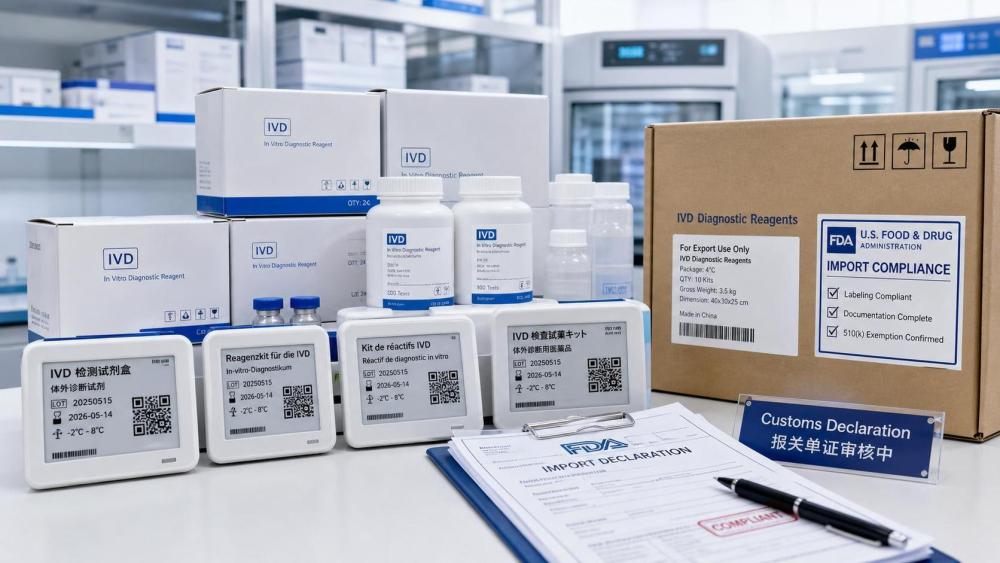
According to the information provided, the FDA issued the updated guidance on July 21, 2026. The rule applies to all IVD reagents imported into the U.S. market. From September 1, 2026, complete label content must be provided in accompanying electronic documentation in English plus the official language of the relevant target market, such as Spanish, Arabic, or Japanese. The same labeling information must also be verified through the FDA eSTAR system. The stated business impact is direct: the requirement affects registration submission workflows, packaging design, and delivery schedules, while non-compliant products may face customs delays or refusal.
Where the Pressure Will Be Felt First
Export registration workflows move to the front line
From an industry perspective, companies that export IVD reagents to the U.S. are likely to feel the change first because the new requirement is tied directly to submission and verification. The immediate impact may fall on regulatory filing steps, document preparation, and internal review cycles. What deserves closer attention is whether existing label files, translation versions, and submission materials are aligned before products are shipped.
Packaging and document control become operational issues
Manufacturing and packaging teams may also be affected because the rule links labeling compliance with accompanying electronic documents rather than treating labeling as a separate downstream task. Analysis shows that packaging design, version management, and release coordination may need closer synchronization with regulatory teams. The key issue is not only what appears on the package, but whether the complete electronic label set is ready for FDA verification in the required languages.
Delivery planning and customs risk become more visible
Supply chain and delivery teams may face added pressure because non-compliance can lead to customs delay or rejection. Observably, this turns label preparation into a logistics risk rather than a purely regulatory one. Companies involved in shipping, distribution, and import coordination should pay close attention to whether multilingual electronic labeling has been completed and verified before dispatch.
What Companies Should Track Now
Watch for any further FDA wording or procedural clarification
Analysis shows that the published requirement is already specific on timing, language inclusion, and eSTAR verification, but companies should continue monitoring whether the FDA issues further clarification on implementation details. That matters because day-to-day compliance often depends on how a rule is applied in submission and import review practice.
Review products and markets with the highest documentation complexity
What deserves closer attention is the combination of product destination and language requirement. Where a company serves multiple target markets or manages several language versions, the workload may rise in document control, verification, and release timing. The practical question is whether high-mix product lines are prepared to maintain complete and consistent multilingual electronic labels.
Separate policy text from execution readiness
From an operational perspective, there is a difference between understanding the rule and being ready to execute it. Companies should focus on whether internal files, translated label content, approval records, and eSTAR submission materials can move together without creating handoff delays. This is especially relevant where packaging, regulatory, and logistics teams work on different timelines.
Prepare customer and supplier communication early
Observably, the new rule may affect delivery commitments if label verification is incomplete. Businesses may need to review supplier coordination, document requests, and customer communication around lead times. The point is not to assume disruption, but to reduce the chance that a documentation gap appears only when a shipment is already in motion.
Why This Looks Like More Than a Short-Term Notice
This section is an editorial observation. It is more appropriate to understand this update as an immediate compliance change with longer-term signaling value. The near-term effect is clear because the effective date and verification path have been stated. At the same time, the broader signal is that electronic labeling, multilingual readiness, and submission-linked documentation control are becoming more central to market access for IVD products entering the U.S. That does not by itself prove how far future requirements may extend, but it does suggest that labeling is being treated more directly as a cross-functional compliance checkpoint.
How the Industry May Best Read This Update
At this stage, the development should be read as a concrete rule change rather than a distant policy discussion. The confirmed facts already point to implications for filing, packaging coordination, and shipment timing. Analysis shows that the most rational industry response is to treat multilingual electronic labeling and eSTAR verification as part of market-entry execution, while continuing to watch for any clarifying language or implementation practice that may shape how the rule works in real transactions.
Basis of This Article and Ongoing Verification
This article is based on the user-provided news title, event date, and event summary regarding the FDA update on multilingual electronic labeling requirements for imported IVD reagents. For this type of industry development, commonly relevant source categories may include official announcements, company notices, industry association updates, authoritative media coverage, and standard-related documents. A specific official source link was not provided in the input, so the exact document path still needs continued verification. Further attention should remain on any additional FDA clarification related to implementation wording, submission handling, and compliance practice.
Have questions about the global trade trends discussed here, or planning your expansion and supply chain strategy? Leave a message below and let the trade experts at MTHH guide you.
We respect your privacy. Your information is strictly confidential.
Related News
- Abbott Launches Next-Generation Whole-Genome Sequencing Oncodetect MRD TestOct 27, 2026Explore Abbott’s Oncodetect MRD test, using whole-genome sequencing to track up to 5,000 ctDNA variants. Discover key clinical evidence and procurement considerations.
- SCIEX Starts Beijing Plant Project, Danaher's Tenth Manufacturing Site in ChinaOct 24, 2026SCIEX's Beijing plant project marks Danaher's tenth manufacturing site in China. Explore how its RMB 100 million-plus investment could strengthen local mass spectrometer supply.
- How laboratory workflow solutions reduce sample processing delaysOct 23, 2026Discover how laboratory workflow solutions reduce sample processing delays, improve tracking, and streamline reporting. Explore practical steps to cut waiting times without compromising quality.
- How to evaluate a web-based LIMS for lab instrument integrationOct 22, 2026Evaluate a web based LIMS for reliable lab instrument integration. Learn how to verify connectors, test failure recovery, and compare costs before choosing your system.