
EU Tightens e-UDI Rules for Imported IVD Reagents
On October 1, 2026, a new compliance threshold takes effect for imported in vitro diagnostic reagents entering the EU. The trigger is the European Commission’s release of the IVDR Transition Implementation Operational Guide (v2.3) on July 22, 2026, which sets out mandatory use of a scannable electronic unique device identifier (e-UDI) and real-time EUDAMED uploads for batch data, label language versions, and CE declarations of conformity. For IVD exporters, especially manufacturers supplying the EU from China, this is worth close attention because it reaches beyond labeling and directly touches packaging design, software connectivity, and the timing of compliance document preparation.
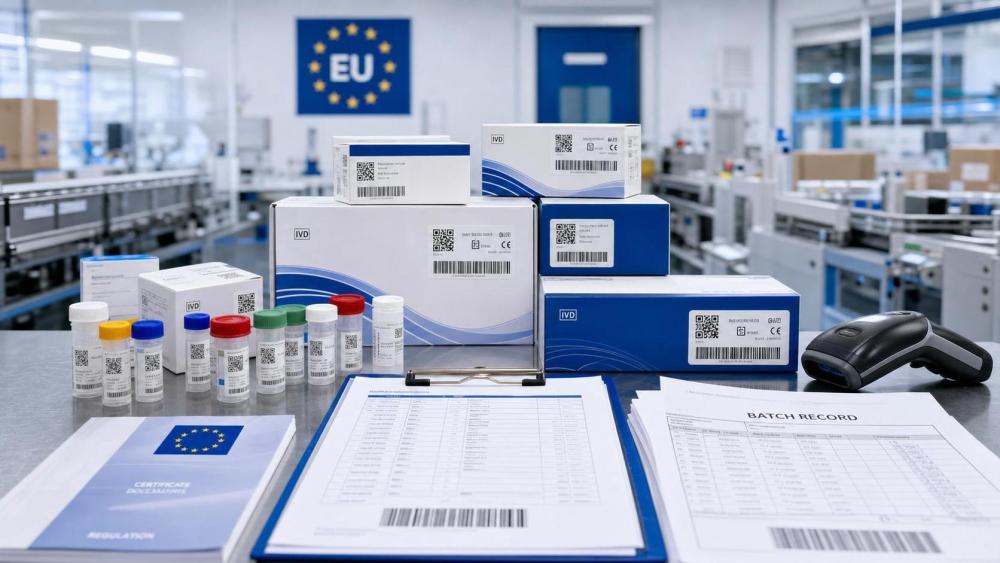
What the New Guide Explicitly Requires
According to the information provided, the European Commission issued the IVDR Transition Implementation Operational Guide (v2.3) on July 22, 2026. The guide clarifies that from October 1, 2026, all IVD reagents imported into the EU must carry a scannable electronic UDI.
The same guidance also requires connection to EUDAMED for automatic real-time upload of three categories of information: batch data, label language versions, and the CE declaration of conformity. The stated effect of this requirement is direct pressure on product packaging, software interface development, and compliance documentation lead times for Chinese IVD export companies.
Where the Operational Pressure Is Likely to Appear
Export-facing manufacturers will feel the packaging impact first
From an industry perspective, manufacturers that ship IVD reagents into the EU are likely to face the most immediate operational changes because the requirement is tied to imported products and a scannable electronic identifier. The likely impact is concentrated in packaging layout, code presentation, and coordination between production release and compliance review.
Regulatory and documentation teams will need tighter synchronization
Analysis shows that the requirement for automatic upload of label language versions and CE declarations of conformity is not only a labeling issue. It also affects the way regulatory affairs, quality, and document control teams manage version consistency, because the information submitted through EUDAMED must align with what is used in market-facing materials.
IT and compliance service providers may become critical implementation links
Observably, the real-time upload requirement creates a practical dependency on software interfaces. That means internal IT teams and external compliance or system service providers may become key participants in implementation, particularly where exporters need to connect product data flows with EUDAMED-related processes.
Distributors and import-side partners will need clearer data handoff
What deserves closer attention is that the requirement concerns imported IVD reagents entering the EU. This suggests that businesses involved in market entry, distribution, or import coordination may need stronger alignment on product data readiness, document status, and timing of shipment release, even though the guide summary provided does not specify new obligations for each downstream role.
What Companies Should Prioritize Now
Check whether packaging revision cycles can meet the deadline
Analysis shows that the October 1, 2026 implementation date matters less as a legal headline than as a production planning constraint. Companies should pay close attention to whether current packaging revision schedules leave enough time to add a scannable e-UDI without disrupting already planned export batches.
Assess interface readiness instead of treating this as a paperwork update
What deserves closer attention is the system side of compliance. Because the guide requires real-time automatic uploads to EUDAMED, companies should distinguish between having compliant documents and having an operational interface capable of transmitting the required data consistently.
Review language-version control and declaration management together
Observably, label language versions and CE declarations of conformity are both named in the required uploads. For companies with multiple packaging versions or multilingual EU market coverage, the practical issue may be whether document version control, approval workflows, and upload logic remain aligned across teams.
Prepare for customer and partner communication around lead times
From an industry perspective, exporters may also need to manage expectations with EU customers, importers, or channel partners. The reason is straightforward: packaging updates, interface development, and document preparation can affect readiness dates, and those effects may show up before or during shipment planning.
Why This Looks Like More Than a Short-Term Labeling Change
This section is an editorial observation. It is more appropriate to understand this development as a concrete implementation signal rather than a vague policy direction. The reason is that the guide summary provided does not stop at general compliance language; it points to specific operational requirements tied to identification, data upload, and documentation handling.
At the same time, it would be premature to present this as a fully settled end state for every workflow. Analysis shows that the business impact will depend on how companies translate the rule into packaging execution, system integration, and internal approval processes. That is why the development should be watched both as an immediate compliance deadline and as a longer-term indicator of stricter digital traceability expectations in EU market access.
How This Update Is Best Understood at This Stage
At this stage, the update is best read as a near-term operational requirement with longer-term regulatory signaling behind it. The confirmed facts already establish a hard compliance direction for imported IVD reagents from October 1, 2026. The broader industry meaning, however, lies in how identification, data transmission, and conformity records are being tied more closely together in actual market-entry practice.
A neutral reading is that this is not merely a documentation reminder. It is a practical compliance change that may reshape preparation timelines for exporters and related service providers, while still requiring continued observation of how implementation details are handled in day-to-day business execution.
Basis of This Article and What Still Needs Verification
This article is based on the user-provided news title, event date, and event summary. The factual core used here comes from the stated July 22, 2026 release of the European Commission’s IVDR Transition Implementation Operational Guide (v2.3) and the stated October 1, 2026 application point for mandatory e-UDI and real-time EUDAMED uploads for imported IVD reagents.
For this type of development, source categories commonly worth checking include official regulatory notices, company compliance communications, industry association updates, authoritative media coverage, and standard-setting or regulatory documentation. The specific official source link was not provided in the input, so further verification remains necessary. Ongoing attention should focus on any subsequent official wording, implementation clarifications, and how affected companies interpret the packaging, interface, and documentation requirements in practice.
Have questions about the global trade trends discussed here, or planning your expansion and supply chain strategy? Leave a message below and let the trade experts at MTHH guide you.
We respect your privacy. Your information is strictly confidential.
Related News
- Abbott Launches Next-Generation Whole-Genome Sequencing Oncodetect MRD TestOct 27, 2026Explore Abbott’s Oncodetect MRD test, using whole-genome sequencing to track up to 5,000 ctDNA variants. Discover key clinical evidence and procurement considerations.
- SCIEX Starts Beijing Plant Project, Danaher's Tenth Manufacturing Site in ChinaOct 24, 2026SCIEX's Beijing plant project marks Danaher's tenth manufacturing site in China. Explore how its RMB 100 million-plus investment could strengthen local mass spectrometer supply.
- How laboratory workflow solutions reduce sample processing delaysOct 23, 2026Discover how laboratory workflow solutions reduce sample processing delays, improve tracking, and streamline reporting. Explore practical steps to cut waiting times without compromising quality.
- How to evaluate a web-based LIMS for lab instrument integrationOct 22, 2026Evaluate a web based LIMS for reliable lab instrument integration. Learn how to verify connectors, test failure recovery, and compare costs before choosing your system.