
EU IVDR Guide Adds Dynamic Traceability for CE-Marked IVDs
On August 1, 2026, a new compliance point takes effect for CE-marked in vitro diagnostic products in the EU market. Based on the European Commission’s July 18 release of the IVDR Supplementary Guidance (2026/Rev.2), new IVD CE submissions and annual surveillance for already certified products must connect UDI-DI data with EUDAMED in real time and enable importers to verify batch information, authorized representative status, and the completeness of archived clinical evidence through QR code scanning. For exporters, importers, and distribution partners, this is worth close attention because it reaches beyond filing work and into labeling, document readiness, and inventory handling.
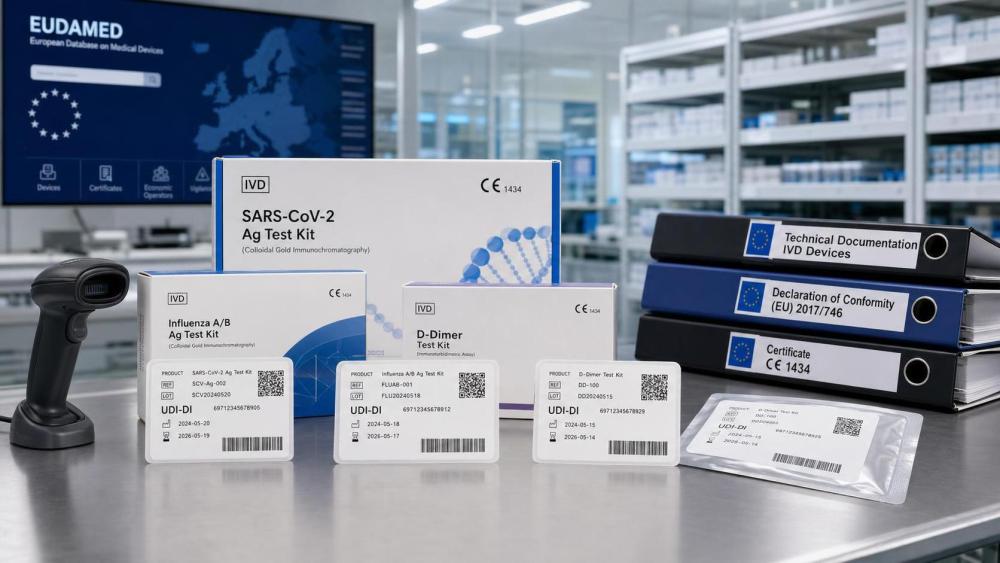
What the New Guidance Confirms
The confirmed facts are limited but operationally specific. The European Commission issued the IVDR Supplementary Guidance (2026/Rev.2) on July 18, 2026. The guidance clarifies that from August 1, 2026, all newly submitted CE certification applications for IVD products, as well as annual surveillance activities for products that already hold certificates, must include real-time linkage between UDI-DI and EUDAMED data.
It also states that importers must be able to use QR code scanning to verify three elements: the production batch, the status of the authorized representative, and the completeness of archived clinical evidence. The input information further indicates that this requirement directly affects the technical documentation preparation cycle, labeling compliance, and distributor inventory management processes of Chinese IVD export companies.
Where the Immediate Pressure Is Likely to Appear
Certification and registration workflows face tighter document coordination
From an industry perspective, companies preparing new CE submissions are likely to feel the impact first because the guidance explicitly ties application work to real-time UDI-DI and EUDAMED linkage. The likely pressure point is not only whether the file exists, but whether identification data and supporting records can stay aligned during submission and review.
Labeling and packaging functions move closer to data compliance
The QR-based verification requirement suggests that labeling is no longer only a presentation issue. Analysis shows that labeling and packaging teams will need to pay closer attention to whether the product label structure supports importer-side verification of batch details, authorized representative status, and clinical evidence archive completeness. That makes label compliance more closely tied to backend data readiness.
Importers and distributors may need to adjust goods handling routines
For importers and channel partners, the practical effect is likely to show up in receiving, verification, and stock management steps. Because QR code scanning is expected to confirm specific compliance elements, distributors may need to pay more attention to whether incoming products can be checked smoothly against the required data points. The input also makes clear that inventory management processes are directly affected, which places extra focus on how existing stock and annual surveillance products are handled.
Chinese IVD exporters face a shorter margin for coordination errors
For Chinese IVD export manufacturers, the stated impact on technical documentation cycles indicates a more compressed preparation rhythm. Observably, any mismatch between product identification data, authorized representative information, and archived clinical evidence could become more visible during both new submissions and ongoing supervision activities.
What Companies Should Watch Now
Check whether filing data and live records can stay synchronized
What deserves closer attention is the distinction between having a compliant dossier and maintaining synchronized data in practice. Companies involved in EU submissions or certificate maintenance should focus on whether UDI-DI records and EUDAMED-linked information can remain consistent across submission, update, and surveillance stages.
Review label readiness against importer verification needs
The QR code requirement makes importer-side usability a practical compliance issue. Companies should pay attention to whether current labels and related product information can support verification of batch data, authorized representative status, and clinical evidence archive completeness without creating ambiguity in cross-border distribution.
Assess the effect on annual surveillance, not only new applications
The guidance does not apply only to products entering certification for the first time. It also reaches products that already hold certificates through annual surveillance. That means businesses should review ongoing certificate maintenance workflows and not treat this only as a forward-looking requirement for future launches.
Prepare for communication friction across exporters, representatives, and channels
Analysis shows that the practical burden may fall across multiple parties rather than one department. Exporters, authorized representatives, importers, and distributors may all need aligned records and clear communication on document status, labeling details, and verification logic. The business issue is not abstract policy interpretation alone, but whether each party is working from the same current information.
Why This Looks Like More Than a Routine Clarification
This section is an editorial observation rather than a statement of fact. It is more appropriate to understand this update as a concrete compliance signal with immediate operational consequences, rather than a distant policy direction. The reason is that the guidance links traceability, labeling, importer verification, and surveillance into one connected requirement set starting from a defined date.
At the same time, it should not be overstated as a complete market reset. Based on the input alone, the guidance establishes a clearer implementation expectation, but further observation is still needed on how companies absorb the requirement in day-to-day certification, stock management, and cross-party coordination.
How the Update Is Best Understood at This Stage
In practical terms, this development matters because it turns traceability from a documentation topic into a live compliance process involving data linkage and importer verification. For IVD businesses serving the EU market, especially Chinese exporters named in the input, the most reasonable reading today is that this is an actionable short-term compliance change that also signals a longer-term tightening of operational traceability expectations. The core issue is not only whether firms know the rule, but whether their documents, labels, and channel processes can support it consistently from August 1, 2026 onward.
Basis of This Article
This article is based on the user-provided news title, event date, and event summary. The confirmed information used here comes from the stated release of the European Commission’s IVDR Supplementary Guidance (2026/Rev.2), the effective date of August 1, 2026, and the described requirements concerning UDI-DI, EUDAMED linkage, QR code verification, and the stated impact on Chinese IVD exporters.
For this type of industry update, commonly relevant source categories may include official announcements, company disclosures, industry association information, authoritative media coverage, and standards-related documents. A specific official source link was not provided in the input, so the exact link still requires ongoing verification. Follow-up attention should remain on any further official wording, implementation clarifications, and how the requirement is applied in submission and annual surveillance practice.
Have questions about the global trade trends discussed here, or planning your expansion and supply chain strategy? Leave a message below and let the trade experts at MTHH guide you.
We respect your privacy. Your information is strictly confidential.
Related News
- Abbott Launches Next-Generation Whole-Genome Sequencing Oncodetect MRD TestOct 27, 2026Explore Abbott’s Oncodetect MRD test, using whole-genome sequencing to track up to 5,000 ctDNA variants. Discover key clinical evidence and procurement considerations.
- SCIEX Starts Beijing Plant Project, Danaher's Tenth Manufacturing Site in ChinaOct 24, 2026SCIEX's Beijing plant project marks Danaher's tenth manufacturing site in China. Explore how its RMB 100 million-plus investment could strengthen local mass spectrometer supply.
- How laboratory workflow solutions reduce sample processing delaysOct 23, 2026Discover how laboratory workflow solutions reduce sample processing delays, improve tracking, and streamline reporting. Explore practical steps to cut waiting times without compromising quality.
- How to evaluate a web-based LIMS for lab instrument integrationOct 22, 2026Evaluate a web based LIMS for reliable lab instrument integration. Learn how to verify connectors, test failure recovery, and compare costs before choosing your system.