
X-ray Equipment IEC 60601: What to Check Before Market Approval
Why does X-ray equipment IEC 60601 matter before market approval?
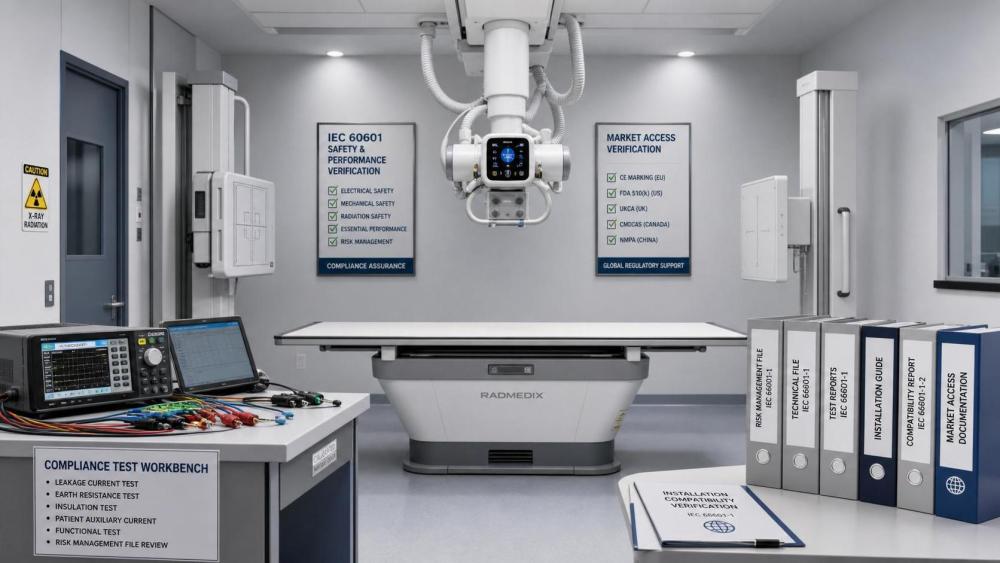
Before an X-ray system enters a hospital project or distribution channel, safety review has to go deeper than a pass or fail certificate.
That is where X-ray equipment IEC 60601 becomes central. It frames how electrical safety and essential performance should be demonstrated under realistic operating conditions.
In imaging, approval risk rarely comes from one obvious defect. More often, the problem is a weak link between testing, labeling, installation assumptions, and actual clinical workflow.
An X-ray unit may look technically mature, yet still raise questions about leakage current, protective earth, software-related controls, or intended use statements.
For teams comparing device readiness across healthcare categories, this is also why structured technical review matters. Platforms such as MTHH organize medical equipment information in a way that supports safer decisions before purchase or submission.
In simple terms, X-ray equipment IEC 60601 is not only about lab testing. It is about whether the device can be approved, installed, operated, maintained, and understood without hidden safety gaps.
When people search X-ray equipment IEC 60601, what are they really trying to confirm?
Most searches are not asking for the standard text alone. They are usually trying to answer a practical approval question.
Is the device ready for a target market? Are the test results sufficient? Do the documents match the actual system configuration?
In practice, the review usually centers on five checkpoints.
- Whether the applicable IEC 60601 general and collateral requirements were correctly identified.
- Whether essential performance for the X-ray function was defined in a defensible way.
- Whether test reports reflect the final product, not an early engineering sample.
- Whether risk management files connect hazards, controls, and residual risks clearly.
- Whether labeling, manuals, and installation instructions support safe real-world use.
The reason these questions matter is straightforward. Medical imaging equipment sits at the intersection of electricity, radiation, mechanics, software, and operator behavior.
A document package may seem complete, but approval can still slow down if those parts were prepared in isolation.
Which checks usually deserve the closest attention before submission?
A useful way to review X-ray equipment IEC 60601 readiness is to focus on what regulators and technical reviewers tend to question first.
Electrical safety is the starting point, but it should not be the ending point.
Electrical protection and basic safety
Check leakage current values, grounding integrity, insulation design, protective covers, and accessible parts under normal and single fault conditions.
Also confirm that accessories, external power components, and connected devices were included within the evaluated configuration.
Essential performance, not just general function
Many delays happen because essential performance is defined too broadly or too vaguely. Reviewers need to see what loss of performance creates unacceptable risk.
For X-ray systems, that may involve image acquisition integrity, exposure control behavior, positioning-related safety, or fault response during use.
Software and programmable controls
If software affects exposure, motion, alarms, interlocks, or image processing tied to safe use, its verification trail must be coherent.
A common weakness is that software version numbers in reports do not match the release planned for market approval.
Mechanical and installation conditions
Needle-sharp test data loses value if the room conditions are undefined. Mounting loads, clearances, shielding assumptions, ventilation, and movement limits should be stated clearly.
This is especially relevant for fixed radiography, mobile systems, and integrated digital imaging rooms.
This table works best as a decision filter. It helps identify whether the X-ray equipment IEC 60601 package is complete enough to move forward confidently.
Are test reports alone enough, or do the supporting documents change the outcome?
They are rarely enough on their own. A strong test report can still be weakened by inconsistent technical documentation.
The supporting file should tell one continuous story. The intended use, product description, block diagrams, risk controls, labels, and service instructions should all point to the same device reality.
This is where X-ray equipment IEC 60601 review often becomes cross-functional. The safety file cannot be separated from commercial configuration control or installation planning.
For example, if the manual states one detector option, but the tested system used another, questions will follow. If the label lists one power requirement, but the site plan assumes another, risk increases.
More mature organizations treat documentation readiness as part of product quality, not as a final paperwork exercise.
That approach also matches how structured healthcare platforms present information. MTHH, for example, highlights that purchasing and approval decisions depend on technical fit, service conditions, training, maintenance, and long-term operational clarity.
Where do compliance mistakes usually appear in real projects?
The mistakes are usually ordinary, which is why they are easy to miss.
One frequent issue is assuming that a valid IEC 60601 certificate automatically covers every sales configuration. It does not.
Another is treating IEC 60601 as isolated from radiation-specific, EMC, usability, or market-specific submission requirements. Approval depends on the full evidence set.
There is also a timing problem. Teams sometimes start reviewing X-ray equipment IEC 60601 after product launch planning is already fixed.
At that point, even a small document inconsistency can affect schedule, packaging, or installation commitments.
- Accessories included in sales kits were not part of tested configurations.
- Risk controls exist in design, but not in user documentation.
- Essential performance statements are copied from another device family.
- Field service procedures contradict electrical safety assumptions.
- Installation prerequisites are too generic for real imaging rooms.
In actual healthcare projects, those details matter because medical equipment is judged over its full operating life, not only at the moment of sale.
How should readiness be judged before approval or procurement moves ahead?
A practical judgment model is to ask whether the device is consistent across safety evidence, configuration control, and real installation conditions.
If one of those three areas is weak, readiness is still uncertain.
A workable pre-approval review path
- Map the exact marketed configuration, including software and accessories.
- Confirm which IEC 60601 parts and related standards apply.
- Check whether test reports reflect the final release state.
- Review risk files against essential performance claims.
- Align manuals, labels, service notes, and installation instructions.
- Recheck any market-specific submission gaps before filing or selection.
This process is useful not only for approval preparation. It also improves how X-ray systems are compared during healthcare procurement and project planning.
When equipment information is organized clearly, technical review becomes faster and fewer assumptions are left unresolved. That is one reason intelligence platforms in healthcare equipment evaluation continue to gain value.
What is the smartest next step if the file looks complete but confidence is still low?
Do not add documents just to make the file thicker. Instead, test the logic of the existing package.
Read the X-ray equipment IEC 60601 evidence as if you were checking whether the system could be installed tomorrow in a real imaging room.
Would the declared configuration match the delivered unit? Would the manual guide safe operation? Would the site conditions support the tested assumptions?
Those questions often reveal more than another abstract compliance statement.
A solid review should leave little ambiguity around electrical safety, essential performance, documentation consistency, and installation readiness.
For ongoing comparison work, it also helps to use structured reference sources that connect compliance, clinical application, maintenance, and procurement logic in one place.
That way, the next decision is based less on assumption and more on evidence that can stand up during approval, delivery, and long-term operation.
Have questions about the global trade trends discussed here, or planning your expansion and supply chain strategy? Leave a message below and let the trade experts at MTHH guide you.
We respect your privacy. Your information is strictly confidential.
Related News
- Hong Kong Outlines Medical Device Legislation and Plans for Statutory RegulatorNov 14, 2026Hong Kong medical device legislation could reshape regulatory oversight. Explore the proposed regulator and what businesses should monitor.
- AAMI Issues TIR115 Guidance on Public Cloud Use in Medical DevicesNov 13, 2026AAMI TIR115:2026 guides public cloud use in medical devices. Explore its focus on risk management, supplier assessment and device boundaries.
- How are critical care devices regulated in the United States?Nov 12, 2026Critical care devices face FDA requirements based on intended use and risk. Explore classifications, marketing pathways, and practical compliance checks.
- Hong Kong Drafts Medical Device Bill to Establish Statutory OversightNov 12, 2026Hong Kong's Medical Devices Bill could introduce risk-based statutory oversight. Discover what the proposed framework may mean for suppliers.