
Which records demonstrate central sterile services compliance?
Central sterile services compliance is demonstrated by a connected record of how reusable devices were received, cleaned, inspected, packaged, processed, and released. The strongest evidence links each relevant device or set to the processing equipment, cycle results, monitoring evidence, and authorized release decision. Equipment certificates and written procedures support that evidence, but they cannot establish whether a particular load met its acceptance criteria.
An audit-ready record must answer two questions: what requirements applied when processing occurred, and what evidence shows those requirements were met? The answer requires both controlled documents defining the process and completed records showing its execution. A passing sterilization indicator alone cannot establish that cleaning, packaging, or device compatibility was acceptable.
Start with the requirements behind each record
A requirements register establishes the basis for evaluating the records. It identifies applicable regulations, adopted standards, accreditation requirements, local policies, and current manufacturer instructions for reusable devices, processing equipment, packaging, and monitoring products. Include document versions, applicability, and the procedure that implements each requirement. A generic list of standards without those connections leaves acceptance decisions difficult to defend.
Requirements vary by jurisdiction, sterilization method, device design, and intended use. Consequently, a fixed biological monitoring schedule or universal retention period should not be copied into every department’s procedures. The documented schedule must reflect the requirements that actually apply. Where instructions conflict, retain the technical assessment and written resolution; an undocumented local workaround does not establish a supported process.
Controlled procedures also need approval dates, revision histories, and evidence that relevant changes reached the people performing the work. A completed record referencing an obsolete cycle specification raises a different issue from an incomplete form: the underlying process itself may require investigation.
The evidence chain from receipt to release
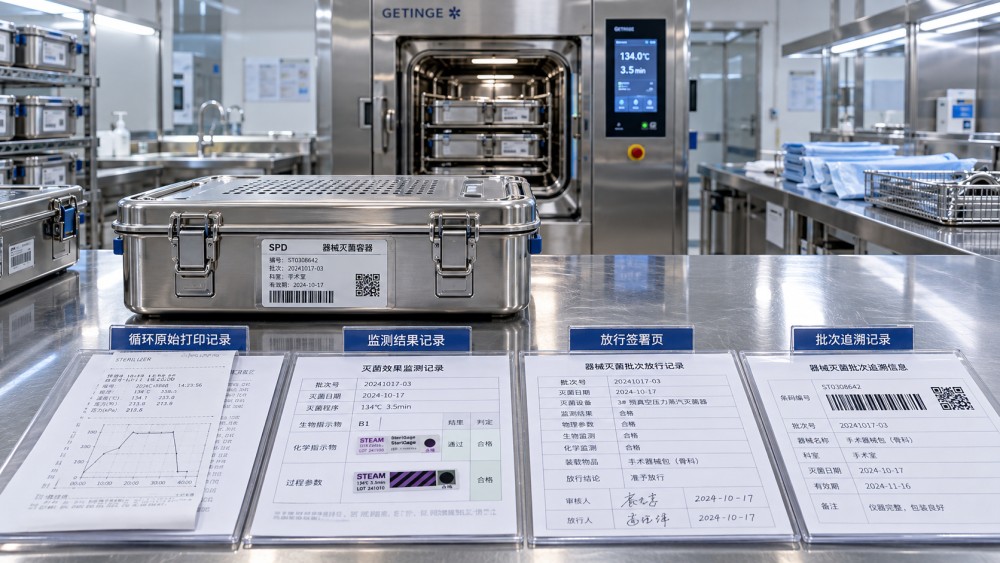
The following records establish different parts of the same processing history. Their identifiers must connect clearly enough to reconstruct a selected load without relying on memory.
The traceability unit needs to be defined. Some workflows track individual instruments; others track trays, sets, containers, or packages. The chosen level must satisfy applicable requirements and support effective recall. Where patient or procedure linkage is required, distribution and clinical records must preserve that connection, including after sets are rebuilt or instruments are substituted.
Cleaning records establish whether sterilization could succeed
Cleaning records should identify the method used and the conditions relevant to that method. For automated cleaning, retain the washer-disinfector identifier, selected program, cycle outcome, alarms, and applicable parameter data. For manual cleaning, documentation should capture critical conditions defined by the validated procedure, such as detergent preparation, contact time, temperature limits, and treatment of internal channels.
A completed washer cycle does not establish that every device was correctly prepared. Disassembly, brushing, flushing, irrigation connections, and load configuration affect whether cleaning reaches the intended surfaces. Records should capture required preparation and verification activities, particularly where complex devices need device-specific handling.
Inspection results need an identifiable outcome. Visible residual soil requires rejection from further processing and return to the appropriate cleaning stage. Where the quality system requires cleaning verification tests, retain the method, sampling location, result, acceptance limit, and action following failure. Residual protein testing and other verification methods answer defined questions; none automatically proves every surface of an entire load is clean.
For a washer-disinfector, thermal disinfection data should remain distinguishable from cleaning evidence. An acceptable disinfection stage does not resolve inadequate soil removal. Repeated failures associated with a particular lumen connection or loading position should be traceable across records, allowing investigation of a recurring process defect.
What a defensible sterilization load record contains
A sterilization load record needs a unique load identifier, sterilizer identification, cycle date and time, cycle selection, load contents, and sufficient information to establish compatibility with the approved process. The load description must distinguish relevant configurations, including mixed materials, hollow devices, containers, and other items subject to specific processing restrictions.
Retain the actual cycle output rather than only a handwritten “pass.” For steam processing, review the recorded time, temperature, pressure relationship, and relevant cycle phases against the approved criteria. Low-temperature processes require their own process-specific data. A steam-cycle acceptance template should not be reused where different variables determine process performance.
The record must also show the monitoring required for that load or processing period:
- Physical monitoring: cycle data, equipment status, alarms, and evidence that required parameters were achieved.
- Chemical indicators: the appropriate indicator identity, placement information where required, and interpreted result. An external process indicator establishes exposure to a process; it does not establish sterility.
- Biological monitoring: where required, document the indicator identification, applicable lot and expiry information, placement or challenge device, incubation details, control result, and final interpretation.
- Air-removal or other equipment performance tests belong in the record set when required for the sterilizer and cycle type. They evaluate a defined equipment function and do not replace load-specific release evidence.
Indicator results must be interpreted within their intended use. A satisfactory chemical indicator cannot override an unacceptable physical cycle record. A negative biological indicator does not correct incompatible packaging, inadequate cleaning, or an unsuitable cycle selection. Conversely, an indicator anomaly requires investigation of the indicator, placement, handling, and process evidence before its significance can be determined.
Record interpretation matters as much as attachment. An unreadable cycle printout, an unrecorded biological indicator control, or an indicator result entered against the wrong load leaves a gap even when the equipment display showed successful completion.
Release decisions need their own evidence
The release record should identify who reviewed the required evidence, when review occurred, and the resulting status. Defined acceptance criteria should cover cycle performance, required monitoring, package condition, and any outstanding exceptions. An automatic equipment message is only one input to this decision.
Wet, torn, punctured, or otherwise compromised packages require a documented disposition even when sterilization parameters were acceptable. Where handling or storage damage is discovered after release, the record should preserve the original processing history and the subsequent withdrawal or reprocessing decision.
Implant loads require particular attention to applicable biological monitoring and quarantine provisions. Where release before a required result is permitted only under an exception procedure, retain the reason, authorization, available evidence, and follow-up. Scheduling pressure does not itself establish that an exception is permitted.
For illustration, suppose a cycle meets its physical criteria but a required biological indicator result remains pending. The record should show the load’s controlled status and location. A final release signature entered before the required evidence exists would misrepresent the decision, even if the later result is satisfactory.
Qualification, maintenance, and competency support the load history
Equipment qualification records establish that the installed system and approved processes perform as intended under defined conditions. Retain installation and operational evidence, performance qualification reports, approved load configurations, acceptance criteria, deviations, and authorization for routine use. Qualification must cover the process actually used; a report for a materially different cycle or load does not establish suitability.
Maintenance files should connect service work to equipment status. Include preventive maintenance, repairs, calibration or verification of relevant measurement devices, identified faults, and return-to-service authorization. Changes affecting process performance need a documented assessment of the testing or requalification required before routine processing resumes.
Utility and environmental records belong in this evidence set where they affect validated conditions. Examples include water quality for cleaning and rinsing, steam quality, and specified storage conditions. The monitoring scope and frequency should follow the applicable process requirements. A room temperature log cannot substitute for evidence about a water quality problem affecting cleaning performance.
Competency records should identify the tasks assessed, assessment method, result, assessor, date, and any restrictions or retraining. Attendance at training establishes participation; demonstrated competency establishes the ability to perform the assigned process. Device-specific activities, load release, and interpretation of monitoring results need assessment appropriate to their complexity.
Failures must remain visible through closure
Deviation records demonstrate how the service responds when acceptance criteria are not met. A useful record identifies the event, affected equipment and loads, immediate containment, investigation findings, disposition, corrective action, and evidence of effectiveness. Preserve unsuccessful cycles and rejected results alongside successful reprocessing records.
A positive biological indicator, failed cleaning test, interrupted cycle, or missing process data does not always require the same response. The documented assessment must use the failure type, process history, applicable requirements, and available traceability to define the affected scope. Where released items require recall, retain distribution searches, notifications, recovery status, clinical escalation where applicable, and closure authorization.
Repeated deviations should remain searchable by equipment, device family, process, and failure type. Otherwise, individually closed incidents can conceal a recurring defect. Effectiveness evidence should address the identified cause—for example, demonstrating reliable channel irrigation after a connection problem—rather than merely recording that training occurred.
Prove that the records can be retrieved and trusted
Paper and electronic systems both need controlled access, legible entries, identifiable authors, and corrections that preserve the original information. Electronic records additionally require appropriate access permissions, audit trails, backup, and retrieval arrangements. Shared accounts weaken attribution, while overwritten results remove evidence needed to reconstruct a decision.
Retention periods must follow applicable legal, accreditation, contractual, and organizational requirements. They should also support relevant device and patient traceability obligations. Establish how records remain accessible after software changes, equipment replacement, outsourced processing, or supplier contract termination.
A focused audit exercise starts with a released set and retrieves its cleaning evidence, packaging record, sterilization data, monitoring results, and release authorization. It then follows one failed load forward to containment and closure. Missing links reveal whether central sterile services compliance is supported by a reconstructable processing history.
Have questions about the global trade trends discussed here, or planning your expansion and supply chain strategy? Leave a message below and let the trade experts at MTHH guide you.
We respect your privacy. Your information is strictly confidential.
Related News
- Hong Kong Outlines Medical Device Legislation and Plans for Statutory RegulatorNov 14, 2026Hong Kong medical device legislation could reshape regulatory oversight. Explore the proposed regulator and what businesses should monitor.
- AAMI Issues TIR115 Guidance on Public Cloud Use in Medical DevicesNov 13, 2026AAMI TIR115:2026 guides public cloud use in medical devices. Explore its focus on risk management, supplier assessment and device boundaries.
- How are critical care devices regulated in the United States?Nov 12, 2026Critical care devices face FDA requirements based on intended use and risk. Explore classifications, marketing pathways, and practical compliance checks.
- Hong Kong Drafts Medical Device Bill to Establish Statutory OversightNov 12, 2026Hong Kong's Medical Devices Bill could introduce risk-based statutory oversight. Discover what the proposed framework may mean for suppliers.