
Which medical devices require SFDA approval in Saudi Arabia?
Which Medical Devices Require SFDA Approval in Saudi Arabia?
Understanding which medical devices Saudi Arabia requires to be approved is a practical starting point for any manufacturer, distributor, hospital group, or procurement team considering the market. A device can be clinically capable and commercially attractive, yet still be unusable in a Saudi project if its regulatory position, labeling, local representation, or import documentation has not been addressed.
In everyday business language, people often say a product needs “SFDA approval.” In most commercial situations, the issue is whether the product must obtain a valid Saudi Food and Drug Authority medical device marketing authorization before it is placed on the Saudi market. That question is broader than customs clearance. It can affect distributor onboarding, hospital tender participation, installation planning, maintenance arrangements, and the ability to supply consumables or software updates after the initial sale.
The short answer is that medical devices and in vitro diagnostic devices intended to be supplied, sold, imported, distributed, or used in Saudi Arabia will generally fall within SFDA oversight. The more useful answer is that the product’s intended purpose, claims, accessories, software functions, and route to market determine what should be reviewed. This is where many early-stage evaluations become too simplistic.
The core test: does the product have a medical intended purpose?
A product is not assessed only by how it looks or where it is used. The key question is what the manufacturer says the product is intended to do. Equipment intended for diagnosis, prevention, monitoring, prediction, prognosis, treatment, alleviation of disease or injury, support of anatomy or physiology, disinfection of medical devices, or related medical purposes is likely to be treated as a medical device. In vitro diagnostic products are assessed separately in practice, but they are also within the medical device regulatory environment.
This distinction matters because similar-looking products can have very different regulatory outcomes. A basic consumer wellness wearable that only tracks general activity may not be marketed in the same way as a wearable that claims to detect arrhythmia, monitor oxygen saturation for clinical decision-making, or alert users to a disease-related condition. A standard chair is furniture; a chair promoted for patient positioning, rehabilitation, or clinical treatment may become a medical device or accessory depending on its intended purpose and design.
For business evaluators, the safest early question is not “Does this product have CE marking or FDA clearance?” It is: “What exact claims appear in the instructions for use, brochure, website, packaging, quotation, and distributor presentation?” Promotional language can create a regulatory issue if it goes beyond the authorized intended use.
Device categories that commonly require SFDA market authorization
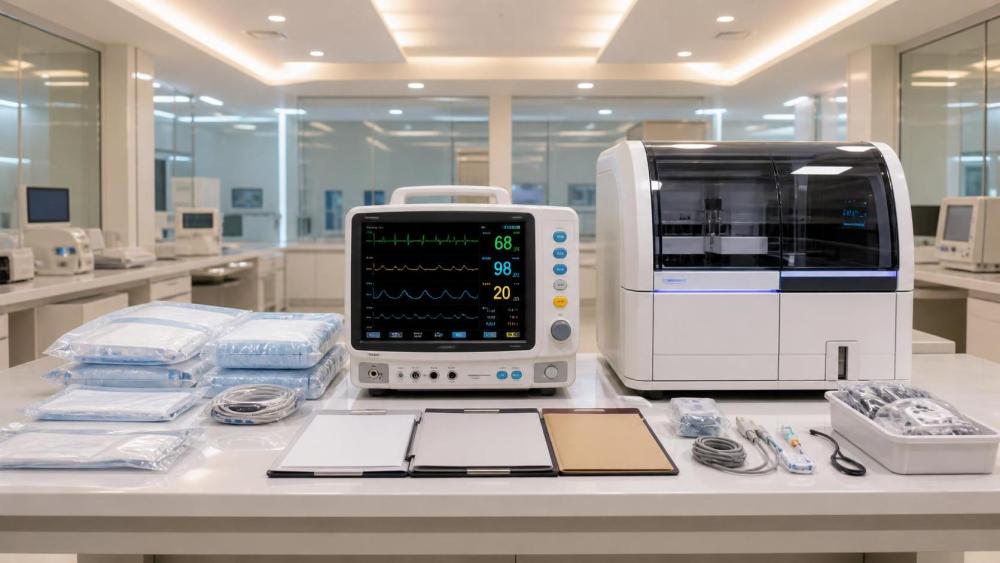
The following categories are normally considered within the scope of medical device regulation when supplied for their medical intended purpose. The list is not exhaustive, but it reflects the product groups most often encountered in hospital procurement, clinical engineering review, and distributor portfolio planning.
Medical consumables should not be overlooked. Syringes, catheters, wound-care products, examination gloves marketed for medical use, specimen collection products, implants, sterile packs, and many single-use items may require a regulatory review even though they are lower in unit value than capital equipment. For a distributor, the compliance work for a disposable product can be just as commercially important because replenishment volume depends on uninterrupted importation and correct product documentation.
Accessories are another frequent blind spot. If an accessory is intended by its manufacturer to enable or assist a medical device to achieve its intended medical purpose, it should not automatically be treated as an ordinary spare part. A dedicated ECG cable, imaging detector, infusion set, probe cover, software module, or device-specific battery may have to be assessed within the relevant regulatory framework.
Products that require careful boundary assessment
Not every product used in a healthcare facility is necessarily a medical device. General office systems, ordinary furniture, construction materials, non-medical cleaning products, and generic IT hardware may sit outside the medical device definition. But the boundary can move quickly when medical claims are added.
Consider hospital beds. A basic bed supplied as furniture is different from an electrically operated bed with patient positioning functions, side rails, alarm features, pressure-injury prevention claims, or integration into a nurse call workflow. Likewise, an air purifier sold for general indoor comfort is not the same as equipment claimed to support infection-control performance in a clinical environment. The product description, technical file, labeling, and sales claims all matter.
Software deserves particular attention. A hospital information system used only for scheduling or billing may not be medical device software. By contrast, software that analyzes a CT image, calculates a diagnostic score, recommends a treatment parameter, or generates alarms that clinicians rely upon can fall within medical device regulation. A common mistake is assuming that cloud delivery removes the regulatory question. It does not. The relevant issue is the software’s medical function, not whether it arrives in a box.
SFDA authorization is not the same as every other market-entry requirement
A valid product authorization is central, but it does not make a supplier fully ready to trade. Manufacturers located outside Saudi Arabia generally need an appropriate local regulatory presence through a Saudi Authorized Representative. The local importer, distributor, or other economic operator may also have its own establishment and operational obligations. These roles should be checked before the commercial agreement is finalized, not after goods have been manufactured and shipped.
For higher-value equipment, there may be parallel requirements outside the core device marketing authorization process. Radiation-producing systems can involve additional technical, site, or radiation-safety considerations. Connected devices raise cybersecurity, network architecture, user-access, data-handling, and software-update questions. A ventilator may be market-authorized, but a hospital can still reject it if the local service team cannot support preventive maintenance, alarm configuration, spare parts, and operator training.
Tender requirements can be stricter in practice than a basic product registration check. Procurement teams may ask for authorization evidence, product catalogues, instructions for use, quality certificates, country-of-origin documents, warranty commitments, maintenance schedules, training plans, and proof that the offered model exactly matches the authorized configuration. A quotation that names a family platform while supplying unlisted modules or different accessories creates avoidable risk.
What should be reviewed before selecting a supplier?
For medical devices Saudi Arabia projects, a useful evaluation starts with the specific commercial unit: manufacturer name, brand, model, variant, intended purpose, classification, and included accessories. “Registered product” is not enough if the supplier cannot show that the exact offered configuration is covered. This is especially relevant for imaging platforms, modular monitors, laboratory analyzers, and software-enabled systems where features may differ by license or market version.
A practical review file usually includes the following questions:
- Is the product a medical device or IVD under its stated intended purpose?
- Does the exact model, variant, and accessory set have the required Saudi market authorization or a clearly documented route to authorization?
- Who is the Saudi Authorized Representative, and who will handle importation, distribution, vigilance, complaints, and field actions?
- Are labeling, instructions for use, and promotional claims aligned with Saudi requirements and the authorized product scope?
- Can the supplier maintain consumables, reagents, spare parts, calibration support, and software updates for the expected life of the equipment?
- For installed systems, have site readiness, acceptance testing, user training, and maintenance responsibilities been allocated in writing?
The last question is often where real projects become difficult. A laboratory may procure an analyzer at an acceptable capital price, only to find later that reagent lead times, calibration arrangements, or interface work were not properly included. An imaging department may receive a system that is technically approved but cannot be commissioned because room preparation, electrical specifications, or shielding coordination were left until too late. Regulatory readiness and operational readiness should be reviewed together.
Documentation quality often reveals the real level of readiness
Well-prepared manufacturers can normally explain their intended use, risk controls, labeling, clinical evidence where applicable, quality management approach, and post-market responsibilities in a consistent way. The documentation does not need to be used as a sales brochure. Its value is that it allows the local representative, distributor, and hospital evaluator to identify mismatches before they become a shipment delay or tender dispute.
There is also a difference between a historical certificate and current market status. Product families evolve: software changes, new probes are added, reagent packs are reformulated, or a manufacturer changes legal entity or production site. Those changes may affect the compliance assessment. Teams should request current evidence and confirm whether the documents correspond to the exact product being offered, rather than relying on an old presentation slide.
This is one reason structured market intelligence is useful before a purchase or distribution commitment. Platforms such as Global MedTech & Healthcare Intelligence Hub help procurement and clinical engineering teams compare not only the headline technology, but also its maintenance requirements, consumable dependency, installation conditions, clinical workflow fit, and documentation readiness. In Saudi market entry, these details are usually more valuable than a broad claim that a device is “compliant.”
A sensible way to approach Saudi market entry
Manufacturers should classify the product and map its intended claims before appointing a distributor or printing Saudi-facing marketing materials. Distributors should validate authorization scope before committing to stock, tenders, or hospital demonstrations. Hospital procurement teams should request evidence early enough that a regulatory gap does not appear after technical selection has already been made.
The question is therefore not simply whether a device “needs SFDA approval.” Most products intended for medical diagnosis, monitoring, treatment, laboratory testing, or direct clinical support should be treated as requiring formal regulatory attention before commercial supply in Saudi Arabia. The more important task is to verify the exact device, its claims, its local market operators, and its lifecycle support. That is the difference between a product that looks eligible on paper and one that can actually be imported, installed, serviced, and used safely in a Saudi healthcare setting.
- medical devices
- medical technology
- hospital procurement
- clinical engineering
- diagnostic imaging
- laboratory diagnostics
- patient monitoring
- medical consumables
- patient monitors
- ventilators
- anesthesia machines
- infusion pumps
- defibrillators
- operating tables
- hospital beds
- rehabilitation equipment
- catheters
- syringes
- laboratory analyzers
- medical device software
- digital medical technology
- medical devices Saudi Arabia
Have questions about the global trade trends discussed here, or planning your expansion and supply chain strategy? Leave a message below and let the trade experts at MTHH guide you.
We respect your privacy. Your information is strictly confidential.
Related News
- Hong Kong Outlines Medical Device Legislation and Plans for Statutory RegulatorNov 14, 2026Hong Kong medical device legislation could reshape regulatory oversight. Explore the proposed regulator and what businesses should monitor.
- AAMI Issues TIR115 Guidance on Public Cloud Use in Medical DevicesNov 13, 2026AAMI TIR115:2026 guides public cloud use in medical devices. Explore its focus on risk management, supplier assessment and device boundaries.
- How are critical care devices regulated in the United States?Nov 12, 2026Critical care devices face FDA requirements based on intended use and risk. Explore classifications, marketing pathways, and practical compliance checks.
- Hong Kong Drafts Medical Device Bill to Establish Statutory OversightNov 12, 2026Hong Kong's Medical Devices Bill could introduce risk-based statutory oversight. Discover what the proposed framework may mean for suppliers.