
Which hospital technology assessment criteria address patient safety?
The hospital technology assessment criteria that directly address patient safety are clinical performance, hazard control, usability, infection prevention, alarm behavior, system compatibility, cybersecurity, and reliability throughout the equipment’s service life. Each criterion needs evidence tied to the intended clinical application. Regulatory clearance establishes an important baseline, but a purchasing decision also requires proof that the proposed configuration will work safely with the hospital’s patients, workflows, infrastructure, and support arrangements.
A useful assessment separates safety requirements that must be satisfied before purchase from performance advantages that can be compared by scoring. An unresolved risk of incorrect treatment, missed deterioration, or ineffective decontamination should not be offset by higher throughput or a lower price. Acceptance conditions should be defined before demonstrations begin, with clear evidence requirements for each safety claim.
Clinical performance must match the intended use
Start with the clinical task and the consequences of an incorrect result or interrupted function. An infusion pump, laboratory analyzer, and patient monitor require different performance evidence because their failures affect care differently. The assessment should identify the intended patient population, care setting, operating range, and conditions under which an error could change treatment.
Headline accuracy figures are insufficient when they hide important limitations. A monitor’s performance during stable conditions does not establish reliability during patient movement or low perfusion. An analyzer’s overall agreement with a comparator can conceal clinically significant differences near a treatment threshold. For imaging equipment, diagnostic image quality and radiation exposure need evaluation together under relevant examination protocols.
Request validation reports that describe test conditions, reference methods, sample characteristics, exclusions, and performance across the claimed operating range. Where applicable, examine subgroup results for the populations included in the intended use. Evidence generated with one accessory, reagent, or software version should not automatically be accepted for a different proposed configuration.
The acceptance question is concrete: does the technology provide sufficiently reliable information or therapy at the points where clinical decisions are made? A technically impressive specification has limited value if its supporting evidence excludes those conditions.
Risk controls need evidence of safe failure
A device can perform accurately during normal operation and still create unacceptable hazards when something goes wrong. Safety assessment should therefore examine power interruption, sensor disconnection, blocked tubing, depleted batteries, software faults, and loss of network services where these events are relevant.
Useful supplier evidence connects each significant hazard to a control and a verification result. A generic statement that risk management has been completed provides little basis for comparison. More informative documentation explains what triggers a protective action, what happens to treatment or data, how the fault becomes visible, and what recovery requires.
Automatic restart deserves particular attention. After power restoration, one device might resume therapy while another requires confirmation. The acceptable behavior depends on the clinical function and the hazards of restarting or remaining stopped. Battery assessment should likewise cover representative workloads, aging, low-battery warnings, and replacement arrangements rather than relying solely on runtime measured under favorable conditions.
Usability and alarms should be tested in realistic workflows
Usability evidence should address safety-critical tasks, including patient selection, parameter entry, accessory connection, alarm response, and recovery from interrupted work. A demonstration led by a product specialist rarely exposes the same difficulties as a busy ward, an urgent transfer, or a handover between shifts.
Representative scenarios reveal whether the interface supports safe action. For a pump, this could involve changing concentration while preserving the intended dose. For a monitor, it could involve admitting a new patient without retaining unsuitable settings. The evaluation should record task errors, recovery difficulty, and the consequences of those errors, rather than relying entirely on satisfaction ratings.
Training is necessary, but a warning in a manual offers weak protection against a predictable interface error. When safe operation depends on remembering an unusual sequence, examine whether a clearer display, constrained entry, or confirmation showing the clinical consequence provides a stronger control.
Alarm assessment needs equal attention. Sensitivity alone does not establish safety: excessive nonactionable alarms compete for attention, while aggressive filtering can delay recognition of deterioration. Relevant evidence includes detection behavior, alarm delay, priority assignment, audibility, visibility, silence duration, and the handling of disconnected sensors.
For distributed alarms, assess the complete path from device detection to notification and acknowledgment. Network interruption, unavailable mobile devices, and routing errors need observable failure indications. A central display or messaging connection should have a defined role, with clear limits on whether it replaces any bedside alarm function.
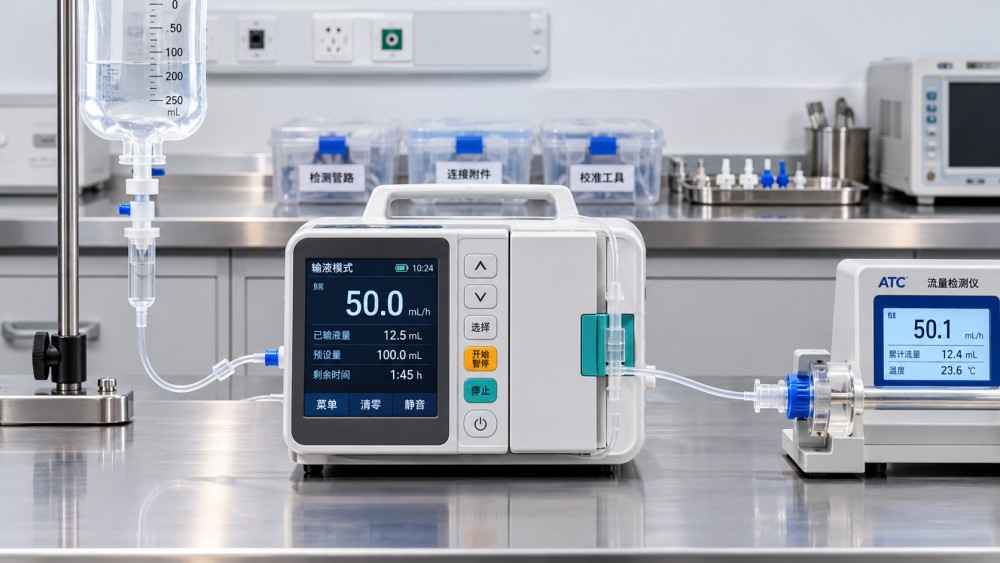
Infection prevention depends on the complete care cycle
Cleaning compatibility should be established for the exact surfaces, accessories, and agents used locally. A claim that equipment is “easy to clean” leaves unanswered questions about disinfectant concentration, contact time, fluid ingress, and repeated exposure. Cracked housings, damaged seals, and degraded touchscreens can create both contamination and functional hazards.
Reusable components require validated instructions appropriate to their clinical contact and design. Channels, joints, textured surfaces, and inaccessible cavities deserve scrutiny because visible cleanliness does not establish effective reprocessing. Required equipment, drying conditions, inspection steps, and permitted reuse limits should be clear.
Turnaround time also affects the safety judgment. If validated reprocessing takes longer than the interval between procedures, adequate spare components or a different workflow is necessary. Otherwise, operational pressure creates an incentive to shorten a safety-critical process. Single-use accessories require equally clear compatibility and handling instructions to prevent substitution or unintended reuse.
Integration and cybersecurity are clinical safety criteria
Connectivity claims should identify exactly what information is exchanged and how it is interpreted. A successful connection does not prove correct patient association, unit conversion, timestamp handling, or treatment of invalid values. Those details determine whether information remains safe to use after it moves between systems.
Interface evaluation should include interrupted connections, duplicate messages, delayed transmission, patient transfers, and corrected results. A particularly important distinction is whether a displayed value is current, historical, or unavailable. Retaining the last valid measurement without a clear age indicator can conceal a loss of monitoring.
Cybersecurity assessment should connect technical weaknesses to clinical consequences. Unauthorized setting changes, inaccessible records, and unavailable monitoring create different hazards and require different controls. Relevant evidence includes access management, protected remote servicing, vulnerability handling, supported update processes, and recovery procedures.
Security controls must also function during care. Authentication that delays urgent access or a patch process that interrupts a critical service needs an agreed operational approach. Where legacy equipment cannot support a required control, any compensating measures need a documented rationale and verification in the intended network environment.
The support agreement should clarify who communicates vulnerabilities, how updates are validated, and what happens when software support ends. An upgrade path that requires replacing otherwise functional hardware affects the period during which the equipment can remain safely supported.
Maintenance, infrastructure, and safety history change the decision
Reliability should be assessed through failure consequences and restoration capability. A component failure that causes a visible shutdown differs from gradual measurement drift that remains unnoticed. Maintenance schedules should address these failure modes through functional testing, calibration where applicable, inspection, and replacement of components subject to wear.
Service documentation should identify required tools, test equipment, specialist access, and tasks reserved for authorized service personnel. Long repair times become a patient safety issue when backup capacity is insufficient. Availability of loan equipment or a defined clinical fallback therefore belongs in the assessment of service support.
Installation conditions can invalidate otherwise strong performance evidence. Electrical supply quality, protective earthing, ventilation, medical gas provision, electromagnetic compatibility, and environmental limits need review according to the equipment involved. Compatibility should include approved accessories and consumables: a connector that physically fits does not establish safe functional interchangeability.
Post-market records add context to laboratory results. Review relevant safety notices, recalls, corrective actions, and reported failure patterns for the proposed model and configuration. Raw incident counts alone are poor comparison measures because exposure, reporting practices, and severity differ. The useful questions concern the failure mechanism, clinical consequences, affected versions, corrective action, and whether the offered equipment incorporates that correction.
Turn the evidence into a release decision
A practical decision record distinguishes among acceptable evidence, a resolvable gap, and an unresolved safety failure. Weighted scoring is useful after mandatory safety conditions are met. It should not allow convenience, purchase price, or additional features to cancel a critical deficiency.
Before purchase approval, each material gap needs a defined disposition. The following outcomes have different implications:
- Accept: evidence supports the intended use, and residual risks fit the hospital’s clinical and operational conditions.
- Conditional acceptance: a specific, verifiable action remains, such as completing an interface test or approving a compatible cleaning process. The condition needs an owner and a deadline before the affected clinical use begins.
- Defer or reject: evidence is inadequate for a safety-critical function, a protective measure fails, or the required supporting infrastructure is unavailable.
Procurement approval and release for clinical use are separate decisions. Installation acceptance should confirm the delivered model, software, accessories, configuration, and local connections against the assessed configuration. Outstanding training, unresolved interface faults, or incomplete safety testing should remain visible as release conditions.
The final acceptance record should state the approved uses, configuration limits, remaining controls, and events that trigger reassessment. A major software update, new patient population, changed disinfectant, or revised network architecture can alter the original safety judgment even when the device itself appears unchanged.
Have questions about the global trade trends discussed here, or planning your expansion and supply chain strategy? Leave a message below and let the trade experts at MTHH guide you.
We respect your privacy. Your information is strictly confidential.
Related News
- Hong Kong Outlines Medical Device Legislation and Plans for Statutory RegulatorNov 14, 2026Hong Kong medical device legislation could reshape regulatory oversight. Explore the proposed regulator and what businesses should monitor.
- AAMI Issues TIR115 Guidance on Public Cloud Use in Medical DevicesNov 13, 2026AAMI TIR115:2026 guides public cloud use in medical devices. Explore its focus on risk management, supplier assessment and device boundaries.
- How are critical care devices regulated in the United States?Nov 12, 2026Critical care devices face FDA requirements based on intended use and risk. Explore classifications, marketing pathways, and practical compliance checks.
- Hong Kong Drafts Medical Device Bill to Establish Statutory OversightNov 12, 2026Hong Kong's Medical Devices Bill could introduce risk-based statutory oversight. Discover what the proposed framework may mean for suppliers.