
When does local manufacturing make sense for medical devices in India?
Local manufacturing makes sense for medical devices in India when it improves the reliability of the delivered clinical product, not merely the factory-side cost of assembly. The strongest case usually appears where demand is recurring, product configuration is stable enough to validate, imported lead times disrupt installation or service, and a realistic local supply chain can support controlled production. In these conditions, local output can shorten replenishment cycles, reduce exposure to freight disruption, and make product variants more responsive to hospital conditions.
The case becomes weaker when a device depends on low-volume specialized components, tightly controlled proprietary subassemblies, or complex calibration methods that cannot yet be transferred without creating quality risk. A local label or final assembly step does not automatically create a sustainable medical devices India operation. The decision needs to account for component origin, incoming inspection, process validation, documentation, field service, and the cost of maintaining the installed base over its working life.
Demand must be predictable enough to support a controlled line
Volume is often discussed as a commercial question, yet its operational meaning is more important. A production line needs repeatable work instructions, trained personnel, approved tooling, inspection equipment, controlled storage, and a dependable flow of materials. These fixed requirements are difficult to sustain when orders arrive as isolated projects with different specifications each time.
Products with regular replacement demand or a consistent need across multiple care settings can be suitable candidates. Examples may include certain patient-care accessories, hospital furniture components, consumable-supporting equipment, basic diagnostic modules, or devices with a manageable number of approved configurations. The relevant question is whether production can follow a stable forecast, rather than whether the category is broadly popular.
Demand should also be separated by configuration. A monitor platform may share an enclosure and power architecture across several versions, while differing sensor inputs, software options, language requirements, mounting kits, and accessories create distinct controlled variants. Combining all expected orders into one headline volume can overstate the feasible local production scale. Each variation affects bills of materials, test procedures, labels, instructions, and spare-parts planning.
Local manufacturing becomes more defensible when product standardization has already been decided before the transfer begins. Frequent engineering changes after tooling has been ordered can cause unusable inventory, version-control errors, and inconsistent field support. A practical starting point is a limited configuration family with clear rules for any market-specific change.
Local assembly and local manufacturing are different operating models
Many investments begin with final assembly because it has a lower technical threshold. Imported subassemblies may be installed into a locally sourced enclosure, wired, tested, packed, and labelled close to the point of sale. This can be a rational model when logistics, finishing, local packaging, installation kits, or final customization create real value.
It should not be confused with full component localization. A device may still rely on imported sensors, imaging detectors, pumps, microcontrollers, optical modules, precision bearings, reagent-contact materials, or sterilization-critical parts. Each item has a different supply risk and qualification burden. A simple plastic housing may be transferred relatively quickly once mold quality and material control are established; an electronic board with safety-critical power performance needs a much deeper process and test capability.
The appropriate model depends on the device architecture. Products that are modular can allow a gradual transition: retain validated high-risk subassemblies from the original source while localizing cabinets, cable sets, mechanical brackets, carts, packaging, non-critical harnesses, or selected external accessories. The interface between local and imported modules must be controlled carefully. Connector orientation, torque values, cable routing, sealing surfaces, electromagnetic behavior, and software version compatibility can all affect final performance.
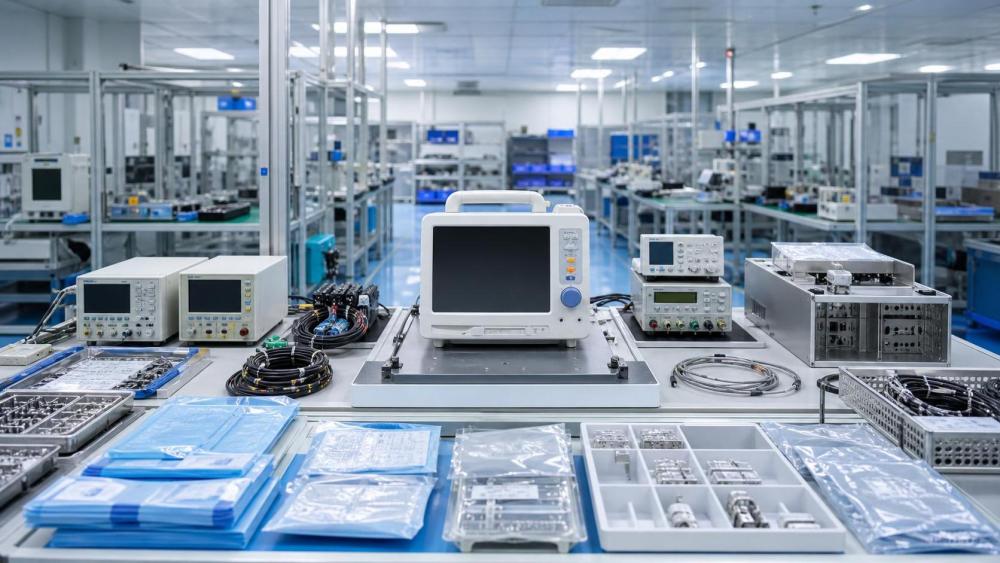
A phased approach can also reveal whether local production is absorbing genuine operational work or simply moving inventory between warehouses. The difference becomes clear in traceability records, test yields, repair turnaround, material losses, and the ability to maintain approved configurations without repeated intervention from the original engineering site.
Component sourcing determines whether cost control is real
Imported finished devices can carry freight, warehousing, customs handling, and long replenishment cycles. Local production may reduce some of these exposures, but it introduces other costs: supplier qualification, incoming inspection, tooling maintenance, quality staff, controlled storage, testing fixtures, scrap, and inventory buffers for long-lead components. A decision based only on unit assembly labor can produce misleading economics.
For each major part, the sourcing review should identify the material grade, dimensional tolerances, surface treatment, expected shelf life, packaging protection, and inspection method. Medical-grade polymers, silicone seals, stainless steel grades, coated aluminum, adhesive systems, battery cells, and cable insulation cannot be treated as interchangeable simply because a part looks similar. Material substitutions may affect chemical resistance, flame behavior, cleaning compatibility, leakage, biocompatibility considerations, or long-term aging.
Local suppliers need enough technical information to reproduce an approved item, but uncontrolled distribution of design files creates its own risks. Drawings, revision status, approved samples, inspection criteria, and change-notification obligations should be governed before production orders are issued. A supplier changing resin, plating thickness, cable source, or molding parameters without review can create a field problem that only emerges after installation.
Dual sourcing can strengthen resilience where the part is not tied to proprietary technology, but two sources create two process histories. Both sources require qualification, and the receiving process must distinguish revisions reliably. Where a component has a long imported lead time, holding controlled safety stock may still be preferable to hurried localization that cannot meet the original technical requirements.
Quality transfer is a production project, not a documentation exercise
A local site needs to prove that it can build and release devices consistently. This involves more than copying assembly instructions. The transfer package normally needs approved drawings, bills of materials, production routings, inspection plans, test limits, equipment specifications, calibration arrangements, traceability rules, packaging instructions, and procedures for nonconforming material. The records must reflect what is actually done at the workstation.
Test capability deserves early attention. Functional testing may require simulators, electrical safety instruments, flow meters, pressure gauges, image phantoms, optical targets, or software loading tools, depending on the device. Test equipment must be suitable for the required accuracy and maintained in a known condition. A final pass/fail result is not enough if it cannot be linked to the unit serial number, test software version, test fixture, and measured results where appropriate.
Process validation becomes especially important where later inspection cannot fully confirm the result. Examples include adhesive bonding, ultrasonic welding, sealing, sterile-barrier packaging, torque-controlled fasteners, battery welding, and software installation. Parameters such as temperature, dwell time, pressure, torque, curing conditions, and fixture alignment need defined ranges. Informal reliance on a skilled technician may appear efficient during pilot builds, but it is difficult to scale and difficult to investigate after a complaint.
Incoming inspection should focus on attributes that can damage device performance or safety. Inspecting every cosmetic surface while overlooking connector retention force, cable continuity, sealing dimensions, or a critical material certificate creates false confidence. Risk-based controls need to connect directly to the device design and the likely failure modes in transport, assembly, cleaning, and clinical use.
Regulatory readiness must match the actual manufacturing activity
The regulatory position depends on the product, its intended use, the activity performed locally, and the markets in which it will be supplied. Final assembly, relabelling, refurbishment, importation, and full production may create different documentation and oversight expectations. Treating a production transfer as a commercial logistics decision can delay release when the technical file, quality records, labels, and registrations do not reflect the real operating model.
Label content and instructions require particular care. Local language needs, importer or manufacturer details, batch or serial identification, storage requirements, warnings, electrical ratings, and software version references must remain aligned with the approved device configuration. A packaging change can seem minor yet affect transport protection, shelf-life control, or traceability at the hospital receiving point.
Complaint handling and post-market investigation also need a local route. When a device failure occurs, the organization must be able to identify the affected production lot, component revisions, test history, service actions, and distribution path. Without this chain, a localized supply model can make corrective action slower rather than faster.
Service requirements often decide the business case
Installed equipment generates a continuing demand for spares, preventive maintenance, calibration, software updates, technical training, and response to unexpected faults. Local manufacturing can improve these areas when common assemblies and repair parts are available nearby. It can also create confusion when the service organization receives units with undocumented configuration differences.
Before the first locally produced unit is shipped, the service documentation should match the factory configuration. Spare part numbers, exploded views, firmware versions, diagnostic procedures, tools, torque settings, and replacement criteria need to be clear. A field technician should not have to determine whether a locally assembled variant accepts the same power module, battery pack, sensor cable, or calibration routine as an imported unit.
Hospital conditions also shape the design of the local model. Power quality, room temperature, dust, humidity, water quality, cleaning chemicals, transport vibration, and available technical support can affect device reliability. These conditions may justify adaptations such as more robust wheels, improved cable protection, revised ventilation paths, voltage conditioning, or packaging reinforcement. Any adaptation needs design control and verification; local familiarity with an operating environment does not remove the need for evidence.
Where localization can introduce avoidable risk
High-complexity systems may require caution even when demand is attractive. Advanced imaging equipment, systems with precision optics, complex in vitro diagnostic platforms, and devices dependent on highly integrated software-hardware calibration can have tightly coupled components. Moving one stage of production without access to specialist fixtures, proprietary diagnostics, or engineering support can impair image quality, assay performance, alarm behavior, or reliability.
Another frequent error is treating all local content as equally valuable. A locally produced cabinet may reduce shipping volume and make repairs easier, while localized electronics create a broad validation burden for modest savings. The better decision may be selective localization that targets bulky, damage-prone, frequently replaced, or configuration-specific parts while retaining imported critical modules.
Short-term delivery pressure is also a poor reason to skip pilot controls. Early builds should expose assembly errors, supplier variation, packaging weaknesses, and test bottlenecks before routine orders depend on the line. Units from pilot production need the same traceability discipline expected in regular production, especially if they enter clinical environments.
A practical threshold for investment
Local manufacturing for medical devices India projects is strongest where recurring demand supports a stable configuration, the supply chain can meet defined material and component requirements, the quality system is capable of controlling the transferred processes, and service operations gain measurable practical value from local availability. It is less compelling where the activity adds inventory handling but leaves technical dependency, long lead times, and repair constraints unchanged.
The investment decision should be tested against the full lifecycle: product release, component continuity, production yield, transport protection, installation readiness, maintenance, spare parts, complaints, and controlled product changes. Local production earns its place when those elements form a coherent operating model that can be maintained after the launch period, not when assembly alone appears inexpensive.
Have questions about the global trade trends discussed here, or planning your expansion and supply chain strategy? Leave a message below and let the trade experts at MTHH guide you.
We respect your privacy. Your information is strictly confidential.
Related News
- Hong Kong Outlines Medical Device Legislation and Plans for Statutory RegulatorNov 14, 2026Hong Kong medical device legislation could reshape regulatory oversight. Explore the proposed regulator and what businesses should monitor.
- AAMI Issues TIR115 Guidance on Public Cloud Use in Medical DevicesNov 13, 2026AAMI TIR115:2026 guides public cloud use in medical devices. Explore its focus on risk management, supplier assessment and device boundaries.
- How are critical care devices regulated in the United States?Nov 12, 2026Critical care devices face FDA requirements based on intended use and risk. Explore classifications, marketing pathways, and practical compliance checks.
- Hong Kong Drafts Medical Device Bill to Establish Statutory OversightNov 12, 2026Hong Kong's Medical Devices Bill could introduce risk-based statutory oversight. Discover what the proposed framework may mean for suppliers.