
When Healthcare Supply Chain Software Starts Reducing Stockout Risk
When does healthcare supply chain software actually start reducing stockout risk?
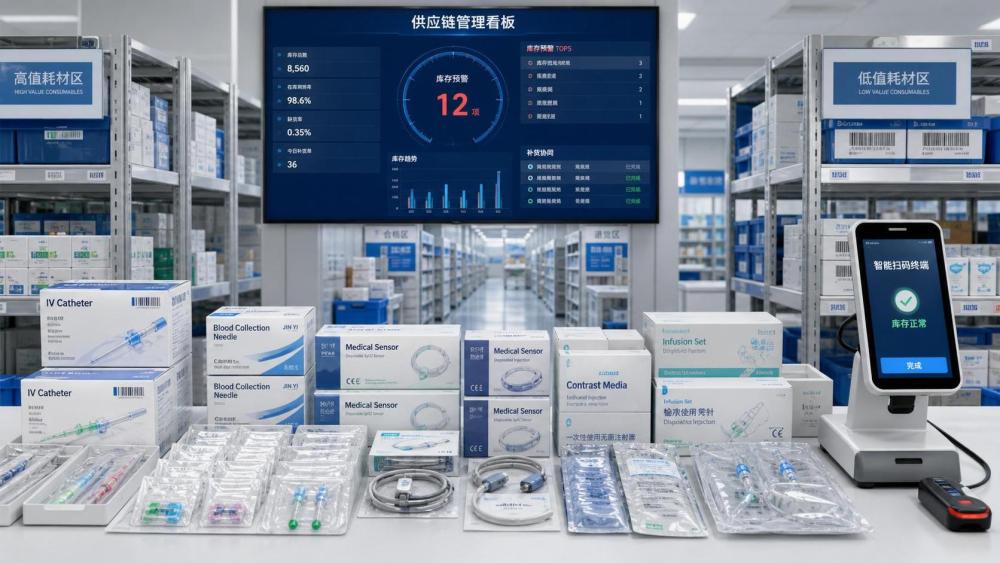
Stockout risk becomes visible long before a shelf is empty.
In healthcare, a missing reagent, sensor, catheter, or imaging accessory can interrupt diagnosis, delay treatment, and increase operating pressure across departments.
That is why healthcare supply chain software matters.
Its value is not limited to inventory visibility.
It starts reducing stockout risk when it links usage patterns, supplier responsiveness, contract data, and replenishment rules into one working process.
In practical terms, the software becomes useful when it can warn teams before a shortage affects patient care or service continuity.
This is especially important in medical technology environments.
A hospital may depend on contrast injectors, infusion consumables, sterilization packs, monitor accessories, and laboratory reagents from different suppliers with different lead times.
A distributor may face uneven regional demand.
A project planner may need installation-ready inventory for imaging or ICU expansion.
Platforms such as MTHH help make sense of these decisions by organizing technical and procurement information into a usable evaluation context.
The better question is not whether software tracks inventory.
The better question is whether healthcare supply chain software can protect clinical workflows while improving purchasing discipline and long-term cost control.
What signals show the software is solving more than a visibility problem?
A dashboard alone does not reduce stockout risk.
The shift happens when the platform begins turning data into action.
One common signal is forecast accuracy at item level.
If the system can distinguish stable usage from surge-driven demand, safety stock becomes more realistic.
Another signal is exception management.
When lead times change, contracts expire, or backorders grow, healthcare supply chain software should raise targeted alerts instead of flooding users with generic notifications.
A third signal is cross-functional alignment.
Stockout prevention improves when clinical demand, procurement cycles, maintenance schedules, and supplier commitments are visible in one place.
This matters in categories where downtime and consumable compatibility are tightly linked.
For example, laboratory systems depend on reagent continuity.
Imaging departments may depend on injectors, detectors, and service parts.
Infection control workflows depend on sterilization inputs that cannot be casually substituted.
If the software understands these relationships, it starts acting like a risk-control tool rather than a stock ledger.
A quick way to test maturity
A useful review is to compare what the platform sees with what the operation needs.
This kind of comparison reveals whether healthcare supply chain software is operationally meaningful or simply administrative.
Which healthcare settings benefit most from stockout-focused software?
The strongest fit is usually found where product availability directly affects service delivery.
Hospitals are an obvious case, but not the only one.
Diagnostic laboratories benefit because reagent dependency, calibration schedules, and throughput targets make shortages expensive and disruptive.
Imaging centers benefit when accessories, injectables, service parts, and consumables must align with tightly scheduled examinations.
Distribution networks benefit when they need to balance multi-site stock, regional volatility, and documentation accuracy.
Healthcare facility projects also benefit.
During new department setup, missing components can delay commissioning even when major equipment has arrived on time.
Healthcare supply chain software helps by connecting planned demand with phased delivery requirements.
This fits the broader logic seen across MTHH content.
Medical equipment decisions rarely depend on purchase price alone.
They depend on compatibility, service readiness, consumable supply, operator support, and the total cost of operating the system over time.
Software that reflects those conditions is far more valuable than software that simply counts boxes.
Where the impact usually appears first
- High-turn consumables with low substitution flexibility
- Reagent-driven diagnostic workflows
- Critical care devices with accessory dependency
- Multi-site operations with uneven replenishment cycles
- Projects where installation readiness depends on coordinated supply
How do you judge whether one platform is better than another?
The easiest mistake is to compare features without comparing operating conditions.
A stronger method is to test healthcare supply chain software against the real causes of stockout risk.
Start with item criticality.
Can the platform separate life-support consumables, routine medical supplies, spare parts, and diagnostic inputs by service impact?
Then review data quality.
If supplier lead times, alternate items, expiry dates, and unit conversions are incomplete, prediction quality will fall quickly.
Integration is another deciding factor.
A platform should connect with ERP, warehouse records, procurement workflows, maintenance systems, and where relevant, laboratory or clinical consumption data.
Usability also matters more than many evaluations assume.
If users cannot act quickly on alerts, forecast outputs, or shortage scenarios, even advanced healthcare supply chain software will underperform.
A practical comparison often includes these checkpoints:
- How accurately does it model demand by department, device type, or test volume?
- Can it flag supplier concentration risk and backup options?
- Does it support expiration control and lot traceability?
- Can it show the business impact of a delayed order?
- How much manual cleanup is required before reports become reliable?
This approach keeps the evaluation grounded in operational value rather than brochure language.
What implementation issues usually weaken results?
Most weak outcomes come from poor assumptions, not bad software.
One common issue is treating all items the same.
A general reorder rule may work for office supplies, but not for blood gas cartridges, ventilator circuits, or assay-specific reagents.
Another issue is ignoring service and maintenance dependencies.
A device may be available, while its sensors, cables, filters, or calibration materials are not.
That is still a functional stockout.
Data governance is also critical.
If item masters are duplicated or supplier records are outdated, healthcare supply chain software will create confidence where caution is needed.
In actual deployment, these risks deserve early attention:
- Overreliance on historical averages during changing demand conditions
- No clear ownership for shortage alerts and escalation
- Incomplete visibility into consignment, remote, or department-level inventory
- No link between procurement decisions and clinical criticality
- Underestimating onboarding needs for staff and suppliers
The best implementations usually begin with a narrow set of critical categories, then expand after the data structure and alert logic prove reliable.
What should be confirmed before moving forward?
Before selecting healthcare supply chain software, it helps to define what a preventable stockout looks like inside the operation.
That definition should include service impact, replacement difficulty, lead-time sensitivity, and clinical urgency.
Then confirm which data sources are trustworthy enough to support forecasting and alerts.
The next step is scenario-based review.
Ask how the platform would respond to a delayed reagent shipment, a failed sterilization batch, a sudden ICU surge, or a service-part shortage for an imaging system.
Those questions reveal more than a feature checklist.
They show whether the software can support continuity across procurement, clinical engineering, and operational planning.
This is where a structured information source such as MTHH becomes useful.
When supply planning touches imaging systems, laboratory analyzers, patient monitoring, sterilization equipment, or hospital infrastructure, technical context matters.
Better evaluations happen when equipment performance, consumable dependence, service expectations, and workflow conditions are reviewed together.
In the end, healthcare supply chain software starts reducing stockout risk when it supports better decisions before disruption appears.
That means linking demand signals, supplier behavior, item criticality, and implementation discipline.
The most useful next move is to map critical items, compare shortage scenarios, and build a short evaluation framework around risk, continuity, and total operating value.
Have questions about the global trade trends discussed here, or planning your expansion and supply chain strategy? Leave a message below and let the trade experts at MTHH guide you.
We respect your privacy. Your information is strictly confidential.
Related News
- FDA Issues Benefit-Risk Discussion Paper on Robotic Medical DevicesNov 07, 2026Explore the FDA discussion paper on robotic medical devices, its potential benefit-risk implications, and what manufacturers and purchasers should monitor.
- How to select ISO standards for medical device performance evaluationNov 06, 2026Choose medical device performance evaluation ISO standards with confidence. Learn to match claims, test methods, and regulatory requirements to reliable evidence.
- FDA Updates QMSR FAQs and Medical Device Cybersecurity GuidanceNov 06, 2026FDA QMSR FAQs and medical device cybersecurity guidance: Explore potential implications for ISO 13485 alignment, compliance planning and supplier coordination.
- Philips Reaches €288 Million Settlement in US Respiratory Device Recall ProbeNov 05, 2026Philips reaches a €288 million US settlement over its respiratory device recall. Explore the financial impact and implications for manufacturers.