
What to verify before choosing a sterile processing equipment supplier
A sterile processing equipment purchase can look straightforward when the comparison starts with chamber size, cycle options, and quoted price. It rarely remains straightforward once the equipment must support surgical turnover, traceability, staff workload, utilities, and infection-control responsibilities every day. For procurement teams, the supplier decision deserves the same scrutiny as the equipment itself.
A capable sterile processing equipment supplier should be able to demonstrate that its proposed system fits the facility's actual workload, can be installed without avoidable infrastructure surprises, and can be kept operational with documented service support. A low initial quotation can become expensive if cycle capacity is mismatched, commissioning is incomplete, spare parts are slow to arrive, or users are left to resolve validation and workflow problems alone.
The first practical question is therefore not, "Which supplier has the lowest price?" It is, "Can this supplier support a reliable sterile processing operation for the full expected life of the equipment?" The answer should be tested through technical evidence, site-specific planning, service commitments, and commercial terms rather than sales claims.
Start with the department workflow, not the equipment catalogue
Sterile processing equipment is purchased to support a sequence of work: receiving contaminated instruments, cleaning, inspection, assembly, packaging, sterilization, cooling, release, storage, and distribution. A supplier may offer a washer-disinfector, ultrasonic cleaner, sterilizer, drying cabinet, and tracking tools as separate items. That does not automatically mean the combination will work as a coherent system in the department.
Before requesting final proposals, procurement should establish a working demand profile with sterile processing staff, operating theatre representatives, infection-control personnel, and clinical engineering. It should identify the instrument types being processed, expected daily and peak volumes, surgical schedules, emergency demand, reprocessing turnaround expectations, and the need to maintain service during maintenance or downtime.
Capacity needs careful interpretation. A larger chamber does not always deliver higher useful throughput. Loading configuration, instrument complexity, cycle duration, drying performance, cooling time, loading and unloading discipline, and the availability of trained staff all affect how many usable sets leave the department. A supplier should be able to translate the facility's workload into a proposed equipment configuration and explain the assumptions behind it.
Ask for the proposed workflow in enough detail to expose bottlenecks. For example, if a sterilizer can complete cycles quickly but there is inadequate space or equipment for inspection, packaging, or drying, the sterilizer will not solve the turnaround problem. Similarly, adding capacity on the clean side may be of limited value when decontamination capacity is the real constraint.
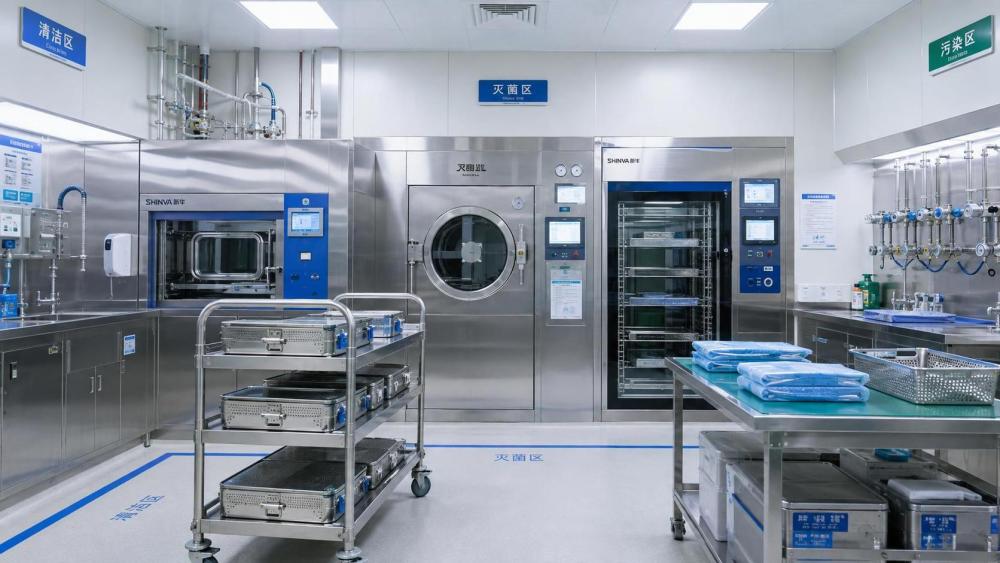
Suppliers should also explain how their equipment supports separation between dirty and clean activities. The precise layout and regulatory expectations vary by jurisdiction and facility type, but the operational principle is consistent: the movement of instruments, staff, carts, and materials should reduce opportunities for cross-contamination and avoid unnecessary handling. A proposal that fits a product list onto a floor plan but creates awkward or conflicting movement paths needs further review.
Verify performance claims through documentation and usable evidence
Performance claims should be specific enough to be evaluated. Statements such as "high efficiency," "advanced sterilization," or "full compliance" do not help a procurement team decide whether a machine will handle its instrument inventory and operating conditions. Ask the supplier to identify the intended use, supported load types, applicable cycle options, required accessories, and operating limits for the exact model proposed.
Documentation should be complete, current, and aligned with the market where the equipment will be used. Depending on the equipment and local requirements, the review may include product registration or authorization documentation, instructions for use, technical specifications, electrical and utility requirements, risk-related documentation, maintenance schedules, and cleaning or sterilization cycle information. Procurement should involve the hospital's quality, regulatory, or infection-control functions where they are responsible for reviewing these materials.
Do not treat a general certificate, a brochure, or a declaration covering a product family as proof that the quoted configuration is appropriate. Options such as chamber size, loading systems, water-treatment connections, software modules, printers, monitoring devices, and process indicators can change the operational scope of the supplied system. The proposal should clearly state what is included and which responsibilities remain with the facility.
For washers and ultrasonic systems, review how the supplier addresses the instruments that create the greatest cleaning challenge, including lumen devices, hinged instruments, complex assemblies, and accessories requiring dedicated connections or adapters. For steam sterilizers or other sterilization technologies, clarify the cycle types offered, load compatibility, cycle monitoring, and the arrangements needed before processed loads can be released under the facility's quality process.
It is also sensible to distinguish between equipment capability and process validation. The supplier can provide information about the machine, its cycles, and the commissioning process. The healthcare facility still needs a defensible local process for its own instruments, loads, packaging methods, water quality, staff practice, and quality controls. A supplier that blurs this distinction may be simplifying a responsibility that cannot safely be outsourced through wording in a quotation.
Make installation readiness a procurement gate
Many avoidable delays arise after an order is placed, when the facility discovers that utilities, drainage, ventilation, access routes, or structural conditions do not match the equipment requirements. Sterile processing systems are particularly dependent on site conditions. Procurement should not accept a delivery schedule based only on manufacturing lead time; it should include the readiness of the room and the services that support the equipment.
A serious supplier should conduct, or provide the basis for, a structured site assessment before the final configuration is locked. The assessment should address:
- Available floor space, equipment access routes, door clearances, service clearance, and ergonomic loading positions.
- Electrical supply, backup arrangements where relevant, and requirements for isolation or connection.
- Water supply quality, pressure, temperature, filtration, treatment needs, and the consequences of water conditions for cleaning performance and equipment life.
- Steam, compressed air, drainage, condensate handling, ventilation, heat output, and any building work required for the selected technology.
- Interface requirements for process monitoring, printers, tracking systems, hospital networks, or data storage.
- Construction sequencing, infection-control controls during installation, testing, and responsibility for restoring the area to operational condition.
Utilities should be considered an operating-cost issue as well as an installation issue. A proposal with a lower purchase price may impose greater demand for water, energy, consumables, or external treatment equipment. Conversely, a technically sophisticated system can be a poor fit if the hospital cannot provide stable utilities or maintain the supporting infrastructure. The evaluation should compare equipment under the conditions the facility can realistically sustain.
Commissioning scope should be written into the contract. This includes delivery coordination, installation, connection, functional testing, calibration where applicable, operator familiarization, technical handover, documentation, and acceptance criteria. Ambiguity often appears when a supplier assumes the hospital will arrange a specialist connection or building modification while the hospital assumes it is part of the supplier's turnkey scope.
Examine service capacity as closely as the equipment specification
A sterile processing department cannot always absorb a long outage. Delayed instrument availability can affect operating schedules, staff workload, and clinical priorities. Service therefore should not be reduced to the length of the warranty. Procurement needs to understand who will respond when the equipment is unavailable, how quickly they can diagnose the issue, and whether the local service model can support the facility after commissioning.
Request a clear description of the service organization for the proposed location. Relevant questions include whether maintenance is performed by the manufacturer, an authorized local partner, or a third party; how many appropriately trained engineers are available; what support is offered outside normal working hours; and how escalation works when a fault cannot be resolved at first visit.
Service response language should be precise. "Priority support" or "rapid response" has little contractual value unless it defines the response channel, target acknowledgement time, target attendance time where required, and the process for escalation. It is equally important to distinguish response time from repair time. An engineer acknowledging a call quickly does not restore equipment availability if a critical part must be sourced from another region.
Spare-parts planning deserves direct attention. Ask the supplier for the recommended critical spare-parts list, expected availability for major wear items and electronic components, and the process used when a part becomes obsolete. Where a department depends heavily on a single machine, the buyer should assess whether the facility needs redundancy, a contingency arrangement, or a stocked spare-parts package. This is a business-continuity decision, not simply a maintenance preference.
Review the preventive-maintenance schedule and its practical impact. Some tasks require a planned shutdown, specialized tools, or consumables that must be ordered in advance. The supplier should state the anticipated maintenance intervals, what is covered by the quoted service agreement, exclusions, and any recommended replacements that are likely to arise over the equipment lifecycle.
Price the whole operating model
Capital price is visible at tender stage; operating costs tend to emerge later through water treatment, utility consumption, detergents, test materials, filters, seals, loading accessories, software support, maintenance, parts, and unplanned downtime. A useful comparison considers the equipment's total cost of ownership over a defined period that reflects the facility's procurement policy.
Suppliers should provide a transparent cost schedule, separating included items from assumptions and optional charges. Procurement can then compare proposals on a consistent basis rather than accepting bundled figures that hide differences in scope. The schedule should identify installation work, commissioning, validation-related support, training, consumables, annual maintenance, remote support, software licensing or updates where relevant, and replacement parts not covered by warranty.
Be cautious with estimates based only on a standard cycle. The local mix of instruments, selected programs, staff practices, water quality, and daily workload may make actual use materially different. Rather than asking for a single claim about cost per cycle, ask suppliers to show the consumption assumptions used and to provide projected use for the facility's likely operating pattern.
Training also has a cost and risk dimension. Basic handover training may be adequate for familiar equipment in an experienced department, but a new workflow, new technology, or high staff turnover calls for a broader training plan. It should cover routine operation, loading principles, alarm response, daily checks, basic troubleshooting, process documentation, and escalation routes. Technical staff need separate training for first-line maintenance and safe isolation procedures where those duties sit with the hospital.
Use the tender process to test the supplier, not only the product
The way a supplier responds before contract award often reveals how it will behave after installation. A well-prepared response addresses the facility's stated workflow and site constraints, identifies assumptions, supplies requested documents, and flags risks that need resolution. A proposal that avoids difficult questions about utilities, service coverage, instrument compatibility, or exclusions should not be made acceptable merely by a competitive price.
Procurement can make this assessment more disciplined by requiring comparable evidence from all bidders. The aim is not to create a long checklist for its own sake. It is to prevent a technically incomplete offer from appearing cheaper than a complete one.
- Require a configuration list that includes accessories, racks, carts, adapters, monitoring devices, and software modules needed for the proposed use.
- Require a site-requirements document and identify which installation tasks are included in the supplier's scope.
- Request a commissioning and acceptance plan with named responsibilities.
- Evaluate maintenance, support, spare-parts access, and training as scored commercial and technical criteria.
- Ask bidders to state exclusions, dependencies, and conditions that could affect the delivery date or operating performance.
- Confirm the supplier's documentation package before making final award decisions.
For larger projects, a demonstration, reference visit, or technical discussion involving users and clinical engineering can be useful, provided it is structured around the hospital's own requirements. The purpose is to examine loading ergonomics, interface clarity, serviceability, workflow fit, and evidence handling, rather than to be persuaded by a polished demonstration cycle.
The strongest choice is often the supplier whose offer makes operational responsibilities visible. It shows what the equipment can do, what the hospital must provide, how failures will be handled, and what the system will cost to sustain. That level of clarity gives procurement teams a firmer basis for comparing bids and reduces the number of critical questions left unanswered after the purchase order is issued.
Have questions about the global trade trends discussed here, or planning your expansion and supply chain strategy? Leave a message below and let the trade experts at MTHH guide you.
We respect your privacy. Your information is strictly confidential.
Related News
- Hong Kong Outlines Medical Device Legislation and Plans for Statutory RegulatorNov 14, 2026Hong Kong medical device legislation could reshape regulatory oversight. Explore the proposed regulator and what businesses should monitor.
- AAMI Issues TIR115 Guidance on Public Cloud Use in Medical DevicesNov 13, 2026AAMI TIR115:2026 guides public cloud use in medical devices. Explore its focus on risk management, supplier assessment and device boundaries.
- How are critical care devices regulated in the United States?Nov 12, 2026Critical care devices face FDA requirements based on intended use and risk. Explore classifications, marketing pathways, and practical compliance checks.
- Hong Kong Drafts Medical Device Bill to Establish Statutory OversightNov 12, 2026Hong Kong's Medical Devices Bill could introduce risk-based statutory oversight. Discover what the proposed framework may mean for suppliers.