
What separates medical device validation from verification in practice?
What separates medical device validation from verification in practice?
Understanding medical device validation and verification is essential for anyone researching how healthcare technologies move from design requirements to safe, reliable clinical use. While the terms are often discussed together, they answer different practical questions about whether a device was built correctly and whether it meets real-world user needs. This distinction matters well beyond a manufacturer’s quality department. It affects procurement reviews, distributor due diligence, installation planning, clinical acceptance, and the confidence a hospital can place in a device over its service life.
In simple terms, verification asks, “Did we build the device according to its documented design requirements?” Validation asks, “Does the finished device meet its intended use and the needs of its intended users?” A device can pass verification and still fail validation if the original requirements did not reflect the clinical environment, user workflow, or foreseeable use errors. Conversely, a device may appear useful in a real setting but cannot be considered adequately controlled if its design outputs were never consistently verified against approved inputs.
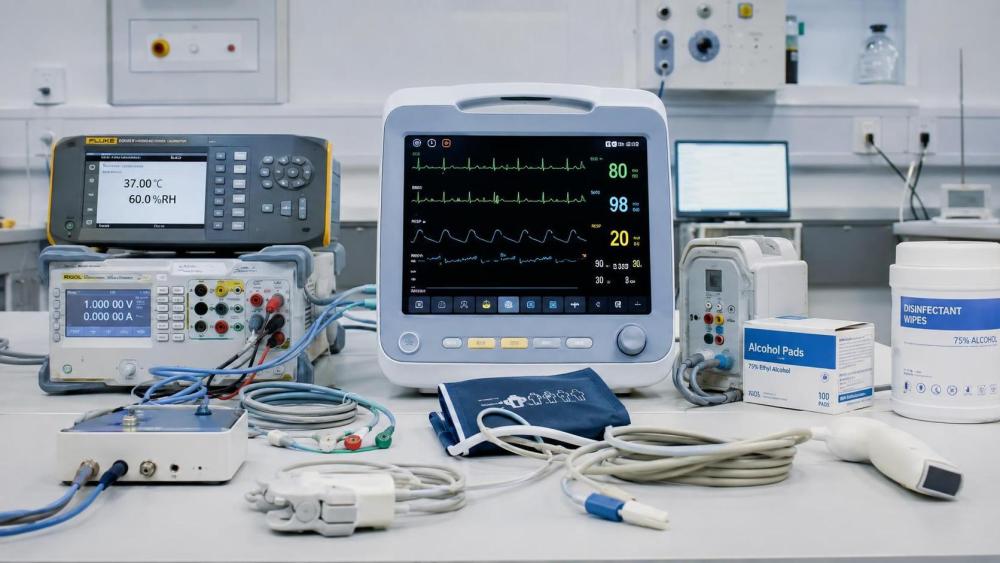
The difference is easy to state but harder to apply. Medical technology is rarely just hardware. A patient monitor combines sensors, alarm logic, software, displays, cables, accessories, instructions for use, cleaning expectations, maintenance procedures, and network connections. An IVD analyzer depends on instrument performance, reagents, calibration, sample handling, quality controls, software workflow, and reporting. In each case, medical device validation and verification must follow the product’s risks and intended use rather than become a box-ticking exercise.
Verification confirms the design was translated correctly
Verification is normally linked to objective design requirements. These requirements may cover dimensions, material compatibility, electrical safety features, measurement ranges, alarm limits, image performance, software functions, labeling content, or interface specifications. The evidence may come from inspection, measurement, analysis, code review, bench testing, or documented comparison with an approved specification.
Consider an infusion pump. Its design inputs may specify delivery accuracy within a defined operating range, a requirement for occlusion detection, alarm audibility, battery performance, and compatibility with specified administration sets. Verification activities examine whether the product meets those defined criteria. The team might measure flow performance under controlled conditions, test alarm behavior, inspect mechanical interfaces, and review whether the final software implements the approved logic. The key question is not whether clinicians like the pump; it is whether the design output conforms to the design input.
For software-enabled devices, verification often becomes especially detailed. Requirements need traceability to software architecture, code, tests, anomaly handling, cybersecurity-related controls where applicable, and release documentation. A statement such as “the system shall display patient data clearly” is not yet easy to verify. It must usually be made more specific: which data, under what conditions, with what display behavior, and how the requirement will be tested. Poorly written requirements make verification difficult because there is no stable pass-or-fail basis.
Verification is therefore closely connected to engineering discipline. It helps detect missing features, incorrect implementation, production inconsistencies, and undocumented changes before a device reaches its intended setting. Yet passing a bench test does not prove that the device fits a busy emergency department, a small laboratory with limited technical staff, or an imaging suite with particular workflow constraints.
Validation tests whether the solution works for its intended use
Validation looks outward from the specification toward the actual use environment. It assesses whether the final device, or a representative production-equivalent unit, satisfies user needs and intended uses under defined conditions. It may involve simulated use, usability evaluation, clinical performance evidence, workflow assessment, packaging validation, transport validation, or other activities appropriate to the device and its risk profile.
A patient monitor may meet every verified engineering requirement for its display and alarm system, but validation can reveal a different problem: under realistic lighting, staff may not recognize a low-priority visual alarm promptly; alarm tones may be difficult to distinguish in a noisy ward; or a required action may be buried too deeply in the user interface. These are not merely “training issues.” They may indicate that the product does not adequately support its intended users in foreseeable conditions of use.
For an IVD system, validation may extend beyond whether the analyzer can technically perform a measurement. It may address whether the complete testing process works as intended with the stated sample types, reagent workflow, calibration practices, operator actions, maintenance intervals, and reporting pathway. If the instrument performs well only when maintained by highly specialized staff, but is intended for a setting with general laboratory technicians, that mismatch needs to be understood before commercialization or procurement.
The phrase “intended use” is central. Validation cannot be separated from claims, labeling, target patient population, user profile, clinical setting, and operating environment. A compact ultrasound system intended for point-of-care use may require validation considerations that differ from those for a fixed radiology department system. Portability, battery handling, cleaning, user interface speed, image interpretation support, and environmental exposure can all become relevant. The same principle applies to ventilators, sterilizers, emergency devices, rehabilitation equipment, and hospital digital infrastructure.
Why the distinction becomes blurred in daily business
In practice, the two activities overlap because both rely on testing, documents, and evidence. A test report alone does not reveal whether it is verification or validation. Its purpose does. Testing a detector against a defined technical sensitivity requirement is verification. Assessing whether the imaging system, detector, workstation, and user workflow support the claimed examination process may belong to validation.
The terms are also confused when organizations treat validation as a final approval stage. That is risky. User needs and intended-use conditions should influence requirements early in development. If validation occurs only after the design is effectively frozen, findings may be expensive to correct. A poorly positioned control, an unclear warning, an unsuitable cleaning process, or a workflow bottleneck may require hardware, software, labeling, and training changes at the same time.
Another source of confusion is the word “validation” in operational settings. Hospitals may validate a local workflow, network connection, sterilization process, or laboratory method after installation. Those activities can be critically important, but they are not identical to the manufacturer’s design validation. Their scope, responsibilities, and documentation needs depend on the device, the local implementation, applicable requirements, and the organization’s procedures.
A practical comparison for non-design stakeholders
This comparison should not be read as a substitute for a device-specific quality plan. The amount and type of evidence vary considerably. A simple non-powered accessory, a networked patient monitoring platform, a molecular diagnostic instrument, and a radiation-emitting imaging system do not present the same technical or clinical questions. Market-specific regulatory requirements may also affect what documentation is expected.
What procurement teams and distributors should look for
Procurement teams are not expected to audit every design record, but they should recognize when a supplier’s evidence is incomplete, vague, or disconnected from the offered configuration. A strong technical discussion links claims to evidence and clearly identifies assumptions. If a supplier states that a device supports high throughput, low dose, remote monitoring, interoperability, or rapid turnaround, the buyer should ask how that claim applies to the proposed model, software version, accessories, consumables, and site conditions.
Useful questions often include:
- What intended use, user group, and clinical setting are stated in the current product documentation?
- Which optional accessories, software modules, reagents, or interfaces are included in the evidence being referenced?
- What local acceptance, installation, calibration, or workflow checks are expected before routine use?
- How are product changes, software updates, replacement parts, and cybersecurity-related updates assessed and documented?
- What training, maintenance resources, service response arrangements, and consumable controls are needed to preserve intended performance?
These questions connect design quality to ownership reality. A device’s validation evidence may support its intended use, but a hospital can still experience poor outcomes if room preparation, electrical supply, network architecture, operator training, cleaning routines, or preventive maintenance are inadequate. This is why procurement decisions should not isolate equipment specifications from implementation requirements and long-term support.
The role of risk management and change control
Medical device validation and verification are closely tied to risk management. A verification failure may show that a protective feature does not meet its stated requirement. A validation finding may show that users can misunderstand an alarm, bypass a safeguard, connect an accessory incorrectly, or use the product in conditions that were not adequately considered. Both findings can require design changes, but the corrective path is different because the underlying problem is different.
Changes deserve particular attention after market release. A new software version, a substitute component, revised packaging, expanded claimed use, different reagent supplier, or updated interface can affect prior evidence. It is not safe to assume that a small technical change has no validation consequence. The manufacturer’s change-control process should determine what needs to be reviewed, re-verified, or revalidated. For distributors and healthcare providers, the practical lesson is to confirm whether changes affect training, compatibility, service procedures, local documentation, or routine clinical workflow.
From quality terminology to better equipment decisions
The value of distinguishing validation from verification is not semantic precision for its own sake. It gives decision-makers a better way to assess evidence. Verification supports confidence that a product conforms to its defined design. Validation supports confidence that those definitions lead to a device that can be used safely and effectively for the purpose claimed. Neither should be treated as a shortcut around the other.
For manufacturers, the discipline starts with clear user needs and measurable requirements. For distributors, it means understanding the limits of product claims and the documentation required in each market. For hospitals and clinical engineering teams, it means separating manufacturer design evidence from local acceptance and implementation responsibilities. Global MedTech & Healthcare Intelligence Hub (MTHH) helps organize these discussions across diagnostic equipment, patient care systems, laboratory technologies, hospital infrastructure, and related procurement considerations.
Before comparing suppliers or approving a project, confirm what has actually been verified, what has been validated, and whether that evidence matches the exact device configuration, intended clinical setting, and operating conditions under consideration. That is often where a promising specification becomes either a dependable healthcare solution or an avoidable implementation risk.
Have questions about the global trade trends discussed here, or planning your expansion and supply chain strategy? Leave a message below and let the trade experts at MTHH guide you.
We respect your privacy. Your information is strictly confidential.
Related News
- FDA Issues Benefit-Risk Discussion Paper on Robotic Medical DevicesNov 07, 2026Explore the FDA discussion paper on robotic medical devices, its potential benefit-risk implications, and what manufacturers and purchasers should monitor.
- How to select ISO standards for medical device performance evaluationNov 06, 2026Choose medical device performance evaluation ISO standards with confidence. Learn to match claims, test methods, and regulatory requirements to reliable evidence.
- FDA Updates QMSR FAQs and Medical Device Cybersecurity GuidanceNov 06, 2026FDA QMSR FAQs and medical device cybersecurity guidance: Explore potential implications for ISO 13485 alignment, compliance planning and supplier coordination.
- Philips Reaches €288 Million Settlement in US Respiratory Device Recall ProbeNov 05, 2026Philips reaches a €288 million US settlement over its respiratory device recall. Explore the financial impact and implications for manufacturers.