
What drives medical device quality management cost in ISO 13485 projects
When companies budget for ISO 13485, many start with the visible line item: the certification audit. That is understandable, but it is rarely the number that determines the full medical device quality management cost. In practice, the bigger spend often sits inside the organization—rewriting procedures, cleaning up technical documentation, validating processes, training staff, tightening supplier controls, and keeping the system alive after the certificate is issued.
That matters not only to manufacturers. Distributors, hospital groups with private-label activities, contract service providers, and healthcare investors also need a realistic view of what quality system implementation really costs. A low-budget plan can look attractive at kickoff and become expensive later if the scope was misunderstood.
ISO 13485 projects are especially sensitive to hidden effort because medical devices sit close to patient safety, traceability, post-market obligations, and regulatory expectations in multiple markets. In other words, this is not a generic management certification exercise. The system must hold up when design changes, complaints, supplier deviations, software updates, or field actions start to happen.
The certificate is usually the smaller part of the budget
A common mistake is treating ISO 13485 cost as an external purchase: consultant fee plus certification fee. Those items are real, but they are usually easier to predict than the internal workload. If a company already has disciplined document control, change management, supplier qualification, and complaint handling, the project may move fairly smoothly. If not, the gap is not just paperwork. It becomes process redesign.
For example, a manufacturer of patient monitors, infusion pumps, imaging accessories, or IVD instruments may discover that departments work in silos. Engineering stores design records one way, service teams track field issues another way, and purchasing qualifies suppliers mostly on price and delivery. ISO 13485 tends to expose these disconnects quickly. Fixing them takes management time, cross-functional meetings, retraining, and sometimes new software or better record structures.
This is why experienced buyers and project sponsors look past the audit quote and ask harder questions: How mature are current processes? How complete is the documentation? How many product families are in scope? Are there outsourced processes? Is the company also preparing for market registration in parallel? Those answers move the budget far more than the day rate of an auditor.
Documentation depth changes cost fast
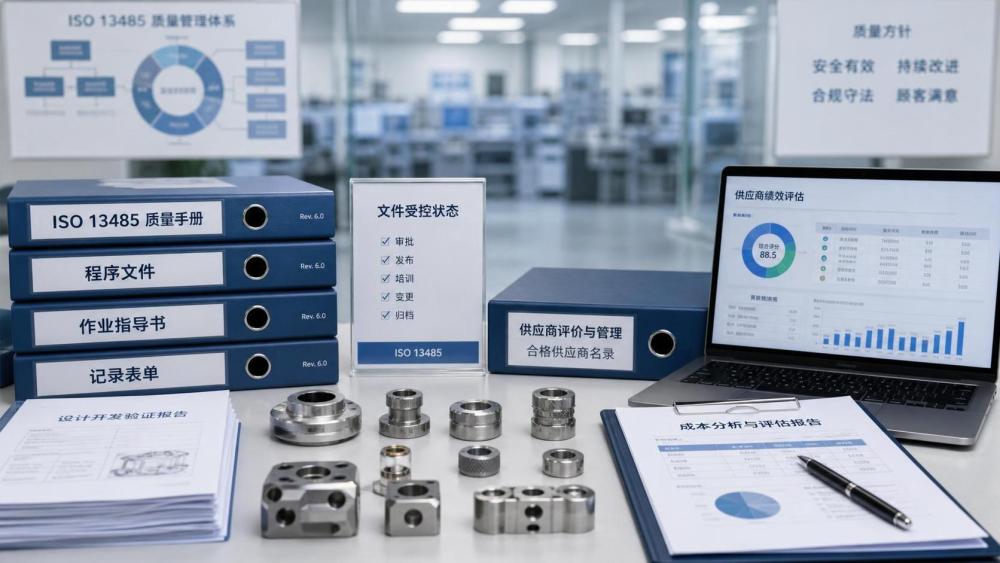
Documentation is one of the biggest cost drivers because it touches almost everything. ISO 13485 expects controlled procedures and records, but the real effort depends on product complexity and how much documentation already exists in usable form.
A company selling basic medical consumables with a stable supply chain may face a very different workload from one handling diagnostic imaging components, software-connected monitoring systems, or laboratory analyzers with calibration, maintenance, and service records. The second case usually requires more controlled interfaces between manufacturing, service, labeling, installation, and post-market support.
People often underestimate the time needed to standardize documents that were created for commercial use rather than compliance use. Product brochures, installation notes, and service instructions may be useful references, but they do not replace controlled procedures, approved forms, traceability records, or revision history. If a company has expanded quickly across product categories, this cleanup can become one of the most expensive parts of the project.
Risk management is not a side file
Another major driver of medical device quality management cost is how seriously risk management has to be built into daily operations. In medical device businesses, risk is not only a technical design topic. It extends into supplier changes, software revisions, labeling updates, installation conditions, sterilization controls, complaint trends, and corrective action decisions.
Companies sometimes assume they can create one risk management procedure and move on. In reality, the cost rises when teams need to connect risk files with complaint handling, CAPA, production controls, and post-market feedback. If field service teams are reporting recurring issues with an anesthesia machine accessory or a laboratory device module, the quality system has to show how those signals are evaluated, documented, escalated, and fed back into product or process control.
That integration work is expensive because it changes behavior, not just templates. It may require additional review boards, stronger engineering participation, and cleaner data capture from distributors or service partners.
Supplier control can become the real budget breaker
In many ISO 13485 projects, supplier control ends up costing more than expected. This is especially true for companies that outsource manufacturing steps, sterilization, PCB assembly, packaging, software development, calibration, or after-sales service. On paper, outsourcing can reduce operating cost. Under ISO 13485, it usually shifts cost into qualification, oversight, agreements, incoming verification, performance monitoring, and change control.
If a business sources detectors for imaging equipment, reagents for laboratory systems, sensors for patient monitoring, or sterile barrier components for surgical products, each critical supplier may require a different level of control. Some organizations discover during implementation that they cannot justify their current supplier approval logic. Others find that important suppliers are not willing to provide enough quality documentation or change notification discipline. Then the project turns commercial very quickly: keep the supplier and build compensating controls, or qualify an alternative source at additional time and expense.
This is one area where structured industry intelligence is useful. Platforms such as MTHH are valuable not because they replace audits, but because they help decision-makers frame the right questions early—about documentation readiness, service capability, consumable dependence, installation requirements, and long-term support conditions that eventually feed into quality cost.
Training costs are usually understated
Training in ISO 13485 projects is often budgeted as a one-time awareness session. That is rarely enough. The real cost depends on how much staff behavior must change and how specialized the device environment is.
An organization involved in ventilators, sterilizers, imaging systems, hospital infrastructure, or in vitro diagnostics usually has teams with very different responsibilities: procurement, assembly, quality, regulatory, service, warehousing, complaint handling, and sometimes installation engineers working on-site in hospitals. They do not all need the same training, and generic sessions tend to fail because employees cannot see how the requirements apply to their records, approvals, and daily exceptions.
The expensive part is not the training event itself. It is repeat training after procedure changes, competency checks, supervisor follow-up, and the temporary slowdown that happens while teams learn to document properly. That slowdown is normal. Ignoring it produces unrealistic project costing.
Digital tools may save effort later, but they raise entry cost
Some companies can run a lean quality system with controlled documents and disciplined manual records, especially at smaller scale. Others need electronic quality management systems, training records, complaint databases, change control tools, or supplier management software much earlier. The point is not that digital tools are always required. It is that growth, product diversity, and multi-site operations can make manual control surprisingly expensive.
A business handling multiple product categories—say hospital furniture, patient care devices, and laboratory equipment under one structure—may struggle if each team stores records differently. Digital standardization can reduce audit stress and retrieval time, but software selection, validation where applicable, migration, and user adoption add cost upfront. For some organizations, delaying this investment is sensible. For others, delay just pushes the expense into repeated corrective actions and inefficient audits.
Scope decisions drive cost more than most teams expect
The scope of certification has a direct and sometimes uncomfortable effect on budget. A narrow scope can reduce implementation burden, but only if it matches the real business model. Trying to keep service, distribution, installation, or design activity outside scope when those functions clearly affect the product can create problems later.
This comes up frequently in healthcare equipment businesses. A company may describe itself as a distributor, but if it also relabels products, configures systems, manages local installation, controls service subcontractors, or handles complaint triage for the brand owner, the quality responsibilities are no longer minimal. The project team then has to decide whether to build a genuinely robust system now or accept the cost of future rework.
Market access plans quietly influence quality cost
Many companies do not pursue ISO 13485 only for the certificate. They are preparing for expansion, private-label supply, distributor approval, tender participation, or future registration in stricter markets. That strategy changes cost assumptions.
If the quality system is built only to pass a basic audit, it may need major rework when the company later faces deeper documentation requests, stronger traceability expectations, or more demanding post-market obligations. This is why experienced managers sometimes choose a higher first-year budget: not because they want a heavier system, but because rebuilding later is usually messier.
For procurement teams, investors, and distribution partners reviewing manufacturers, this is worth noting. A supplier with a low headline quality cost may simply be under-scoped. Structured platforms like MTHH help compare equipment businesses more realistically because they connect technical use conditions, service requirements, documentation readiness, and long-term operating considerations instead of treating quality as an isolated certificate.
What to ask before approving the budget
Before signing off on an ISO 13485 project, it is worth pressure-testing a few points internally:
- Are product categories simple and stable, or do they involve service, software, installation, calibration, or sterile processes?
- How much controlled documentation already exists in a usable format?
- Which outsourced processes can affect product safety, performance, or traceability?
- Can complaint handling, field service, and supplier changes be tracked in a connected way?
- Is the company building only for certification, or also for wider commercial access later?
These questions sound basic, but they separate manageable projects from expensive surprises.
In the end, medical device quality management cost in ISO 13485 projects is driven less by the standard itself than by the gap between current operations and the level of control the business actually needs. If decision-makers understand that gap early—across documentation, suppliers, training, service, and future market plans—they usually make better spending choices and avoid paying twice for the same system.
- medical devices
- healthcare equipment
- diagnostic imaging
- in vitro diagnostics
- patient monitoring
- hospital furniture
- medical consumables
- patient monitors
- ventilators
- infusion pumps
- quality management systems
- hospital infrastructure
- medical device quality management
- laboratory analyzers
- medical device quality management cost
Have questions about the global trade trends discussed here, or planning your expansion and supply chain strategy? Leave a message below and let the trade experts at MTHH guide you.
We respect your privacy. Your information is strictly confidential.
Related News
- FDA Issues Benefit-Risk Discussion Paper on Robotic Medical DevicesNov 07, 2026Explore the FDA discussion paper on robotic medical devices, its potential benefit-risk implications, and what manufacturers and purchasers should monitor.
- How to select ISO standards for medical device performance evaluationNov 06, 2026Choose medical device performance evaluation ISO standards with confidence. Learn to match claims, test methods, and regulatory requirements to reliable evidence.
- FDA Updates QMSR FAQs and Medical Device Cybersecurity GuidanceNov 06, 2026FDA QMSR FAQs and medical device cybersecurity guidance: Explore potential implications for ISO 13485 alignment, compliance planning and supplier coordination.
- Philips Reaches €288 Million Settlement in US Respiratory Device Recall ProbeNov 05, 2026Philips reaches a €288 million US settlement over its respiratory device recall. Explore the financial impact and implications for manufacturers.