
What documents are required for medical device compliance with EU MDR?
Medical device compliance with Regulation (EU) 2017/745, the EU Medical Device Regulation (MDR), requires technical documentation, risk management records, clinical evidence, labeling, an EU declaration of conformity, and post-market surveillance documentation. Quality management records and notified body certificates are also required where the applicable conformity assessment route calls for them. These documents must describe the same device, intended purpose, configuration, and claims.
The main documentation framework appears in Annexes II and III of the MDR. Annex II covers the device and the evidence supporting conformity; Annex III addresses post-market surveillance. A certificate alone cannot establish that every model, software version, accessory, or clinical claim is covered. Missing links between these records frequently create documentation gaps during conformity assessment and subsequent audits.
Classification determines the documentation route
Before assembling the file, establish whether the product falls under the MDR, define its intended purpose, and document its classification under Annex VIII. In vitro diagnostic devices fall under a separate regulation. Accessories require their own classification assessment, and software classification depends on its intended medical function and the consequences of the decisions it supports.
The classification rationale needs to identify the applicable rule and explain its application. Descriptions such as “non-invasive” or “software only” are insufficient when other characteristics determine the class.
A classification rationale should be revisited when the intended purpose changes. Adding a diagnostic claim, extending use to a different patient population, or changing a software decision function can alter both the classification and the evidence required.
The technical documentation must identify exactly what is covered
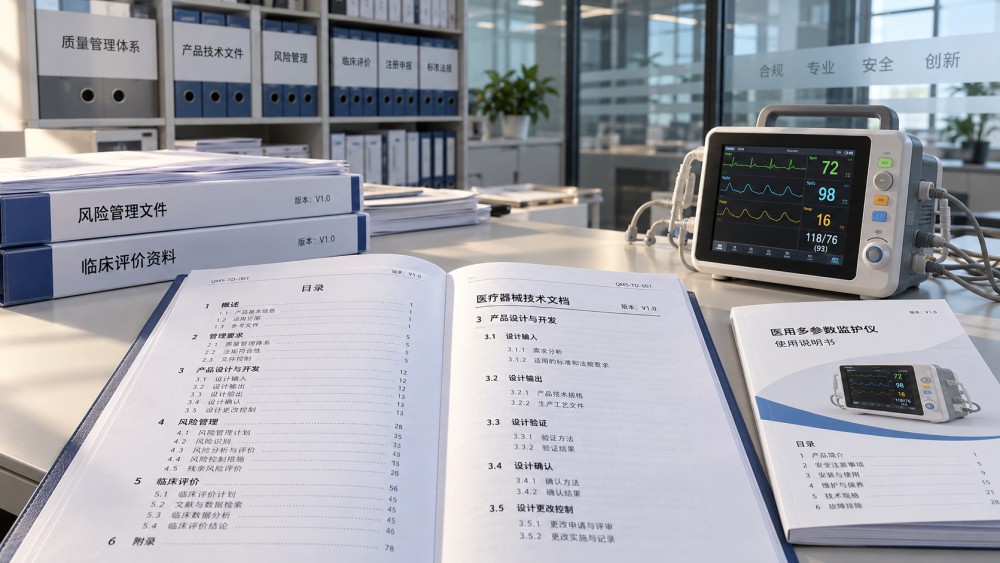
Annex II requires an organized, searchable technical file that explains the device and demonstrates conformity. Its device description should include the intended purpose, indications, contraindications, patient population, operating principles, accessories, configurations, and relevant identifiers. Previous generations and similar devices also belong in the description where applicable.
For a configurable device, a model matrix can connect catalogue numbers to hardware, software, patient-contacting materials, accessories, and labeling. Without that mapping, a test report for one configuration can mistakenly be treated as evidence for an entire product family.
Design and manufacturing information should describe the design stages, manufacturing processes, process validation, monitoring, and final testing. It must also identify the sites involved, including relevant suppliers and subcontractors. Outsourced sterilization, for example, requires traceable evidence connecting the validated process to the actual product and packaging configuration.
The general safety and performance requirements matrix
A documented assessment against the applicable General Safety and Performance Requirements (GSPRs) in Annex I forms a central part of the file. Each applicable requirement needs the method used to demonstrate conformity and a precise reference to the supporting controlled document. Requirements considered inapplicable need a reasoned explanation.
Useful references identify document numbers, revisions, and relevant sections. A reference reading only “electrical safety report” makes review difficult when several reports cover different models. Likewise, listing a standard does not show that testing covered the marketed configuration or that every applicable requirement was addressed.
Risk management and verification records must agree
The risk management file documents the process from hazard identification through risk control, residual risk evaluation, and production and post-production review. It should explain foreseeable misuse, relevant fault conditions, and the relationship between individual risks and the overall benefit-risk assessment.
Risk controls need evidence of implementation and effectiveness. If excessive temperature is controlled through a sensor and an automatic shutdown function, the file needs verification of those controls under relevant operating and fault conditions. A warning in the instructions cannot substitute for a feasible design control without an appropriate justification.
Verification and validation evidence depends on the device’s characteristics. Relevant records include:
- Biological safety: an evaluation addressing the nature and duration of body contact, supported by material information, chemical characterization, testing, and justified use of existing evidence.
- Electrical safety and electromagnetic compatibility reports covering the relevant configuration, accessories, and operating conditions.
- Software documentation: requirements, architecture, verification, validation, anomaly evaluation, and cybersecurity evidence proportionate to the device and its connected functions.
- Usability engineering records demonstrating that safety-related tasks, interfaces, alarms, and instructions have been evaluated in the intended use context.
- Sterilization, packaging, shelf-life, transport, and reprocessing validation where those characteristics form part of the supplied device or its intended use.
The evidence should reflect the finished device. A biological evaluation based on a raw material certificate needs to account for processing residues and manufacturing changes. Packaging validation must address maintenance of the sterile barrier through the claimed shelf life and relevant distribution conditions.
Applied standards also need a documented rationale. Using a harmonized standard can support a presumption of conformity for the requirements it covers, but standards do not replace the MDR assessment. Alternative methods require sufficient evidence that the applicable requirements are met.
Clinical evaluation needs a defensible evidence chain
A clinical evaluation is required throughout the device lifecycle. Its documentation includes a clinical evaluation plan, identification and appraisal of relevant clinical data, analysis of that evidence, and a clinical evaluation report (CER). The report must support the intended purpose, clinical benefits, safety, performance, and acceptability of the benefit-risk profile.
Bench testing establishes technical characteristics; it does not automatically establish clinical benefit. For example, measurement accuracy alone does not substantiate every diagnostic or treatment-related claim made for a device.
Where equivalence is used, the assessment must address technical, biological, and clinical characteristics and demonstrate sufficient access to the relevant data. A published description of a similar device rarely resolves every equivalence question. Implantable and Class III devices are subject to specific clinical investigation requirements and defined exceptions; similarity alone does not establish an exception.
Post-market clinical follow-up (PMCF) belongs within this evidence cycle. The documentation needs a PMCF plan and evaluation report where applicable, or a supported justification when PMCF is considered inapplicable. Generic statements about long market history do not explain whether remaining clinical uncertainties have been addressed.
Labeling and conformity documents must match the evidence
Labels, instructions for use, and other information supplied with the device belong in the technical documentation. They must accurately communicate the intended purpose, relevant warnings, contraindications, residual risks, installation conditions, maintenance, and disposal information as applicable. Language requirements depend on the Member States where the device is made available.
Instructions concerning cleaning, disinfection, sterilization, or reuse require supporting validation. A reusable instrument’s instructions, for example, must correspond to the validated processing conditions and any applicable reuse limits. Copying processing instructions from a similar product does not establish their suitability.
The EU declaration of conformity is a legally significant manufacturer declaration under Article 19 and Annex IV. It identifies the device and responsible legal entity, states the applicable legislation, and includes the required identification, conformity assessment, and signature information. The Basic UDI-DI belongs in the declaration where applicable.
Where notified body involvement is required, the certificate set must match the device scope and assessment route. An ISO 13485 certificate alone does not establish MDR conformity. Certificate validity, conditions, covered activities, and device scope need to be read together; a certificate covering one product group does not automatically cover an adjacent model.
For Class III devices and implantable devices, other than custom-made or investigational devices, a summary of safety and clinical performance is required under Article 32 and is validated by the notified body. Implant cards and accompanying information are also required for implantable devices unless a specific exemption applies.
Post-market documentation continues after release
The post-market surveillance (PMS) plan must define how information will be collected and evaluated throughout the device’s lifetime. Relevant inputs include complaints, serious incidents, service records, literature, feedback, and information concerning similar devices. The plan needs methods and indicators capable of detecting changes in safety or performance.
These records must influence the rest of the file. Repeated complaints about an alarm, for instance, require assessment against the risk analysis, usability evidence, and clinical evaluation. Closing individual complaints without evaluating the emerging pattern leaves the documentation disconnected from actual device performance.
Quality system records and document control close the gaps
The MDR requires a quality management system proportionate to the device type and risk class. Supporting records address regulatory strategy, design controls, supplier management, production, release, corrective and preventive action, change control, and the responsibilities of the person responsible for regulatory compliance. A quality manual alone does not demonstrate that these processes operate.
Administrative records also matter: authorized representative arrangements where required, applicable actor and device registrations, UDI records, and traceability information must align with the device documentation. EUDAMED obligations should be assessed against the applicable module requirements and implementation timetable.
Before release, reconcile the device identity across the declaration, certificates, labels, test reports, CER, and risk file. A software update that changes alarm behavior, for example, needs an assessed effect on verification, usability, risk controls, and supplied information. Whether notified body review is required depends on the change and the applicable assessment arrangements.
Technical documentation, the EU declaration of conformity, and relevant certificates must generally remain available for at least ten years after the last covered device is placed on the market; the period is at least fifteen years for implantable devices. Revision histories and archived evidence must make it possible to reconstruct which requirements, tests, and approvals supported a particular released configuration.
Have questions about the global trade trends discussed here, or planning your expansion and supply chain strategy? Leave a message below and let the trade experts at MTHH guide you.
We respect your privacy. Your information is strictly confidential.
Related News
- Hong Kong Outlines Medical Device Legislation and Plans for Statutory RegulatorNov 14, 2026Hong Kong medical device legislation could reshape regulatory oversight. Explore the proposed regulator and what businesses should monitor.
- AAMI Issues TIR115 Guidance on Public Cloud Use in Medical DevicesNov 13, 2026AAMI TIR115:2026 guides public cloud use in medical devices. Explore its focus on risk management, supplier assessment and device boundaries.
- How are critical care devices regulated in the United States?Nov 12, 2026Critical care devices face FDA requirements based on intended use and risk. Explore classifications, marketing pathways, and practical compliance checks.
- Hong Kong Drafts Medical Device Bill to Establish Statutory OversightNov 12, 2026Hong Kong's Medical Devices Bill could introduce risk-based statutory oversight. Discover what the proposed framework may mean for suppliers.