
What compliance requirements apply to operating room equipment in South Africa?
Operating room equipment placed on the South African market must be assessed as a medical-device, electrical-safety, installation, and facility-readiness matter at the same time. A surgical light, anaesthesia workstation, electrosurgical unit, patient monitor, operating table, suction system, or ceiling-mounted service unit may have different technical functions, but each can affect patient safety, continuity of surgery, infection prevention, and the integrity of the theatre environment.
For operating room equipment in South Africa, compliance begins with confirming the product’s regulatory route under the South African Health Products Regulatory Authority (SAHPRA). The applicable requirements can depend on the device classification, intended purpose, accessories, software functions, sterility status, and whether the equipment is supplied as a standalone device or as part of an integrated theatre project. Documentation should show that the device is legitimately supplied through an appropriately licensed local establishment and that the current SAHPRA requirements for the product category have been addressed.
Medical-device regulatory status
SAHPRA regulates medical devices under South Africa’s medicines and related substances framework. Before a purchase order is released, the product description should be matched to the manufacturer’s stated intended purpose. This step is important because a device marketed for general examination may fall under a different regulatory route from one intended for use during surgery, anaesthesia, invasive monitoring, life support, or energy delivery.
Evidence normally requested during technical review may include the device classification rationale, a declaration of conformity, product registration or listing information where applicable, instructions for use, labeling samples, technical specifications, and the details of the South African establishment responsible for importation, distribution, or supply. Regulatory expectations can change, particularly where transitional arrangements, product groupings, or submission pathways apply. Current status should therefore be confirmed against SAHPRA guidance rather than inferred from a certificate issued for another market.
A CE marking, FDA clearance, or approval from another jurisdiction may support the technical file, but it does not automatically establish South African market compliance. The supplied model number, software version, accessories, and intended use must correspond to the submitted and supported documentation. A common error is accepting a general certificate that covers a product family while the proposed configuration includes an unlisted module, a different power supply, or a surgical accessory with separate risk implications.
Quality documentation and traceability
Operating theatre devices should arrive with a controlled documentation package rather than a collection of undated brochures. Quality-management evidence commonly includes ISO 13485 certification or equivalent quality-system documentation relevant to the legal manufacturer and the supplied device range. The certificate scope matters: a certificate covering a low-risk accessory does not demonstrate control of a high-risk active device or sterile invasive component.
The technical file should support the product’s safety claims. Depending on the equipment, this may include risk-management records aligned with ISO 14971 principles, clinical evaluation evidence, verification and validation summaries, biocompatibility evidence for patient-contact materials, sterilization validation, usability engineering records, cybersecurity documentation, and post-market surveillance procedures. Full confidential files are not always transferred during commercial review, but sufficient controlled evidence should be available to substantiate the relevant claims.
Traceability is especially important when equipment includes reusable patient-contact parts, single-use sterile accessories, implants, cables, energy-delivery electrodes, or software-enabled functions. Serial numbers, lot numbers, expiry dates, revision levels, and service histories need a clear link to the supplied configuration. Labels should be legible, durable, and suitable for the expected cleaning process. Instructions, warnings, electrical ratings, environmental limits, and local contact details should be available in a form suitable for use in South Africa.
Electrical safety in the theatre environment
Medical electrical equipment used in an operating room is exposed to conditions that differ from an ordinary clinical room. Patients may be connected to multiple devices simultaneously, conductive fluids may be present, staff may be working in restricted space, and an interruption of power can affect an active procedure. Product-level electrical safety evidence should therefore be reviewed together with the electrical design of the room.
International IEC 60601 series standards are widely used to demonstrate the basic safety and essential performance of medical electrical equipment. Relevant particular standards may apply to individual device types, such as high-frequency surgical equipment, anaesthetic systems, patient monitors, surgical luminaires, infusion equipment, or electrically operated hospital beds. The exact standard set depends on intended use and device design. A test report should identify the tested model and configuration, not merely cite a standard in marketing material.
South African electrical installations must also meet applicable national wiring rules and local installation requirements. SANS 10142-1 is central to low-voltage electrical installations, while medical locations may require additional provisions relating to protective measures, equipotential bonding, isolation, emergency supply arrangements, and verification. The precise design approach should be confirmed by qualified electrical and clinical engineering parties against the current applicable editions and the site’s approved electrical drawings.
Voltage and frequency compatibility must be checked early. Equipment intended for a different supply voltage, plug type, earthing arrangement, or frequency may require an approved adaptation, dedicated circuit, isolation transformer, or replacement power module. Informal plug conversion is unsuitable for critical clinical equipment. It can invalidate the original safety evidence, create earthing defects, and complicate future maintenance.
Essential performance, alarms, and software control
Electrical compliance is not limited to shock protection. In an operating theatre, essential performance may include the accuracy of monitored parameters, ventilator delivery, alarm operation, illumination, table movement limits, electrosurgical output control, battery autonomy, and safe response after a power interruption. Acceptance testing should demonstrate the functions needed in the installed environment, using the approved accessories and the intended power source.
Where network connectivity is included, the review should cover software version control, user-access levels, audit logs where available, backup and recovery methods, interface specifications, cybersecurity patch arrangements, and the effect of a network outage. A device may remain safe when disconnected from a hospital network, but this must be understood before a system is placed into routine clinical service. Unsupported operating systems, undocumented remote-access tools, or software updates supplied without change-control records introduce avoidable risk.
Installation conditions and theatre integration
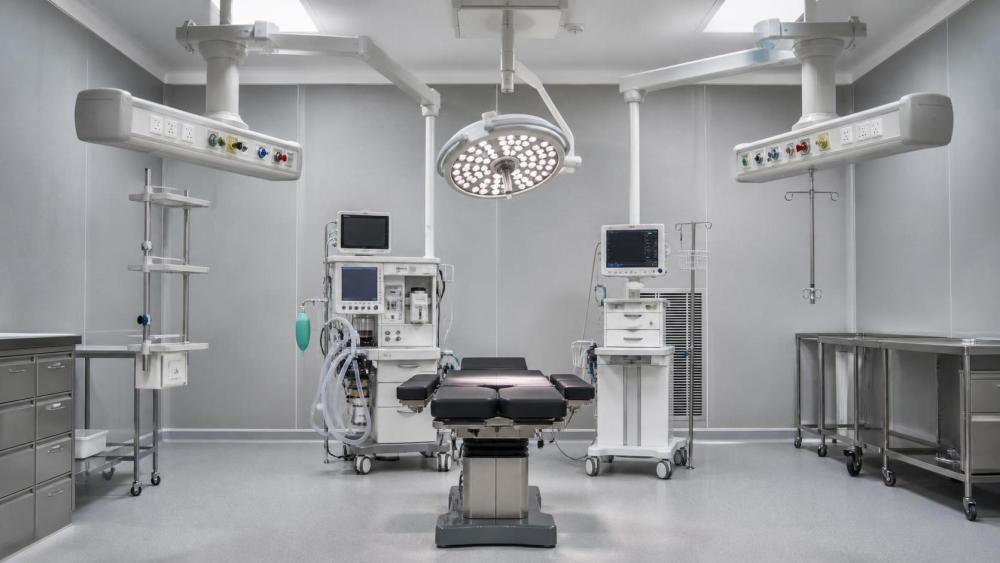
Compliance can fail at installation even when the device itself is correctly certified. Ceiling-mounted equipment requires verification of structural load capacity, anchoring method, service-zone layout, collision clearance, and maintenance access. Operating tables need suitable floor loading, movement space, compatible imaging access where required, and stable positioning on the finished floor surface. Mobile equipment requires adequate storage, charging points, cable management, and routes that do not obstruct emergency access.
Medical gas interfaces require particular care. Anaesthesia and respiratory equipment must be compatible with the installed gas pipeline system, terminal units, connectors, pressures, scavenging arrangements, and alarm systems. Cross-connection hazards cannot be managed by visual similarity alone. Site documentation should identify the gas type, terminal standard, pressure range, installation test status, and responsibility for final connection.
Equipment that produces heat, smoke, aerosols, radiation, or electromagnetic energy may also affect room controls. Electrosurgical smoke evacuation, ventilation performance, room pressure relationships, shielding needs, electromagnetic compatibility, and the placement of sensitive monitoring equipment should be evaluated as an integrated design issue. For mobile imaging devices used during surgery, radiation protection requirements, shielding assessment, controlled access arrangements, and local radiation-authority expectations may apply separately from medical-device compliance.
Cleaning, infection prevention, and material compatibility
Operating room surfaces are repeatedly exposed to disinfectants, body fluids, mechanical cleaning, and occasional impact. Device materials should tolerate the validated cleaning agents and contact times stated in the instructions for use. Stainless steel grade, polymer composition, seam design, cable jacket material, paint finish, and upholstery construction all affect cleanability and long-term integrity.
Seams, damaged coatings, cracked control membranes, poorly sealed joints, and inaccessible crevices can become hygiene and maintenance concerns. A product may be technically functional while still being unsuitable for a theatre if its cleaning instructions are incomplete or incompatible with the facility’s infection-control process. For reusable accessories, reprocessing instructions should state disassembly steps, cleaning method, disinfection or sterilization parameters, permitted cycle limits where applicable, drying requirements, and inspection criteria.
Sterile devices and sterile accessories require controlled packaging and clear expiry information. Packaging damage during transport or storage can affect sterility claims even if the outer carton appears intact. Storage conditions, including temperature, humidity, stacking restrictions, and protection from direct sunlight, should be included in receiving procedures for sensitive components.
Commissioning records and acceptance testing
The installed system should not be treated as ready merely because it powers on. Commissioning normally includes verification of delivered serial numbers, accessories, software versions, room utility connections, electrical safety tests, functional checks, alarm checks, battery condition, imaging or illumination performance where relevant, and correct integration with attached systems. The results should be recorded against agreed acceptance criteria.
- Installation records should identify the exact room, asset number, serial number, installation date, supplied manuals, and responsible service contact.
- Electrical safety measurements need to be performed with suitable test equipment and retained with the asset record, particularly after repair, relocation, or modification.
- For integrated theatres, interface testing should include video routing, control panels, data connections, booms, lights, tables, and any linked anaesthesia or monitoring equipment.
- Outstanding defects should be formally closed before clinical release, rather than being left as informal notes on a delivery document.
Maintenance, service capability, and change control
Maintenance support is part of the compliance position because safety and performance can degrade after installation. Service documentation should define preventive-maintenance intervals, functional test methods, calibration needs, replacement parts, battery replacement requirements, software support status, and escalation arrangements for safety notices or field corrective actions. A warranty statement without a service scope does not establish how the device will remain safe in use.
Repairs and modifications require control. Replacing a cable, changing a power supply, adding a third-party accessory, updating software, or moving ceiling-mounted equipment can alter the validated configuration. Compatibility should be supported by the device documentation or by a documented engineering assessment. Parts described as “equivalent” should not be accepted solely because they fit mechanically.
Operating room equipment in South Africa should therefore be evaluated as a documented lifecycle system: lawful market supply, suitable technical standards, verified site installation, cleaning compatibility, controlled commissioning, and maintainable service support. Gaps are easiest to correct before delivery, when room drawings, utility schedules, certificates, and product configurations can still be aligned.
Have questions about the global trade trends discussed here, or planning your expansion and supply chain strategy? Leave a message below and let the trade experts at MTHH guide you.
We respect your privacy. Your information is strictly confidential.
Related News
- Hong Kong Outlines Medical Device Legislation and Plans for Statutory RegulatorNov 14, 2026Hong Kong medical device legislation could reshape regulatory oversight. Explore the proposed regulator and what businesses should monitor.
- AAMI Issues TIR115 Guidance on Public Cloud Use in Medical DevicesNov 13, 2026AAMI TIR115:2026 guides public cloud use in medical devices. Explore its focus on risk management, supplier assessment and device boundaries.
- How are critical care devices regulated in the United States?Nov 12, 2026Critical care devices face FDA requirements based on intended use and risk. Explore classifications, marketing pathways, and practical compliance checks.
- Hong Kong Drafts Medical Device Bill to Establish Statutory OversightNov 12, 2026Hong Kong's Medical Devices Bill could introduce risk-based statutory oversight. Discover what the proposed framework may mean for suppliers.