
What affects import costs for medical devices in Brazil?
Import cost for medical devices in Brazil begins with the commercial invoice price, but that figure rarely represents the amount ultimately committed. The landed cost may include customs duties, indirect taxes, regulatory preparation, freight, insurance, port and airport handling, customs brokerage, inland transport, storage, installation readiness, and future service obligations. A quotation that appears competitive at the factory gate can become expensive once the equipment enters the Brazilian market and is placed into clinical operation.
The cost model also depends on the device category, its intended use, the importing entity, the customs classification, the selected Incoterm, and the destination state. A compact bedside monitor, an imaging system, a laboratory analyzer, and a shipment of sterile consumables can follow very different cost paths even when they arrive through the same port. Budget approval should therefore be based on a documented landed-cost model rather than a single supplier quotation.
Customs classification shapes the first layer of cost
The Harmonized System classification assigned to an imported product affects duty treatment, documentation review, and the way customs authorities interpret the shipment. Classification should reflect the actual technical function of the device, its principal components, and the condition in which it is imported. Accessories, spare parts, software media, probes, detectors, cables, disposable kits, and replacement modules may require separate treatment from the main unit.
A common error is to adopt a broad classification from a supplier catalogue without comparing it to the invoice description, technical dossier, packing list, and configuration supplied for import. This can create questions during customs clearance, particularly where the shipment contains a base system plus several accessories with different functions. If the declared description is too generic, it may not explain why an item belongs under the selected code. If it is overly promotional, it may conflict with the technical documentation.
Classification should be reviewed before a purchase order is released, not after goods have departed. The review normally needs a concise product description, model and part numbers, technical specifications, intended medical use, component list, country of origin, and information about whether accessories are essential for the stated function. This work can also expose whether certain items are being imported unnecessarily with the initial shipment when they could be sourced or supplied later under a more appropriate commercial arrangement.
Taxes are applied to a broader base than the invoice value
Import duties and taxes can be calculated on a customs value that includes more than the supplier's equipment price. Depending on the transaction structure, freight and insurance to the point of entry may be included in the taxable base. Additional taxes and charges may then be applied according to the product classification, import operation, and destination. State-level treatment can affect the final result, so a budget built solely from national duty assumptions may be incomplete.
Tax recoverability also matters. A charge that may be creditable or recoverable under a particular operating structure has a different financial effect from a charge that remains embedded in the asset or inventory cost. This distinction should be considered alongside accounting treatment, resale arrangements, use within a healthcare facility, and the entity recorded as importer of record. The same tax amount may have different implications depending on the transaction chain.
Regulatory readiness can create direct and indirect import expense
Medical products entering Brazil may require regulatory steps and documentation associated with the applicable health authority requirements. The precise route can vary with the product type, risk profile, intended use, and commercial arrangement. Delays are not merely administrative inconveniences. They can create storage charges, demurrage exposure, rescheduled installation work, revised delivery commitments, and extended equipment-rental needs where a facility is waiting for replacement capacity.
The documentation set should be internally consistent. Product identity on the invoice, label, packaging, regulatory records, manuals, technical file, and customs declaration should not describe materially different configurations. A monitor listed with one module set on the commercial documents but another set in the regulatory file can trigger clarification work. The same issue arises when a laboratory instrument is shipped with reagent packs, calibrators, or software options not included in the original documentation.
Portuguese-language labeling, instructions, warnings, and local documentation arrangements may also need planning. Translation is not simply a publishing cost. Medical terminology, contraindications, alarm descriptions, electrical specifications, maintenance intervals, and disposal instructions must remain technically accurate. A poorly controlled translation can result in relabeling, revised artwork, document correction, or a longer release process. Packaging dimensions and label placement should be validated early, especially for small sterile packs or components where available surface area is limited.
Products with software require additional attention. Software version, cybersecurity controls, network requirements, language settings, remote-service capability, and licensing terms should be reconciled with the device configuration being imported. A software license billed separately may have commercial and tax implications distinct from the hardware. If the system depends on cloud connectivity or remote diagnostics, the recurring operating expense should be visible in the approval model rather than treated as an informal service detail.
Freight choices affect capital tied up in transit
Air freight can reduce transit time for urgent replacement parts, high-value compact instruments, or cold-chain-sensitive materials, but its price may substantially alter the cost of a shipment. Ocean freight can be suitable for large equipment, furniture, non-urgent infrastructure items, and consolidated orders, yet it introduces a longer planning horizon and more dependence on packaging integrity, port handling, and arrival scheduling. The appropriate choice depends on clinical urgency, shipment dimensions, weight, fragility, and the cost of delayed availability.
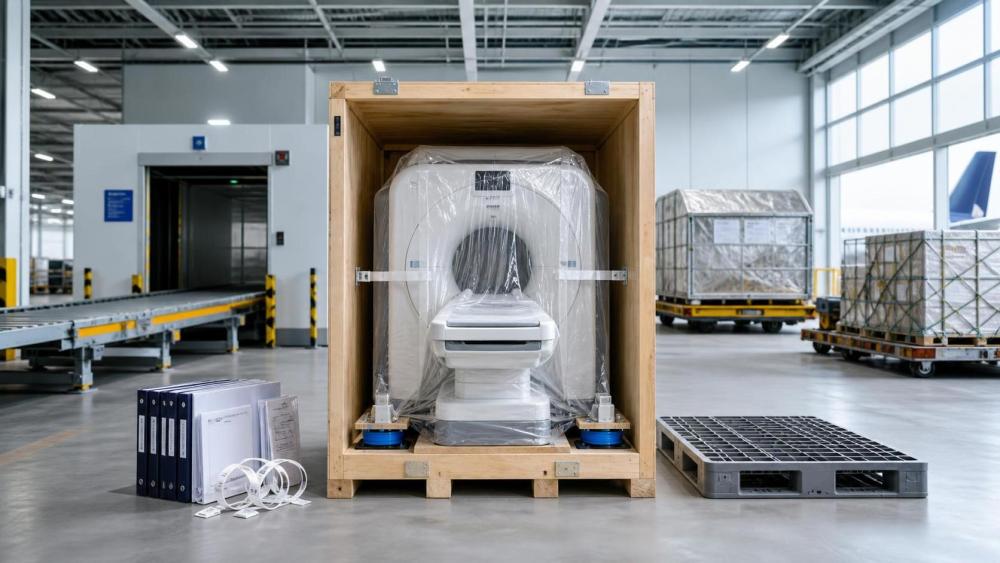
Many medical systems travel with sensitive components: imaging detectors, optical assemblies, precision pumps, electronic boards, temperature-sensitive reagents, sterilization chambers, and calibrated sensors. Packaging specifications should account for shock, vibration, humidity, tilt, and stacking restrictions where relevant. A crate that protects a system during factory dispatch may still be inadequate for repeated handling, long dwell times, or inland road transport. Damage discovered after release can lead to inspection costs, insurance claims, replacement freight, and delayed commissioning.
Insurance should be evaluated against the actual route and handover points defined by the Incoterm. A supplier may arrange transport under one term while risk transfers earlier than expected. The invoice can show freight included, yet the importer may remain responsible for losses at a particular stage. The policy wording, insured value, exclusions, claim-notification requirements, and procedure for documenting visible damage should be known before dispatch.
Currency exposure changes the approved amount after the order is placed
Imported equipment is frequently quoted in a foreign currency, while local budgets, taxes, inland services, and operating revenue may be denominated in Brazilian reais. Exchange-rate movement can affect the equipment value, freight, insurance, tax base, and local currency amount required to settle the transaction. It can also affect spare parts and consumables purchased later under the same supply arrangement.
Currency planning should distinguish between committed amounts and forecast amounts. A signed purchase order may fix the foreign-currency value without fixing the local-currency cost. Deposit schedules, milestone payments, letters of credit, and final acceptance payments can occur at different exchange rates. Where a system is shipped in stages, the exposure may continue through installation and handover. Treating every line as if it converted at the quotation-date rate can create a misleading approval figure.
Service agreements deserve the same scrutiny. A low first-year service cost may be less meaningful if later charges are indexed to a foreign currency, if travel is billed separately, or if replacement parts are excluded. For equipment with a long expected life, the financial model should show the currency basis for warranty extensions, licenses, consumables, calibration tools, and critical spare parts.
Port, airport, brokerage, and storage costs are often underestimated
Local logistics costs may be charged by several parties: terminal operators, freight forwarders, customs brokers, bonded warehouses, carriers, surveyors, and specialized handling providers. These charges can include document processing, cargo handling, inspection support, storage, delivery appointments, and equipment needed to move oversized crates. Their effect grows when documentation is incomplete, release is delayed, or delivery cannot occur immediately after clearance.
Storage risk is particularly relevant when the receiving site is not ready. An imaging system may clear customs before the room has completed shielding, electrical works, cooling provisions, structural reinforcement, or access modifications. A sterilization unit may arrive before water treatment, drainage, steam, or exhaust arrangements are available. The result can be extended warehouse storage, double handling, and additional transport coordination. Import planning should be linked to the site-readiness schedule rather than treated as a separate logistics exercise.
Shipment consolidation can reduce some transport and handling expenses, but it can also delay an urgent component while waiting for other goods. Splitting a shipment may be justified where a small set of critical accessories is required for installation, while bulky non-critical items can arrive later. The decision should compare added freight against storage, project delay, and the possibility of delivering a system that cannot yet be commissioned.
Installation conditions can turn an import purchase into a construction expense
The imported unit may represent only one part of the deployed asset. Installation can require electrical upgrades, voltage conditioning, grounding, network outlets, medical gas connections, radiation shielding, ventilation, reinforced flooring, drainage, clean utilities, access ramps, or lifting equipment. These costs are not customs charges, but excluding them from the import decision produces an incomplete investment estimate.
Site constraints also influence the transport plan. Door widths, lift capacity, corridor turning radius, floor loading, ceiling height, and delivery-hour restrictions should be confirmed against crate dimensions and weights, not merely the dimensions of the installed product. Some systems need partial unpacking or specialized rigging before they can enter a clinical area. That work needs to be coordinated without compromising packaging protection or warranty conditions.
Acceptance criteria should be established before arrival. They may include installation verification, electrical safety testing, functional checks, image or measurement quality, network connectivity, accessory confirmation, documentation delivery, and training completion. A delayed acceptance can postpone payment or service commencement, while rushed acceptance can leave unresolved defects difficult to allocate later.
Lifecycle obligations belong in the import cost assessment
Medical technology often depends on consumables, calibration materials, preventive maintenance, batteries, sensors, filters, valves, imaging accessories, or proprietary software. Importing the capital equipment without establishing the ongoing supply route can create a false impression of affordability. In vitro diagnostic systems are particularly sensitive to reagent availability, lot management, storage conditions, calibration requirements, and shelf-life constraints. Equipment with low acquisition cost may carry a high ongoing spend if consumables have limited sourcing options.
Warranty language should state whether it covers parts, labor, travel, remote support, software updates, and replacement equipment during downtime. It should also identify exclusions caused by power quality, environmental conditions, unauthorized maintenance, late preventive service, or use of non-approved accessories. Local service capacity, spare-parts lead time, and diagnostic-tool access affect downtime risk and should be translated into contractual terms wherever possible.
A robust approval record separates supplier price, estimated taxes, freight, insurance, customs and terminal charges, regulatory preparation, site work, installation, commissioning, initial consumables, training, and lifecycle commitments. It should also record assumptions that could change: classification, exchange rate, shipment mode, destination, document readiness, and service scope. That level of visibility makes the cost of medical devices in Brazil easier to compare across alternatives and reduces the risk of treating customs clearance as the final expense rather than one stage of a longer clinical asset commitment.
Have questions about the global trade trends discussed here, or planning your expansion and supply chain strategy? Leave a message below and let the trade experts at MTHH guide you.
We respect your privacy. Your information is strictly confidential.
Related News
- Hong Kong Outlines Medical Device Legislation and Plans for Statutory RegulatorNov 14, 2026Hong Kong medical device legislation could reshape regulatory oversight. Explore the proposed regulator and what businesses should monitor.
- AAMI Issues TIR115 Guidance on Public Cloud Use in Medical DevicesNov 13, 2026AAMI TIR115:2026 guides public cloud use in medical devices. Explore its focus on risk management, supplier assessment and device boundaries.
- How are critical care devices regulated in the United States?Nov 12, 2026Critical care devices face FDA requirements based on intended use and risk. Explore classifications, marketing pathways, and practical compliance checks.
- Hong Kong Drafts Medical Device Bill to Establish Statutory OversightNov 12, 2026Hong Kong's Medical Devices Bill could introduce risk-based statutory oversight. Discover what the proposed framework may mean for suppliers.