
What FDA expects in a medical device process validation protocol
What FDA Expects in a Medical Device Process Validation Protocol
For quality and safety professionals, an FDA process validation medical device protocol is not a document prepared simply to complete a project milestone. It is the planned evidence that a manufacturing process can repeatedly produce devices meeting predefined requirements for safety, performance, and quality. When that evidence is weak, the problem is rarely limited to one validation report. It can affect complaint investigations, nonconforming product decisions, supplier oversight, design transfer, audit readiness, and confidence in the entire quality system.
FDA’s long-standing Quality System Regulation, particularly 21 CFR 820.75, requires validation where process results cannot be fully verified by subsequent inspection and test. The practical implication is clear: if inspection alone cannot reliably confirm that every unit meets requirements, the manufacturer must demonstrate control of the process itself. Sterilization, sealing, welding, molding, coating, software-driven production steps, and certain cleaning processes are familiar examples, but the principle applies more broadly.
A strong protocol therefore answers a regulator’s central question: why should this process be trusted to deliver conforming product under routine operating conditions? It should make that answer traceable to product requirements, risk controls, equipment capability, trained personnel, approved methods, and objective data—not to assumptions or a single successful engineering run.
The protocol must begin with a defensible validation rationale
Before defining sample quantities or test conditions, the protocol should establish why validation is required and what decision the study is intended to support. This sounds basic, yet it is where many documents become vague. A statement such as “to validate the assembly process” is too broad unless the protocol identifies the specific process outputs that matter: bond strength, dimensional fit, leak resistance, particulate control, labeling accuracy, software configuration, or another measurable characteristic linked to device requirements.
The scope should identify the device family, configuration, manufacturing line, facility, equipment, tooling, software version, materials, and process boundaries covered. It should also state what is excluded and why. If the study is intended to cover several product variants, the justification for grouping them matters. FDA reviewers will generally expect a scientific basis for selecting a worst-case configuration, material, size, or processing condition. “Similar products” is not, by itself, a sufficient rationale.
This is especially relevant for manufacturers of diagnostic instruments, patient-monitoring accessories, infusion components, imaging-system assemblies, and consumables. A small material or configuration change may alter thermal behavior, fit, electromagnetic characteristics, reagent-contact surfaces, or sealing performance. The protocol should show that the validation model reflects those risks rather than merely the most convenient production version.
FDA expects linkage between risk, requirements, and process controls
Process validation should not sit apart from risk management. The protocol needs to show how process failure modes could affect the finished device and which controls are being challenged or confirmed. A critical process parameter is not simply a setting that operators watch frequently; it is a parameter whose variation may affect a critical quality attribute or another required output.
For example, a heat-sealing process may involve temperature, pressure, dwell time, material condition, jaw alignment, and cooling conditions. The protocol should explain which of these factors can influence seal integrity, how their operating ranges were established, and which measurements will demonstrate acceptable output. For a software-assisted assembly or test station, the relevant controls may include access levels, approved program versions, recipe selection, data transfer, alarm response, and protection against unintended changes.
Risk-based thinking does not mean reducing evidence wherever risk appears low. It means directing study design toward the failures that would matter most. A process that creates an irreversible product characteristic, or one where later inspection has limited sensitivity, usually deserves more rigorous attention than a step that can be fully and reliably verified downstream.
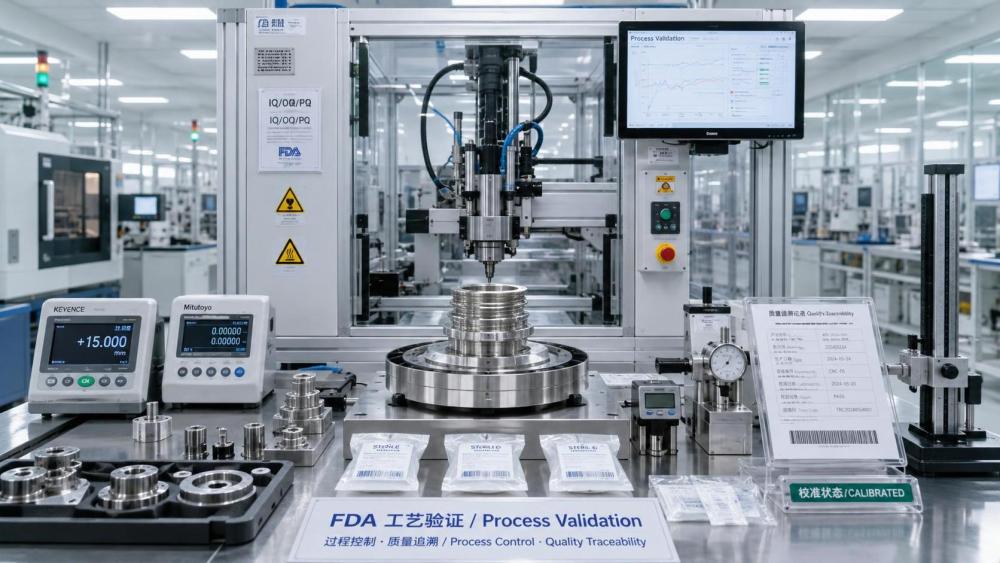
What a usable validation protocol should contain
FDA does not prescribe a single protocol template. However, a protocol that supports inspection readiness normally contains enough detail for an independent reviewer to understand exactly what was planned, why it was planned, and how success or failure would be determined before data collection began.
- Purpose and scope: the process, product(s), location, equipment, and intended validation status.
- Responsibilities and approvals: accountable functions such as quality, manufacturing, engineering, validation, and laboratory personnel, with approval before execution.
- Prerequisites: approved procedures, qualified equipment, calibrated measuring devices, trained operators, released materials, and controlled drawings or specifications.
- Process description: the sequence of operations, key inputs, in-process controls, output characteristics, and relevant environmental conditions.
- Study design: defined lots or runs, sampling locations, sampling rationale, challenge conditions, test methods, and data forms.
- Acceptance criteria: predetermined, objective requirements tied to approved specifications or justified validation limits.
- Deviation handling: how departures from the protocol will be documented, evaluated, investigated, and approved before they are treated as acceptable.
- Final conclusions: criteria for approval, restrictions, required follow-up actions, and release of the process for routine use.
The level of detail should allow execution without informal interpretation. If an operator must decide what constitutes an acceptable setup, a meaningful process challenge, or an invalid test result, those rules should be defined in the protocol or in controlled documents referenced by it.
Installation, operational, and performance evidence must fit the process
Many organizations use the terms installation qualification (IQ), operational qualification (OQ), and performance qualification (PQ). These labels are widely understood, but FDA’s concern is not whether the labels appear. The concern is whether the validation evidence establishes that equipment and utilities are installed as intended, that the process performs across justified operating conditions, and that routine production can repeatedly meet requirements.
Installation evidence may include equipment identification, utility verification, safety features, calibration status, preventive maintenance requirements, approved software, and documentation of installation conditions. Operational work commonly establishes or confirms the operating window, alarm behavior, setpoint tolerances, and response to selected challenging conditions. Performance evidence should represent normal production as closely as practical, including approved materials, routine operators, standard work instructions, and production-scale conditions.
A common weakness is treating engineering development data as automatic process-validation evidence. Development studies can be valuable, particularly when they establish parameter ranges or identify failure mechanisms. But they may not represent released procedures, final equipment configuration, trained production personnel, or controlled measurement methods. A protocol should state which prior data are being leveraged and why those data remain applicable.
Sampling plans need a scientific explanation, not a familiar number
There is no universal FDA-required number of validation lots or samples. The often-repeated “three consecutive lots” approach may be appropriate in some circumstances, but it is not a substitute for rationale. The protocol should explain what the sampling plan is designed to detect and why it is adequate for the process risk, product volume, variability, and test method capability.
Sampling should address meaningful sources of variation. Depending on the process, that may include the beginning, middle, and end of a run; multiple cavities or stations; shifts; operators; material lots; equipment lanes; or locations within a sterilization or environmental chamber. A plan that samples only the easiest-to-reach output may miss the variation the validation was meant to control.
The protocol should also consider whether the test method itself is capable of supporting the claim. Under 21 CFR 820.72, inspection, measuring, and test equipment must be suitable for its intended purpose and capable of producing valid results. If a measurement system is too variable, acceptance of the validation run may say more about the test method than the manufacturing process.
Acceptance criteria cannot be written after the results are known
Predetermined acceptance criteria are one of the clearest indicators of a credible validation plan. They should be linked to approved product specifications, design outputs, risk controls, process limits, or applicable standards used by the manufacturer. Criteria must be measurable and unambiguous. “Results are acceptable” or “no significant defects observed” does not tell an auditor what passing looks like.
Where the protocol uses statistical analysis, the selected method needs to fit the data and the decision being made. Capability analysis, confidence intervals, trend assessment, attribute sampling, or other tools may be useful, but no statistic should obscure a failed requirement. A favorable index does not justify accepting product that exceeds a safety-critical specification. Conversely, a one-time outlier should not be dismissed without understanding whether it reveals a real source of process variation.
Control the records, deviations, and electronic systems behind the study
Process validation is as much a documentation discipline as a technical one. FDA expects validation activities and results to be documented, including monitoring and control methods, dates, personnel, major equipment, and, where appropriate, the statistical methods used. Original data, test records, calibration information, material traceability, and executed batch documentation should support the final report.
Protocol deviations deserve particular care. A deviation is not automatically a validation failure, but it cannot be handled as an informal note. The team should assess its effect on data validity, product quality, and the study conclusion. Repeating only the failed portion without understanding the cause can create a misleading record. Where electronic systems create, modify, store, or approve required records, manufacturers should also assess applicable electronic record and signature controls, including the relevance of 21 CFR Part 11 to their intended use.
Change control closes the loop. A validated process is not permanently validated regardless of later changes. New tooling, firmware updates, alternate suppliers, revised materials, facility moves, parameter changes, or maintenance events may require documented impact assessment and, when warranted, revalidation. The extent of work should reflect the change and the risk to validated outputs.
A protocol should withstand both technical and commercial scrutiny
For hospitals, distributors, and procurement teams, process validation records are not normally reviewed line by line during an initial equipment evaluation. Yet documentation maturity can reveal whether a manufacturer understands repeatability, traceability, service controls, and the consequences of process changes. This becomes more visible with products used in critical care, laboratory testing, sterilization, infusion, and other settings where dependable device performance depends on disciplined manufacturing.
Global MedTech & Healthcare Intelligence Hub (MTHH) approaches these questions as part of the wider medical technology decision process. Technical capability, clinical workflow, maintenance support, consumable continuity, and documentation readiness are connected. A device may meet a purchasing specification on paper, while weak validation or change-control practices create downstream concerns for distributors, clinical engineers, and healthcare institutions.
The most useful FDA process validation medical device protocol is therefore one that makes its logic visible: which risk is being controlled, which parameters matter, how routine conditions were represented, what counts as success, and what happens when the process changes. If any of those answers rely on unwritten knowledge, the protocol is not yet ready for execution—or for an FDA investigator’s questions.
Have questions about the global trade trends discussed here, or planning your expansion and supply chain strategy? Leave a message below and let the trade experts at MTHH guide you.
We respect your privacy. Your information is strictly confidential.
Related News
- Hong Kong Outlines Medical Device Legislation and Plans for Statutory RegulatorNov 14, 2026Hong Kong medical device legislation could reshape regulatory oversight. Explore the proposed regulator and what businesses should monitor.
- AAMI Issues TIR115 Guidance on Public Cloud Use in Medical DevicesNov 13, 2026AAMI TIR115:2026 guides public cloud use in medical devices. Explore its focus on risk management, supplier assessment and device boundaries.
- How are critical care devices regulated in the United States?Nov 12, 2026Critical care devices face FDA requirements based on intended use and risk. Explore classifications, marketing pathways, and practical compliance checks.
- Hong Kong Drafts Medical Device Bill to Establish Statutory OversightNov 12, 2026Hong Kong's Medical Devices Bill could introduce risk-based statutory oversight. Discover what the proposed framework may mean for suppliers.