
Medical devices Canada compliance requirements for market access
Canada market access for medical devices is governed by device classification, licensing status, bilingual labeling, quality system evidence, and post-market control obligations. The practical question is whether a product can be placed on the market with a dossier that matches its risk class and intended use, and whether the documentation remains consistent from manufacturing through importation, installation, servicing, and complaint handling.
For medical devices Canada compliance requirements, the first issue is classification. The same hardware platform may fall into different classes depending on intended purpose, invasiveness, duration of contact, energy source, or whether it measures, diagnoses, treats, or supports a critical function. That classification drives the level of review expected for the device licence and the depth of technical support needed in the file. A common error is to assume that a product family can share one pathway simply because the enclosure, software shell, or accessory set looks similar. In practice, accessories, sterilization states, software modules, and single-use components can shift the regulatory position.
The regulatory file usually needs a clear description of the device, its variants, materials in patient-contacting parts, accessories, software version control, power requirements, and compatible consumables. For devices with patient contact, the material composition and contact duration matter because they affect biocompatibility assessment, cleaning compatibility, and wear behavior. For reusable equipment, the instructions for reprocessing must match the actual design: temperature limits, chemical compatibility, validated drying cycles, and packaging method after sterilization or disinfection. If the instructions are looser than the device can tolerate, compliance risk appears immediately.
Labeling is another point where submissions fail for avoidable reasons. In Canada, bilingual labeling is often part of the commercial reality, but the issue goes beyond translation. Symbols, warnings, contraindications, storage limits, electrical ratings, and intended-use statements need to align with the technical evidence. If a monitor is intended for clinical settings only, the environmental limits, alarm behavior, and power backup expectations should be stated in a way that matches the actual performance envelope. If an IVD system relies on refrigerated reagents, the storage range, transport window, and open-vial stability need to be reflected in the labeling and supporting documents.
Quality system expectations also shape market access. Even when a finished device is sourced from a contract manufacturer, the legal entity placing the product on the market must be able to demonstrate control over design, purchasing, production release, traceability, complaint handling, recalls, and corrective actions. For higher-risk products, a recognized quality management framework is commonly part of the evidence package. In practice, this means document control, supplier oversight, incoming inspection criteria, calibration records, and change control cannot be treated as internal housekeeping. They are part of the market access position.
Software is a frequent source of hidden compliance work. A device that depends on embedded software, cloud connectivity, or algorithmic interpretation needs version discipline, cybersecurity consideration, and a clear boundary between medical and non-medical functions. A small UI update can affect alarm priority, data export, or measurement display, which in turn can trigger documentation updates. If the software interacts with hospital networks, remote servicing, or electronic records, the cybersecurity and interoperability claims should be restrained and supportable. Vague compatibility language is a weak point when the device is installed in a real clinical network.
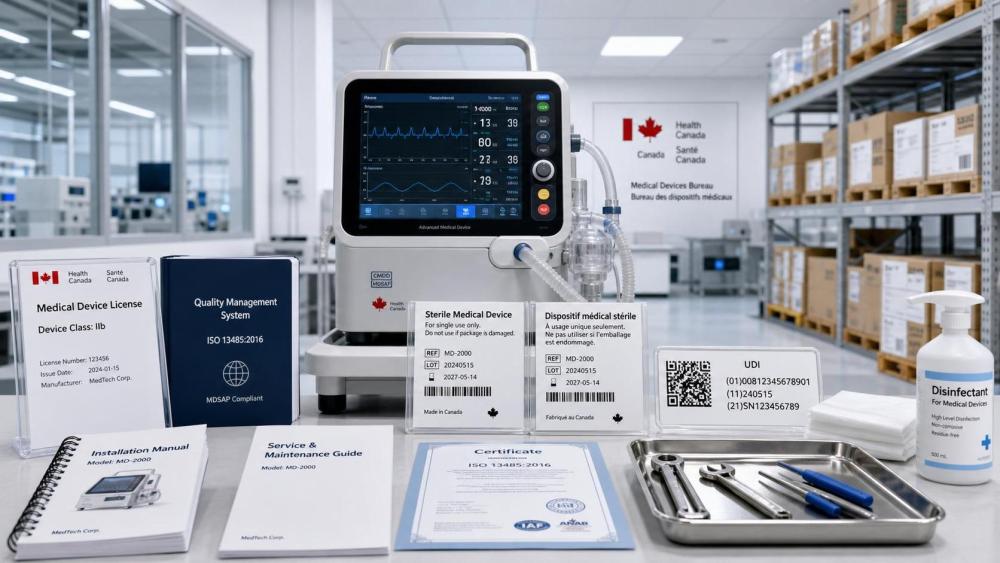
Importation and distribution add a second layer of control. The device may already have the technical approvals needed for sale, but the importer still needs evidence that the exact configuration shipped into Canada matches the licensed configuration. Serial number traceability, lot identification for consumables, packaging integrity, and transport conditions matter because damage during transit can compromise calibration, sterility, or sensor performance. For products sensitive to vibration, humidity, or temperature excursions, shipping qualification should reflect the actual route, not an idealized warehouse move.
Installation and commissioning are not separate from compliance. Imaging equipment, anesthesia systems, sterilizers, and networked patient monitoring systems often depend on room layout, grounding, ventilation, water quality, medical gas interfaces, or shielding conditions. If those site conditions are not specified early, the device may arrive on site and remain unusable until the room is corrected. That becomes a compliance and project risk at the same time. A device can be technically approved and still fail market access in commercial terms if the installation requirements are unrealistic for the target facility type.
Maintenance obligations also shape the real cost of compliance. Preventive maintenance intervals, spare parts availability, service manuals, and calibration tools should be consistent with the device's risk profile and expected duty cycle. A lab analyzer that depends on proprietary reagents, frequent recalibration, or tightly controlled environmental conditions may be acceptable in one setting and impractical in another. The same is true for devices with sensors that drift, batteries with defined replacement cycles, or pumps that require periodic flow verification. If the maintenance burden is understated, the product may meet paper requirements and still underperform in use.
Risk management files should describe known hazards in practical terms: loss of power, occluded tubing, sensor misreadings, user misconnection, contamination, delayed alarm response, or failed data transfer. The file should connect each hazard to a mitigation that is visible in the product design, labeling, training, or service process. Weak risk documentation usually shows up as a mismatch between claims and controls. For example, if a device claims portability but the cart, battery runtime, and transport protection are not defined, the risk position is incomplete.
Clinical evidence requirements vary by device type, but the principle is consistent: claims must be supported by data appropriate to the intended use. For an imaging system, that may mean image quality, dose management, artifact control, or workflow performance. For an IVD instrument, that may mean analytical precision, carryover, linearity, and specimen compatibility. For patient support equipment, it may involve alarm performance, operating limits, or reliability under defined conditions. Marketing language often stretches beyond the evidence package; that is a common source of correction requests and delayed launch.
Documentation quality matters as much as technical quality. A complete dossier is not just a collection of certificates. It should read as one controlled set of records, with consistent model numbers, version identifiers, intended use statements, accessory lists, and manufacturing site information. Differences between the instruction manual, declaration pages, and test reports create doubt even when the underlying device is sound. In Canada compliance work, that kind of inconsistency can slow review more than a missing brochure would.
For multi-market portfolios, it is tempting to reuse the same technical package across jurisdictions. That only works where the device configuration, language set, evidence format, and post-market commitments remain aligned. Canada may accept a product family structure, but only if the variant boundaries are clear and the supporting records are disciplined. When an enclosure, software build, reagent set, or power adapter changes, the file should show whether the change is cosmetic, functional, or performance-related. Ambiguity here is expensive because it forces later clarification during commercialization or audit.
Medical devices Canada compliance requirements for market access are therefore a control problem, not a paperwork exercise. The strongest files usually connect the product's actual design, its intended clinical use, its labeling, its quality records, and its service model into one coherent argument. When that connection is weak, the device may still be technically capable, but the path to lawful and stable market entry becomes slower and less predictable.
Have questions about the global trade trends discussed here, or planning your expansion and supply chain strategy? Leave a message below and let the trade experts at MTHH guide you.
We respect your privacy. Your information is strictly confidential.
Related News
- Hong Kong Outlines Medical Device Legislation and Plans for Statutory RegulatorNov 14, 2026Hong Kong medical device legislation could reshape regulatory oversight. Explore the proposed regulator and what businesses should monitor.
- AAMI Issues TIR115 Guidance on Public Cloud Use in Medical DevicesNov 13, 2026AAMI TIR115:2026 guides public cloud use in medical devices. Explore its focus on risk management, supplier assessment and device boundaries.
- How are critical care devices regulated in the United States?Nov 12, 2026Critical care devices face FDA requirements based on intended use and risk. Explore classifications, marketing pathways, and practical compliance checks.
- Hong Kong Drafts Medical Device Bill to Establish Statutory OversightNov 12, 2026Hong Kong's Medical Devices Bill could introduce risk-based statutory oversight. Discover what the proposed framework may mean for suppliers.